Herringbone Floor Sanding London
Floor Sanding & Restoration in London — At a Glance
- Price range: £25–£45 per sqm
- Typical duration: 1–2 days for an average room
- Free site visit: Yes — book online or call 020 8830 9782
- Customer rating: 4.5/5 (590+ reviews)
- Experience: 22 years, established 2004
Herringbone parquet is one of the most demanding floors to sand well, and one of the most rewarding to get right. The interlocking block pattern means the grain runs in two opposing directions simultaneously: so the sanding sequence is completely different from straight-laid floors. We have been sanding herringbone floors in London for over 20 years, and it remains one of the jobs we most enjoy doing.
- Over 20 years sanding floors across London
- Free, no-obligation quotes
- Fully insured, dust-controlled equipment
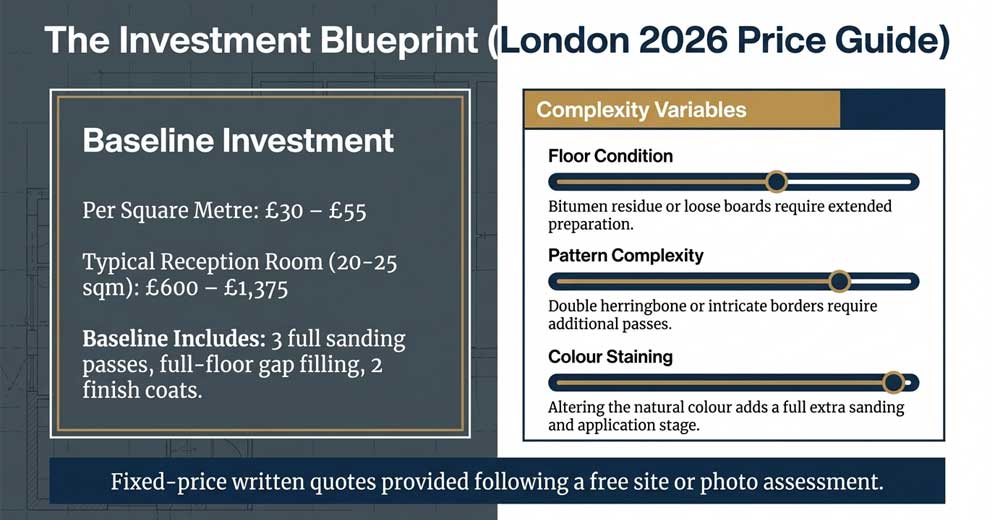
- Prices from £30–£55 per sqm
Our Herringbone Floor Sanding Process
Every job follows the same proven sequence: from first assessment to final inspection.
1. Assessment: Pattern, Block Condition and Subfloor
We start by checking the pattern geometry (standard herringbone or double herringbone), block thickness, species and the condition of the subfloor beneath. Old London herringbone floors were typically laid in Merbau, oak or pine on bitumen adhesive: all three behave differently under the machine and require different paper sequences.
2. Repairs: Loose, Missing or Damaged Blocks
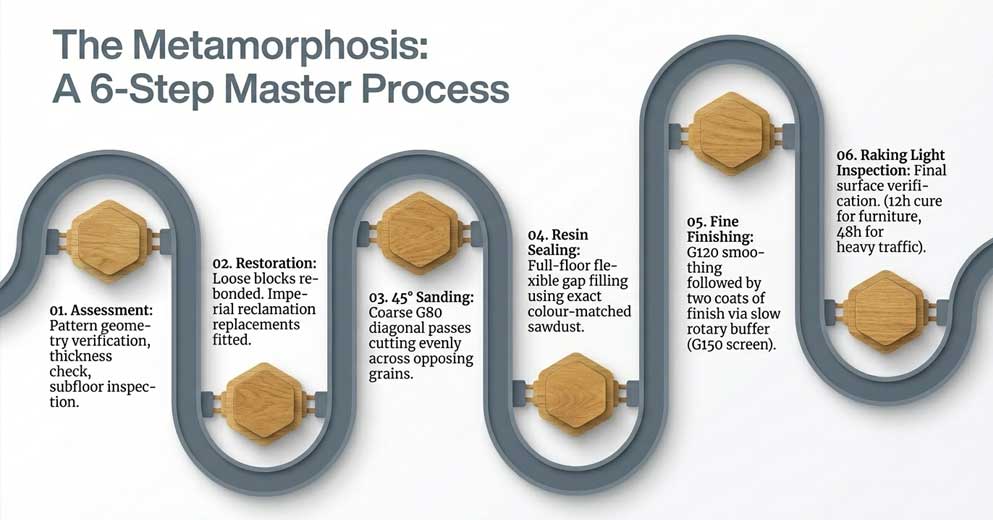
Any loose blocks are re-bonded before sanding starts. Missing blocks are sourced from reclamation yards to match the original species and dimensions: many London herringbone floors used imperial-sized blocks (typically 9" x 3" x 7/8") that require careful matching. We never use filler to substitute for missing blocks; it doesn't work and looks wrong.
3. Coarse Sanding: 45 Degrees to the Pattern
Unlike straight boards, herringbone floors must be sanded at 45 degrees to the direction of the V-shape. We make the first pass diagonally across the room, then rotate 90 degrees and repeat. This ensures both grain directions are cut evenly and prevents the machine riding along the grain of one direction while against the other.
4. Gap Filling
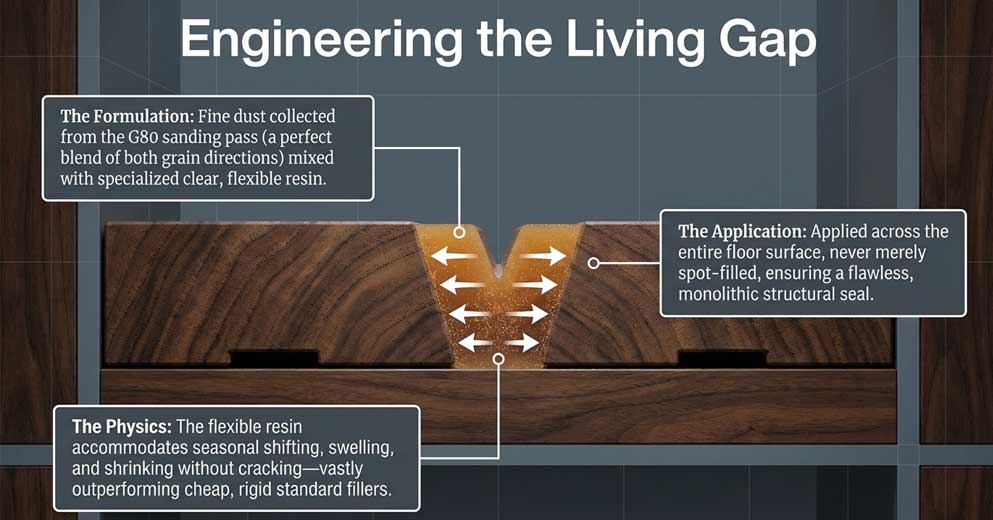
After the G80 pass, we collect the fine dust: which on herringbone is a blend of the two grain directions: and mix it with flexible resin. This creates a perfectly colour-matched filler that moves with the blocks through seasonal changes. We fill the full floor rather than spot-filling gaps, which gives a cleaner result.
5. Fine Sanding and Finish
G120 removes the cured filler and prepares the surface for finishing. We apply two coats of your chosen finish: oil or varnish: with a G150 screen between coats on a slow rotary buffer. The herringbone pattern becomes dramatically more visible once oiled or varnished, which is one of the most satisfying moments of any job.
6. Final Inspection and Handover
We check the floor under raking light to confirm the pattern reads cleanly and the finish is even across both grain directions. Allow 12 hours before furniture, 48 hours before heavy traffic.
Herringbone Floor Sanding Cost in London
The cost of herringbone floor sanding in London typically ranges from £30–£55 per sqm for a standard job including three sanding passes, gap filling and two coats of finish. A typical London living room (20–25 sqm) comes to £600–£1375.
Factors that affect the final price:
- Floor condition: repairs, loose boards or bitumen residue add time and cost
- Pattern complexity: geometric parquet patterns require additional passes
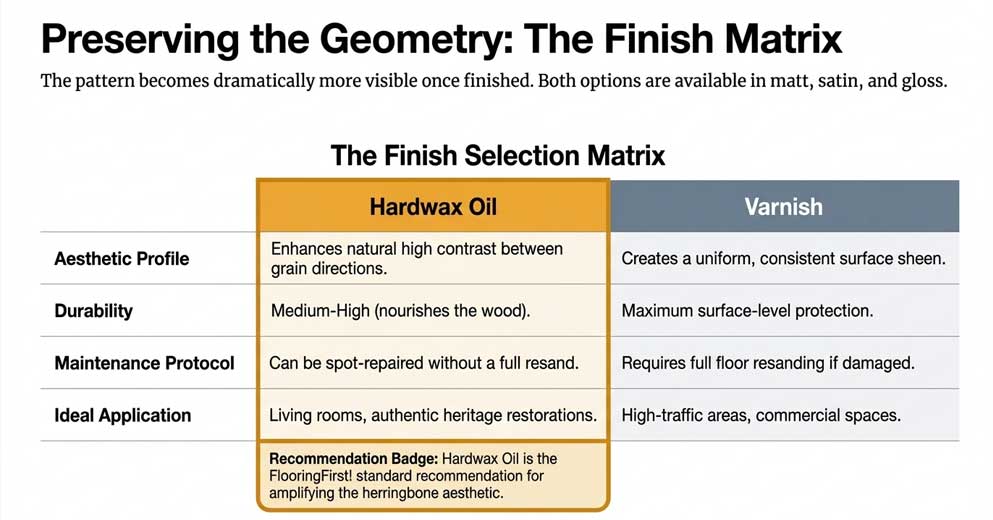
- Finish type: hardwax oil and multi-coat varnish are priced differently
- Staining: colour changes add one full extra sanding and application stage
We provide fixed-price written quotes after a free site visit or photo assessment.
Frequently Asked Questions
How much does herringbone floor sanding cost in London?
Herringbone floor sanding in London typically costs £30–£55 per sqm, depending on block condition, pattern complexity and finish. A 20 sqm reception room comes to approximately £600–£1,100 for a full restoration including repairs, gap filling and two coats of finish.
Why is herringbone harder to sand than straight floors?
The interlocking block pattern means the wood grain runs in two opposing directions across the floor. A straight-grained floor can be sanded along the grain in one direction. Herringbone requires the machine to work at 45 degrees to the pattern, with multiple direction changes, to cut both grain orientations evenly without scratching.
Can my herringbone floor be fully restored?
In most cases yes. Original London herringbone floors: typically 1930–1970 vintage: used solid timber blocks 18–22mm thick that can be sanded multiple times. We check block thickness at the survey. Blocks under 12mm may be too thin for a full sand; we'll tell you honestly at that stage.
What finish works best on herringbone parquet?
Hardwax oil is our most common recommendation for herringbone. It enhances the natural colour contrast between the two grain directions, is easy to maintain and can be spot-repaired without resanding. Varnish gives a harder surface and is better for high-traffic areas. Both are available in matt, satin and gloss.
How long does herringbone floor sanding take?
A standard herringbone room (20–30 sqm) takes one full day for sanding and a second day for the finish coats. The additional direction changes on herringbone add approximately 20–30% to the sanding time compared to straight-grained floors of the same area.
Related Services
Areas We Cover
We sand herringbone floors across all London boroughs, including South West London (Wandsworth, Clapham, Battersea, Wimbledon), South East London (Greenwich, Dulwich, Peckham), North London (Islington, Highgate, Muswell Hill), West London (Hammersmith, Chiswick, Ealing) and Central London. We also cover Surrey, Kent and parts of Hertfordshire.