Parquet Floor Installation & Fitting in London
Wood Floor Fitting & Installation in London — At a Glance
- Price range: £35–£60 per sqm
- Typical duration: 1–3 days depending on floor type
- Free site visit: Yes — book online or call 020 8830 9782
- Customer rating: 4.5/5 (590+ reviews)
- Experience: 22 years, established 2004
FlooringFirst supplies and fits parquet flooring across London, including herringbone, chevron, basket weave and brick bond, in both solid and engineered construction. Parquet is one of the most exacting floors to fit well. The pattern only looks right when every block is set out correctly from the start, and a centimetre out at the centre shows across the whole room. Our fitters take care of subfloor preparation, acclimatisation, adhesive selection and finishing, so the floor performs as well as it looks.
Planning a parquet project? Call us on 020 8830 9782 or book a free site visit. We assess the subfloor, confirm the layout and give you a fixed price before any work starts.
Patterns we install
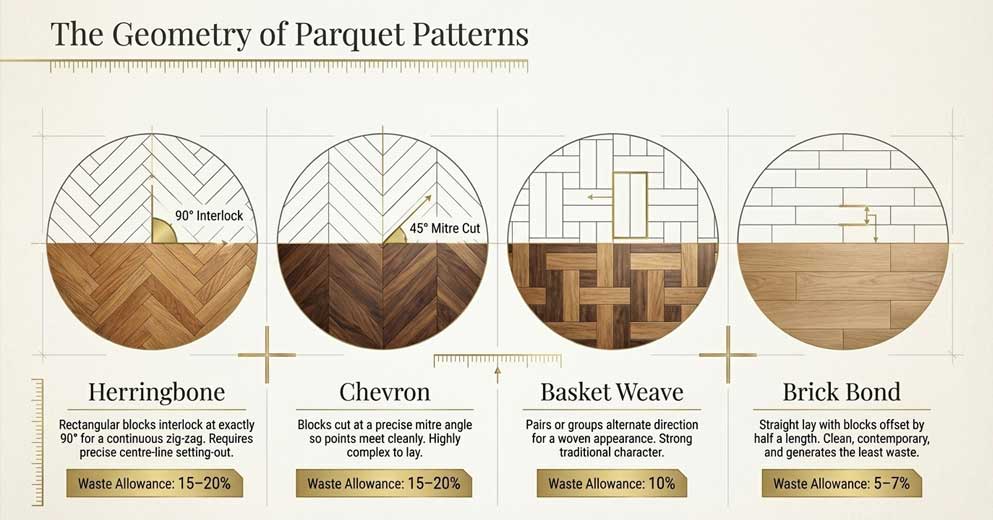
Each parquet pattern has its own setting-out demands and waste profile. We're experienced across all of them.
- Herringbone: the most popular pattern in London at the moment. Rectangular blocks interlock at 90° to create a continuous zig-zag. Requires precise centre-line setting-out and a 15–20% waste allowance for perimeter cuts.
- Chevron: similar visual effect to herringbone but blocks are cut at a mitre angle so the points meet cleanly. Slightly more complex to cut and lay than herringbone; expect a comparable waste allowance.
- Basket weave: pairs or groups of blocks alternate direction to create a woven appearance. A traditional pattern with strong character, well suited to period properties.
- Brick bond (straight lay): blocks offset by half a length, like brickwork. Less waste than angled patterns and a cleaner, more contemporary look in the right room.
- Feature borders: contrasting border runs can frame a herringbone or chevron field, particularly effective in hallways, reception rooms and open-plan living areas.
Herringbone parquet fitters in London
Herringbone is the pattern we're asked to fit most, and it's the one where your choice of fitter matters most. Every block locks against its neighbour at 90°, so a small error near the start carries through the whole floor. Herringbone fitters and installers work differently from general floor fitters in four ways:
- They set out from the centre line, not from a wall, because walls in London properties are rarely square.
- They dry-lay the pattern before any adhesive goes down, to confirm symmetry, border allowances and cut positions.
- They plan the waste. Angled perimeter cuts mean ordering 15 to 20% extra material.
- They bond every block with a flexible adhesive matched to the subfloor, so the floor has no hollow spots.
If you're comparing herringbone installation companies, ask each one whether they test subfloor moisture and flatness before quoting, whether they dry-lay the pattern, and whether the quote is fixed and in writing.
Ask too whether they can sand and finish the floor themselves, because unfinished blocks need parquet floor sanding once they're down. FlooringFirst has been fitting and restoring wood floors in London for over 20 years, and we carry out the whole job in-house, from the site visit to the final coat.
Chevron oak flooring installation
Chevron looks similar to herringbone, but the blocks are cut at a mitre angle so the ends meet in a continuous V down the room. That makes it harder to fit. Each block end has to be cut accurately, and the layout has to be planned so the points run true along the centre of the floor. The result is a cleaner, more directional pattern that suits long hallways and open-plan rooms.
Oak is the usual choice for chevron. It's stable, takes oil and stain well, and comes in both solid blocks and engineered boards. Engineered oak chevron is a sensible option for flats, new-builds and rooms with underfloor heating, and we cover it in more detail under supply and fit engineered wood flooring.
| |
Herringbone |
Chevron |
| Block ends |
Square cut |
Mitred |
| Appearance |
Staggered zig-zag |
Continuous V with clean points |
| Setting-out |
Centre line |
Centre line, plus point alignment |
| Cutting |
Straightforward |
Precise mitre on every block |
| Waste allowance |
15 to 20% |
15 to 20% |
You can see finished parquet floors in our gallery before choosing between the two.
Commercial parquet and herringbone flooring installation
Parquet suits offices, restaurants, bars, showrooms and retail units, but a commercial floor is under more pressure than a domestic one, and the specification changes to match. Four things need attention:
- Subfloor: newer screeds often hold more moisture than they appear to, so moisture testing comes before anything else.
- Adhesive: a flexible, fully bonded system that copes with heavy footfall and trolley traffic.
- Finish: a hard-wearing lacquer such as Bona Traffic HD or Junckers HT700 usually suits busy premises better than oil.
- Programme: out-of-hours and phased working keep downtime low for open businesses.
We fit herringbone, chevron and block parquet in commercial premises across London. Our floor sanding and fitting services for businesses cover the full job, and our commercial floor sanding for offices, pubs, restaurants and retail covers refinishing and maintenance once the floor is in.
Solid parquet vs engineered parquet
The construction type affects the fitting method, how the floor behaves over time, and compatibility with underfloor heating.
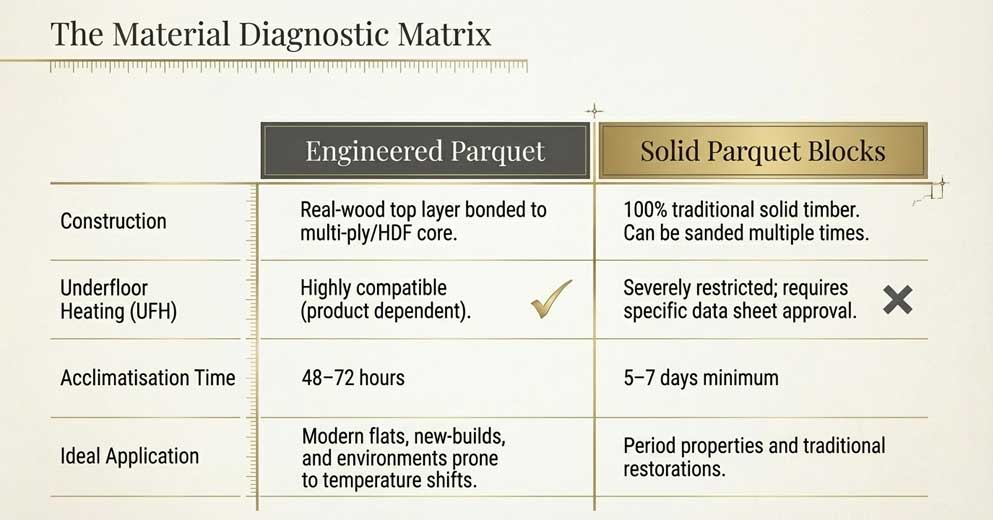
Engineered parquet
Engineered parquet has a real-wood top layer bonded to a multi-ply or HDF core. The layered construction resists seasonal movement better than solid wood, making it a reliable choice for flats, new-builds, and rooms with underfloor heating (where the product is rated for UFH use). Installation is typically full glue-down, though some click-profile products can be floated.
Solid parquet blocks
Solid parquet is traditional and can be sanded and refinished multiple times over its lifespan. It requires longer acclimatisation, typically 5–7 days minimum in the room, and is almost always installed using a fully bonded adhesive system. Subfloor moisture control is critical; solid blocks are more sensitive to damp than engineered products.
Subfloor requirements
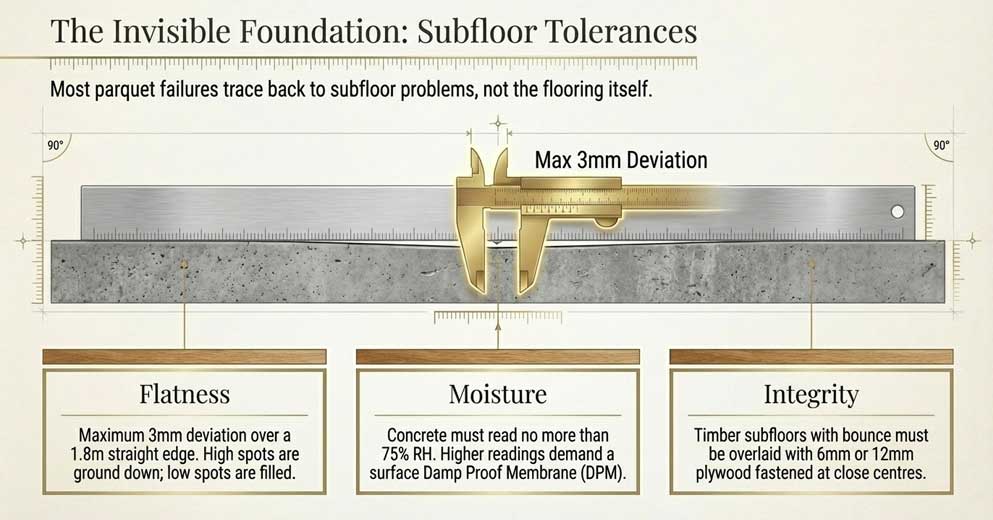
Most parquet failures trace back to subfloor problems, not the flooring itself. We carry out moisture checks and flatness assessments on every job before a single block goes down.
- Moisture: concrete subfloors must read no more than 75% RH (or 3.5% CM). Higher readings require a surface DPM or moisture-tolerant adhesive system.
- Flatness: the subfloor must be within 3mm over a 1.8m straight edge. High spots are ground down; low spots are filled with a suitable levelling compound.
- Structural integrity: timber subfloors with movement, bounce, or rot must be addressed before installation. We typically overlay with 6mm or 12mm plywood, fastened at close centres, to create a stable base.
- Cleanliness: the subfloor must be free of contamination. Old adhesive, paint, and dust all affect bond strength.
Acclimatisation
Timber flooring needs to reach equilibrium with the room's temperature and humidity before installation. Lay it too soon, and you risk gapping in winter or buckling in summer.
- Solid parquet blocks: 5–7 days minimum in the installation room, loosely stacked or in open bundles. Some batches may need longer.
- Engineered parquet: 48–72 hours is typically sufficient, but always follow the manufacturer's specification.
- The room should be at normal living temperature (18–21°C) and humidity (40–60% RH) during acclimatisation and throughout the installation window.
- Do not bring timber in from an unheated van or cold storage and install it straight away.
Glue-down vs floating installation
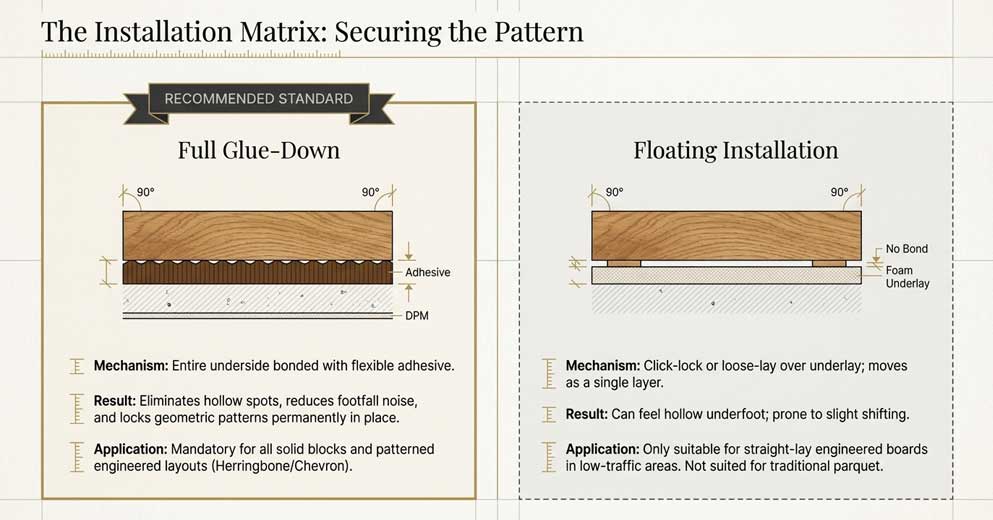
Glue-down is the standard method for parquet and the one we recommend in most situations. The entire underside of the block or board is bonded to the subfloor with a flexible, moisture-tolerant adhesive. This eliminates hollow spots, reduces noise underfoot, and locks the pattern in place over time. It's the correct method for all solid parquet and for herringbone or chevron layouts in engineered products.
Floating (click-lock or loose-lay) is an option with some engineered parquet products in low-traffic areas. The floor is not bonded to the subfloor; it moves as a single floating layer. It is faster to install and easier to remove, but it doesn't suit patterned layouts well and can feel hollow underfoot compared to a fully bonded floor.
Where we fit parquet floors across London
We fit parquet in every part of London. If you're searching for parquet fitters or floor layers near you, these are some of the areas we work in most:
- North-west London: Willesden, West Hampstead, Swiss Cottage, St John's Wood, Wembley and Ruislip
- North and east London: Dalston, Clapton, Chingford, Chigwell, East Ham and Dagenham
- South and west London: Sutton and the surrounding boroughs
Every job starts with a free site visit, so we can check the subfloor, measure up and agree the layout before quoting. See our full list of areas we cover in London, or call 020 8830 9782 to check we can reach you.
Parquet installation costs in London
Prices vary depending on the pattern, product, and subfloor condition. These are realistic ranges for London-based work:
- Engineered parquet, straight-lay or brick bond: typically £70–£100 per m² supply and fit
- Engineered parquet, herringbone or chevron: typically £85–£120 per m² supply and fit (pattern premium of 10–20% over straight-lay reflects additional setting-out, cutting, and waste)
- Solid parquet blocks, herringbone: from £100 per m² upwards, depending on species and board size
- Subfloor preparation: levelling compounds, DPM, and plywood overlaying are priced separately and depend on site conditions
- Waste allowance: budget for 15–20% extra material on herringbone and chevron patterns
We provide fixed quotes after a site visit, with no estimates and no hidden extras on the invoice.
Our parquet floor fitting process
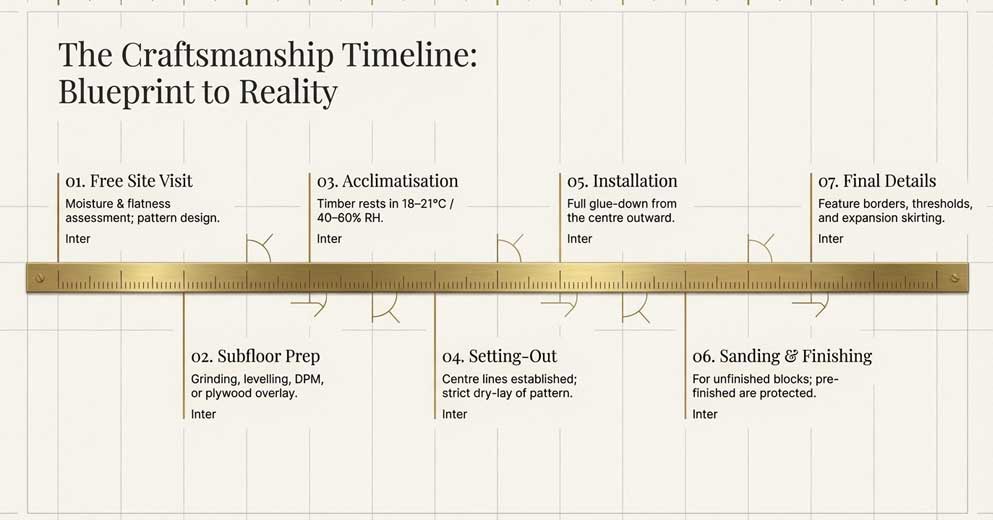
- Free site visit — we check the subfloor, confirm room measurements, discuss pattern direction and border options, and identify any prep work needed before installation.
- Subfloor preparation — moisture checks, grinding or filling to achieve the required flatness, plywood overlaying on timber subfloors if required.
- Acclimatisation period — timber is left in the room for the required period before installation begins.
- Setting-out — centre lines are established, and the pattern is dry-laid before any adhesive is applied. This is where symmetry, border allowances, and cut positions are confirmed.
- Installation — full glue-down using the correct adhesive for the product and subfloor. Blocks are laid in sequence from the centre lines outward.
- Sanding and finishing (where required) — unfinished parquet is sanded flat and finished with oil or lacquer on site. Pre-finished products are protected and cleaned down after installation.
- Borders, thresholds and skirting — feature borders are fitted, thresholds are installed at doorways, and expansion gaps are covered with appropriate beading or skirting.
Where we fit parquet floors across London
We fit parquet in every part of London. If you're searching for parquet fitters or floor layers near you, these are some of the areas we work in most:
- North-west London: Willesden, West Hampstead, Swiss Cottage, St John's Wood, Wembley and Ruislip
- North and east London: Dalston, Clapton, Chingford, Chigwell, East Ham and Dagenham
- South and west London: Sutton and the surrounding boroughs
Every job starts with a free site visit, so we can check the subfloor, measure up and agree the layout before quoting. See our full list of areas we cover in London, or call 020 8830 9782 to check we can reach you.
Frequently asked questions
How much does parquet floor installation cost in London?
Supply and installation of engineered parquet typically runs £80–£120 per m² all-in for herringbone or chevron layouts. Straight-lay patterns are slightly less. Solid parquet starts from around £100 per m² and rises with the species and board dimensions. Subfloor preparation is priced separately based on site conditions.
What is the waste allowance for herringbone parquet?
Allow 15–20% extra material for herringbone and chevron patterns. The angled cuts at room perimeters, doorways, and alcoves produce significantly more offcuts than straight-lay flooring. Your fitter will confirm the exact allowance once the room is measured.
Should parquet be glued down or floated?
Full glue-down is the correct method for solid parquet and for all patterned engineered layouts. It gives a solid, hollow-free feel and keeps the pattern stable. Floating is only appropriate for certain engineered products in specific low-traffic applications. It is not suitable for traditional parquet blocks.
How long does parquet need to acclimatise?
Solid parquet blocks need a minimum of 5–7 days in the installation room before fitting. Engineered parquet typically needs 48–72 hours. The room must be at normal living temperature and humidity throughout the acclimatisation period. Don't rush this, because it's one of the most common causes of post-installation movement.
What subfloor do you need for parquet?
The subfloor must be dry (no more than 75% RH for concrete), flat (within 3mm over 1.8m), clean, and structurally sound. Concrete with elevated moisture needs a DPM. Timber subfloors typically need a plywood overlay to provide a stable, flat base for the adhesive bond.
Can parquet be installed over underfloor heating?
Engineered parquet with a UFH rating can be installed over water-fed underfloor heating, provided the surface temperature doesn't exceed 27°C. Solid parquet blocks are more restricted, so check the specific product's technical data sheet before proceeding. Electric mat systems are generally not suitable for solid timber.
How long does parquet installation take?
Most single rooms take two to four days to fit, depending on the pattern and floor area. Subfloor preparation, acclimatisation (5 to 7 days for solid blocks) and, for unfinished parquet, sanding and finishing come on top of that. Herringbone and chevron take longer than straight-lay patterns because of the setting-out and cutting. Your fitter will give a programme after the site visit.
Do you need underlay for herringbone flooring?
Not for a glue-down installation, which is the standard method for herringbone. The adhesive bonds the blocks directly to a prepared subfloor, so there's no underlay. Floating click-lock products need the underlay the manufacturer specifies, but floating suits patterned layouts poorly. If sound insulation is the concern, see our floor insulation and soundproofing service.
Why is my parquet floor buckling?
Buckling almost always comes from moisture. The usual causes are damp in the subfloor, a leak, blocks laid before they had acclimatised, or no expansion gap at the walls. Find and fix the moisture source first, then let the floor dry fully before deciding on repairs. Sanding or refitting over a wet floor makes the problem worse. Our parquet floor repairs service can assess the damage, and our guide to common wood flooring issues and their causes explains what to look for.
Can you fit parquet in offices, restaurants and shops?
Yes. We fit herringbone, chevron and block parquet in commercial premises across London, using adhesive and finish systems chosen for heavy foot traffic. Out-of-hours and phased working can keep disruption to a minimum.
Ready to get started? Call us on 020 8830 9782, email cs@flooringfirst.co.uk, or book a free site visit online. We cover all of London and can usually arrange a survey within a few days.