LVT & SPC Floor Installation - Supply & Fit
Wood Floor Fitting & Installation in London — At a Glance
- Price range: £35–£60 per sqm
- Typical duration: 1–3 days depending on floor type
- Free site visit: Yes — book online or call 020 8830 9782
- Customer rating: 4.5/5 (590+ reviews)
- Experience: 22 years, established 2004
LVT flooring installation involves preparing the subfloor, ensuring moisture levels are suitable, and fitting luxury vinyl tiles or planks using click-fit or glue-down systems. LVT flooring is popular in London homes because it is durable, water-resistant, compatible with underfloor heating, and available in realistic wood and stone-effect designs.
At FlooringFirst!, we supply and install LVT and SPC flooring across Greater London — from straight plank layouts to herringbone LVT and other geometric patterns. We handle the complete job: subfloor assessment, preparation, fitting, and finishing. Our team has been laying LVT and SPC in London homes and businesses since 2004, and we bring that experience to every project, regardless of size.
Call 020 8830 9782 or book a free site visit to get a fixed quote.
What Is LVT and SPC Flooring?
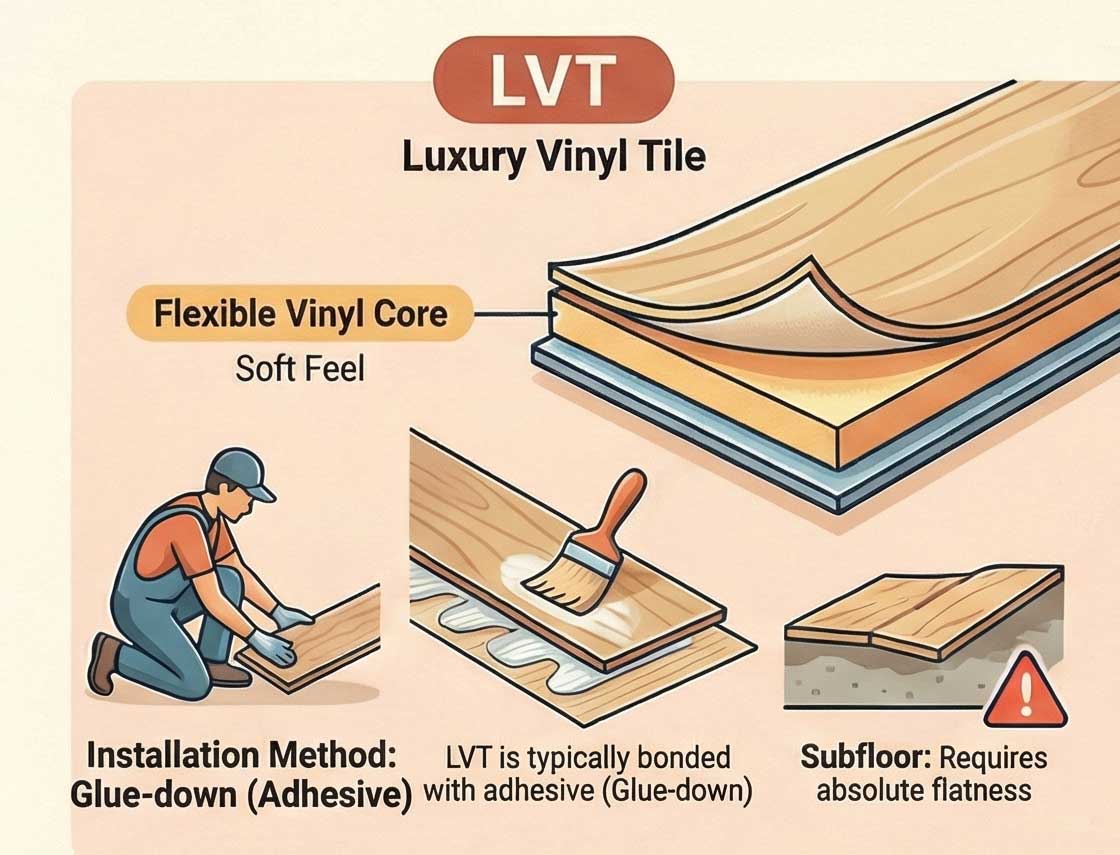
LVT (Luxury Vinyl Tile) and SPC (Stone Plastic Composite) both fall under the broad category of luxury vinyl flooring. All products in this category share the same layered construction: a realistic photographic print layer that replicates wood grain or natural stone, a protective wear layer on top, and a waterproof core below. What sets them apart is the type of core.
LVT — Luxury Vinyl Tile
LVT has a flexible vinyl core. It is thinner and softer underfoot than SPC, which makes it particularly comfortable in rooms where people stand for long periods. Because the core is flexible, the floor will follow any imperfections in the subfloor beneath it — which is why subfloor preparation is critical for LVT installations. It is the product of choice for glue-down herringbone patterns and other geometric layouts, and is widely used in high-end residential and commercial projects.
SPC — Stone Plastic Composite
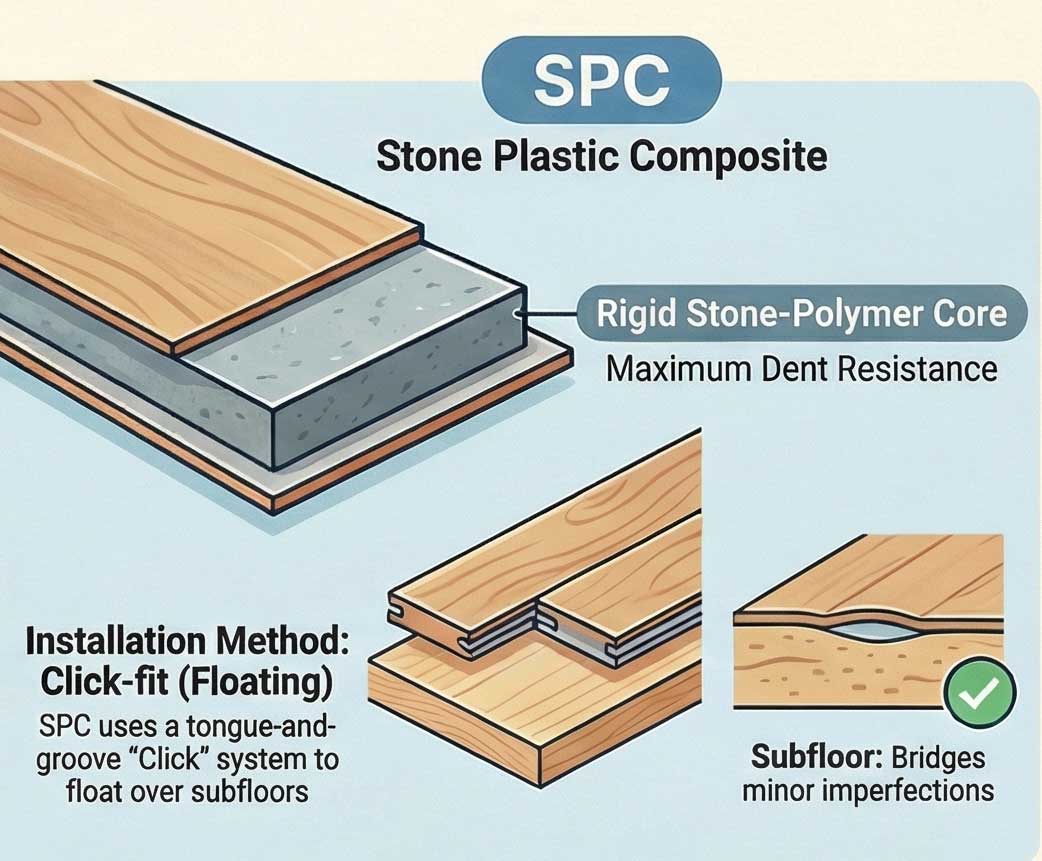
SPC has a rigid core made from limestone powder and PVC. It is denser and more dimensionally stable than flexible LVT, which means it resists dents, heavy loads, and temperature fluctuations better. The rigid core also bridges minor subfloor imperfections more effectively than flexible LVT, making it a practical choice for older properties where the subfloor isn't perfect. SPC is most commonly installed as a floating click floor, without adhesive, which makes it faster to fit and easier to replace if a board is damaged later.
As a rule: if you want a glue-down installation, a herringbone or geometric pattern, or a premium high-end finish — choose LVT. If you want a click floor that is quicker to install and slightly more forgiving of the subfloor — choose SPC.
Herringbone LVT Installation
Herringbone is one of the most popular LVT patterns we fit — and one of the most technically demanding. Unlike straight plank layouts, herringbone requires the floor to be glued down using a full-spread pressure-sensitive adhesive. There is no click-lock herringbone option for LVT — the precision of the pattern simply cannot be maintained with a floating installation.
Getting herringbone right starts long before any adhesive is applied. The centre line of the room must be established, the pattern balanced so that cuts at both sides of the room are equal, and the first row laid with absolute precision — because every subsequent row references back to it. A misalignment of even a few millimetres in the first rows becomes increasingly obvious as the pattern builds outward.
We also fit herringbone SPC in floating format, though this is less common — the click joints at the angles are more complex and require a higher-specification product than standard plank SPC. We will advise on the best product and method for your room at your free site visit.
Installation Methods: Glue-Down vs Click
Glue-Down LVT
Glue-down is the professional's method of choice for LVT installation. The planks or tiles are bonded directly to the prepared subfloor using a pressure-sensitive adhesive applied with a notched trowel. Once cured, the result is a completely solid, stable floor with no movement, bounce, or hollow sound underfoot.
Glue-down is the only appropriate method for herringbone and geometric LVT patterns. It is also the preferred method for commercial installations, wet rooms, and any situation where maximum dimensional stability is required. The trade-off is that it demands more preparation time, a higher-specification subfloor, and a more experienced fitter — but the finished result is superior to any floating installation.
Click SPC — Floating Installation
Click SPC uses a tongue-and-groove locking system and floats over the subfloor without adhesive. It is faster to install, can be laid over most existing hard floors (provided they are sound and level), and is easy to remove if needed. Individual boards can be replaced if damaged without lifting the whole floor.
An underlay is often integrated into the product itself, or can be added separately for improved acoustic performance and a softer feel underfoot. For properties in purpose-built flats or apartments, check your lease requirements for impact sound reduction — some buildings require a minimum specification.
Suitable Rooms and Applications
LVT and SPC are among the most versatile flooring products available. They work in rooms and situations where natural wood flooring is not suitable:
Kitchens and bathrooms — Both LVT and SPC are 100% waterproof. There is no swelling, warping, or staining from moisture. LVT and SPC can be taken right up to the base of a bath, shower tray, or kitchen sink with no risk to the floor.
Hallways and high-traffic areas — The wear layer provides strong resistance to scuffs, scratches, and the kind of abrasion that comes from shoes, pets, and furniture movement. For hallways and kitchens, we recommend a minimum 0.5mm wear layer.
Open-plan living spaces — LVT and SPC can run continuously through multiple interconnected rooms — kitchen into dining into living — creating a seamless, unified floor across the whole space.
Basements and ground-floor rooms — Ground-level moisture rules out most wood floors in basement conversions and ground-floor rooms with solid concrete subfloors. LVT and SPC handle this comfortably.
Rooms with underfloor heating — Most LVT and SPC products are compatible with underfloor heating up to 27°C surface temperature. Check the product specification, and always bring the heating up to operating temperature gradually after installation to allow the floor to adjust.
Commercial properties — Offices, retail, hospitality, and rental properties benefit from the durability and low maintenance of commercial-grade LVT. Our commercial flooring service covers all types of business premises across London.
The Wear Layer — Choosing the Right Specification
The wear layer is the transparent protective coating on the surface of the floor. It determines how resistant the floor is to scratching, scuffing, and UV fading — and it is the single most important specification to check when comparing products.
Wear layers are measured in millimetres:
- 0.2mm–0.3mm — Light residential use. Suitable for bedrooms and low-traffic rooms.
- 0.5mm (20 mil) — Heavy residential. Kitchens, hallways, family rooms. This is the specification we recommend for most London homes.
- 0.55mm and above — Commercial grade. Retail, offices, rental properties, and any space with very high footfall.
A thicker wear layer means greater resistance to everyday damage and a longer product warranty — typically 15 to 20 years on a 0.5mm product. Products with thinner wear layers will show wear much sooner in busy rooms, regardless of how well they are fitted. We only supply products from manufacturers we trust, and we will always recommend the right specification for your specific room and usage.
Subfloor Preparation — The Foundation of a Good LVT Installation
Subfloor preparation is the most critical stage of any LVT or SPC installation. LVT is one of the thinnest flooring products on the market — typically 2.5mm to 5mm thick — which means every imperfection in the subfloor beneath it will eventually telegraph through to the surface.
Flatness requirements
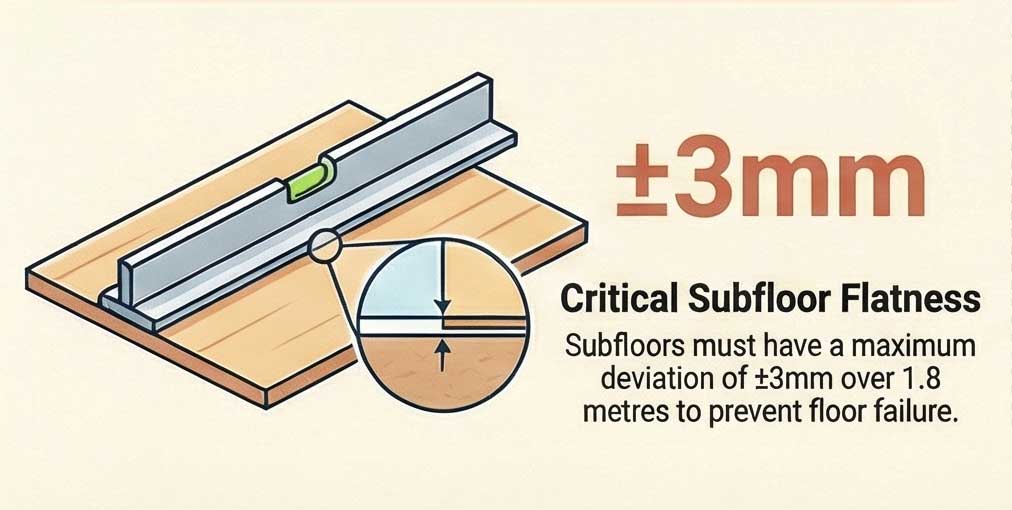
The industry standard for glue-down LVT is a maximum deviation of ±3mm over 1.8 metres. For click SPC the tolerance is slightly more forgiving, but the subfloor must still be flat, stable, and free from debris.
Any high spots must be ground down. Any dips or low areas must be filled with a flexible floor-levelling compound — never standard filler or sand-and-cement, which will crack under the floor as the building moves. The levelling compound must be allowed to cure fully before fitting begins.
Timber subfloors
On timber subfloors — floorboards, chipboard, or plywood — we typically overlay the existing surface with 6mm ply, screwed at close centres to eliminate any flex or bounce. The joints are feather-finished and sanded smooth. This creates a stable, solid base that the LVT can bond or float over without risk of movement.
Concrete subfloors
On concrete or screed subfloors, we apply a floor-levelling compound throughout, check levels, and allow to cure. We also carry out moisture testing using calibrated equipment. For concrete, moisture levels must be within acceptable limits — typically below 75% Relative Humidity, verified by a professional hygrometer or CM moisture test.
If moisture readings are elevated, we apply a liquid damp-proof membrane (DPM) before proceeding. Skipping this step is the most common cause of LVT failures — adhesive bonds break down, floors lift, and bubbles appear. We do not skip it. For more on subfloor moisture protection, see our soundproofing, damp proofing and insulation service →
The Wear Layer and Why It Matters
The wear layer is the transparent protective coating on top of the print. It is measured in millimetres (or mil in older spec sheets):
- 0.2mm to 0.3mm (8-12 mil): Light residential use. Bedrooms, spare rooms.
- 0.5mm (20 mil): Heavy residential. Kitchens, hallways, family rooms. This is what we recommend for most London homes.
- 0.55mm and above: Commercial grade. Retail, offices, rental properties.
A thicker wear layer means more resistance to scratching, scuffing, and UV fading. Products with a 0.5mm wear layer typically carry a 15 to 20-year residential warranty. Products with thinner layers wear through faster in busy rooms.
Acclimatisation
Click SPC products should be stored in the room where they are to be fitted for a minimum of 48 hours before installation. This allows the product to adjust to the ambient temperature and humidity of the space, reducing the risk of expansion or contraction after fitting.
Glue-down LVT requires less acclimatisation time due to the nature of the adhesive bond, but the room should still be at normal living temperature (18°C–22°C) and stable humidity before and during installation. We will advise on the specific requirements of your chosen product at the site visit stage.
Our LVT & SPC Installation Process
Every LVT and SPC installation we carry out follows the same structured process — no shortcuts, no assumptions:
1. Free site visit
We visit your property, assess the subfloor condition, take measurements, and discuss your chosen product, pattern, and any practical considerations. We provide a written, fixed quote before any work is agreed.
2. Subfloor preparation
We strip out any existing floor covering, check levels and moisture thoroughly, and carry out all necessary preparation — ply overlay, levelling compound, DPM — before a single plank is laid.
3. Layout planning
We plan the start point and pattern alignment carefully, ensuring balanced cuts at the perimeter and — for herringbone or geometric layouts — a perfectly centred, symmetrical result.
4. Fitting
We lay the floor using the agreed method: glue-down LVT or click SPC. All cuts around door frames, pipework, and obstacles are made cleanly and precisely.
5. Finishing
We fit all skirting boards, trims, thresholds, and transition strips. Door frames are undercut where needed for a clean, professional finish. All waste is removed from site.
6. Handover
We walk through the finished floor with you, answer any questions, and provide aftercare advice. Most LVT and SPC products require very little maintenance — we'll tell you exactly what's needed to keep your floor looking its best. Our floor care and aftercare service is also available if you need professional cleaning or maintenance in future.
Why Choose FlooringFirst! for LVT & SPC Installation in London?
- 20+ years of experience — established in 2004, we have fitted LVT and SPC in thousands of London properties
- Fully insured — all work is fully insured for complete peace of mind
- Bona-certified technicians — trained and certified to the highest industry standards
- Junckers-approved contractor — recognised for quality installation
- Free on-site survey — no call-out charge, no obligation, just an honest assessment and a fixed quote
- Free aftercare kit — every job includes a free floor care kit to help you maintain your floor
- All of Greater London covered — residential and commercial, all boroughs
Areas We Cover for LVT & SPC Installation
We install LVT and SPC flooring across all of Greater London — North, South, East, West, and Central London — as well as surrounding areas including Surrey, Hertfordshire, and Essex. We work in homes, flats, offices, and commercial premises of all sizes.
Frequently Asked Questions — LVT & SPC Flooring
Can LVT or SPC be fitted over existing tiles or vinyl? In many cases, yes — provided the existing surface is sound, firmly bonded, and level. Loose, hollow, or damaged tiles must be removed first. We assess this at the site visit and advise honestly on the best approach.
Can LVT be repaired if a plank is damaged? Glue-down LVT can be repaired by carefully removing and replacing individual planks, provided matching material is available. Click SPC is even easier to repair — individual boards can be unlocked and replaced without disturbing the rest of the floor.
Is LVT suitable for underfloor heating? Yes — most LVT and SPC products are compatible with underfloor heating up to a maximum surface temperature of 27°C. Always check the specific product datasheet, and bring the heating up to operating temperature gradually after installation.
What is the difference between LVT and laminate flooring? Both replicate the look of wood using a photographic print layer, but the core material is completely different. LVT is 100% waterproof — laminate is not. Laminate has a wood-fibre (HDF) core that swells when exposed to moisture, which is why it cannot be used in kitchens, bathrooms, or ground-floor rooms with damp subfloors. LVT can be used in all of these locations.
Does LVT need to acclimatise before fitting? Click SPC should be left in the room for at least 48 hours before installation. Glue-down LVT has less strict requirements, but the room should be at normal temperature and humidity before and during fitting. We confirm requirements for your specific product at the site visit.
How long does LVT flooring last? With a 0.5mm wear layer, a well-fitted LVT floor in a domestic property will typically last 15 to 20 years before the wear layer shows significant degradation. Commercial-grade products (0.55mm and above) are rated for heavy traffic and carry longer warranties. The quality of the subfloor preparation has a significant impact on the long-term performance of any LVT installation.
How long does LVT installation take? Most rooms are completed within one to two days. Larger areas, complex patterns such as herringbone, or rooms requiring significant subfloor preparation will take longer. We confirm the expected duration in your written quote.
Book Your Free LVT & SPC Survey
Whether you're planning a straight plank SPC installation in a kitchen, a herringbone LVT in a hallway, or a full commercial LVT fit-out across multiple rooms — the first step is a free, no-obligation site visit.