Looking for a Professional Floor Sanding Company in Central London?
Floor Sanding in Central London — At a Glance
- Price range: £25–£45 per sqm
- Typical duration: 1–2 days for an average room
- Free site visit: Yes — book online or call 020 8830 9782
- Customer rating: 4.5/5 (590+ reviews)
- Experience: 22 years, established 2004
Floor sanding in Central London requires an understanding of the area's unique architectural heritage. Central London's period properties – whether Victorian townhouses, Edwardian mansion flats, or converted warehouses – often feature original timber that's been covered or damaged over decades. Our specialists have handled the specific challenges that Central London properties present: uneven Victorian boards that need careful hand-finishing, historic parquet that has shifted with age and humidity, and solid wood in period conversions that can be temperamental.
We've completed over 80 floor sanding projects across Central London, restoring everything from reclaimed Victorian pine to modern solid oak. The work here often involves removing decades of surface wear – carpet adhesive, scratches, staining – while preserving the character that makes these floors special. Whether you're uncovering original boards in a listed property or refreshing worn engineered wood in a modern conversion, the approach in Central London is always tailored to the building's age and construction.
Central London covers everything from Georgian townhouses in Bloomsbury and Marylebone to converted offices in the City and riverside apartments near the Thames, and our sanding technicians work across all of it. We use dust-free sanding equipment finished exclusively with sealants from Bona, Loba, Junckers, and Osmo, with a free on-site assessment first, since floor age, board type, and building history vary enormously from one postcode to the next.
What our Central London sanding service covers
- Floor sanding and sealing for solid wood floors, restoring the natural grain before applying a durable finish
- Standard gap filling between floorboards, tightening up boards that have shifted with age
- Parquet restoration, including refitting loose or lifted blocks in herringbone, chevron, or mosaic patterns
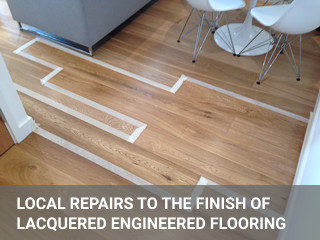
- Engineered floor sanding, approached carefully given the limited depth on the wear layer
- Water damage repair, addressing warped or stained boards from leaks or spills
Period properties across Central London
Original floorboards in the area's Georgian and Victorian buildings have often been sanded more than once over their lifetime, so checking remaining depth is the first step before agreeing to a full sand, particularly in properties within a conservation area. Our wood floor sanding and restoration service assesses this on-site, and once sanding is complete, standard gap filling between floorboards tightens up any gaps that have opened over time.
Parquet in period and converted buildings
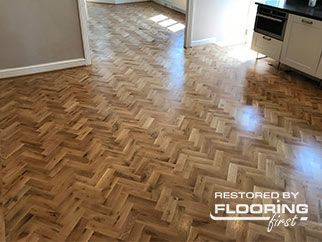
Herringbone, chevron, and mosaic parquet turns up throughout Central London's period conversions and mansion flats, and blocks that have come loose or lifted need re-securing before sanding begins, otherwise, the sander can catch an edge and cause further damage. Our parquet floor repair and restoration service handles this kind of detailed, pattern-specific work without disturbing the surrounding blocks.
Engineered floors in newer developments
More recently built or refurbished properties across Central London are more likely to have engineered flooring, which only has a thin layer of real wood over a plywood base. Our engineered floor sanding and refinishing service checks the wear layer's thickness before agreeing to a full sand, since sanding too far removes the veneer completely.
Choosing a finish
For period interiors, hardwax oils from Osmo give a natural look and are easy to spot-repair locally if a section gets marked. For busier households, offices, or high-traffic commercial floors, lacquers from Bona or Loba hold up better under constant use, and Junckers is worth considering too for solid wood specifically. None of these is a default pick; it comes down to how the space is used day to day.
Why choose us for floor sanding in Central London
- Over 20 years of expertise, working as a trusted name for floor sanding and restoration across the capital
- Dust-free technology that keeps homes and businesses clean and safe throughout the work
- Comprehensive repairs, from floorboard replacement to gap filling and water damage repair
- Flexible scheduling, with evening and weekend availability to limit disruption for homeowners and businesses
- Free site visits and obligation-free quotes, tailored to the specific property rather than a generic estimate
Get an extra 10% discount on our clean & polish service for any floor previously fitted or restored by FlooringFirst.
Commercial floor sanding across Central London
Offices, pubs, restaurants, and retail units throughout Central London often need floor work scheduled around trading or business hours rather than a standard weekday slot. Our commercial floor sanding for offices, pubs, restaurants and retail service is built around that, using the same dust-controlled equipment and finish options as our residential work.
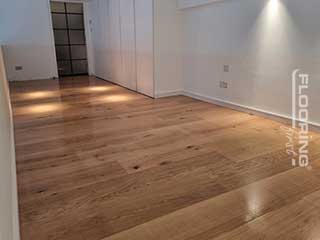
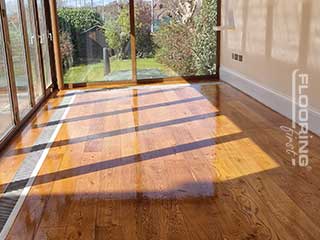
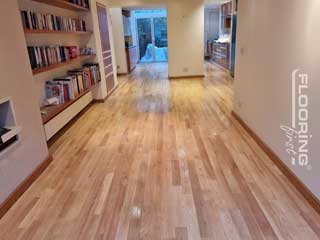
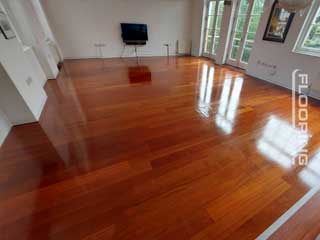
Featured Project in Central London: Back at VOGUE Magazine Headquarters - Parquet Floor Restoration and Repair in Central London
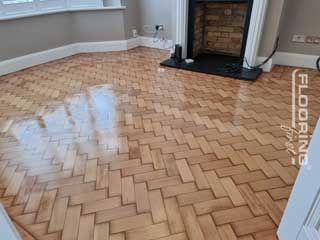
Parquet flooring requires regular and proper care in order to last for many decades. This Central London project was focused on improving the condition and look of a beautiful parquet floor leading to the Board Meeting Room of VOGUE Magazine Headquarters by taking care of all issues with special attention to details.
For this parquet floor restoration, we started with inspecting the condition of the floor, something we provide for free to all clients. Next, our parquet restoration specialists concluded what the necessary steps are and continued with repairing some of the main issues the floor was struggling with. After that, the team continued with filling the gaps, sanding the surface of the floor with attention to all details, which is highly required when we work with a complex parquet pattern, and finally applying high-quality wood floor finish. All gaps were filled in for extra durability and improvement of the insulation.
Floor Care Tips and Advice:
Find Our More on Sanding in Central London
Local Project: Back at VOGUE Magazine Headquarters - Parquet Floor Restoration and Repair in Central London in Central London — 1 March 2020
Real wood floors are highly sought after because of their natural beauty, especially when it comes to the unique charm of the parquet flooring patterns. In order to take proper care of parquet flooring and ensure it will last for decades, regular maintenance including sanding, refinishing, and repair is required.
For this parquet floor restoration, we started with inspecting the condition of the floor, something we provide for free to all clients. Next, our parquet restoration specialists concluded what the necessary steps are and continued with repairing some of the main issues the floor was struggling with. After that, the team continued with filling the gaps, sanding the surface of the floor with attention to all details, which is highly required when we work with a complex parquet pattern, and finally applying high-quality wood floor finish. All gaps were filled in for extra durability and improvement of the insulation.
Local Project: Engineered Wood Flooring Buffing & Re-Oiling in Central London in Central London — 1 June 2019
This project wasn’t anything of a challenging one that requires extra energy, time, elbow grease, and money to be finished. The floor was in a pretty good condition but in need of some refreshment and rejuvenation. This is usually the case with wood floors with an oiled finish – they require a fresh new application of the oil finish every now and then. Once the floor is re-oiled, you can quickly go back to using it and enjoying it and rest assured that you’ve done the best for it. Re-oiling is part of the maintenance for real wood floors and it guarantees great visual results immediately.
We started this project by buffing the wood floor’s surface. When it comes to oiled floors that are in a pretty good condition (no deep scratches, dents, marks, or permanents stains) and in a need of maintenance only (no repairs and renovation required), buffing is enough to get rid of the old layer of oil finish. Buffing is done to remove the smaller imperfections on the surface of the floor along with the old finish that may become dirty and dull with time and affect the overall appearance of the floor.
Once the surface of the floor is buffed thoroughly, it is left extra smooth and uniform. The pores of the wood are open and ready for the upcoming application of the oil finish. This is very important, especially with oil finishes, as they soak into the wood’s structure and ensure extra protection not only on the surface but also from within. This way you can enjoy an extra durable, hard-wearing, and long-lasting floor with only a few re-oiling treatments every couple of years. The advantages of an oil finish are not only its fast drying power that allows you to use your floor almost immediately. An oil finish allows the natural texture and colour of wood to remain visible and boosts wood’s natural beauty.
It is a perfect choice for interiors with a more tranquil atmosphere and natural and organic design. It also camouflages scratches and marks better than high gloss lacquer finishes, which means it is a great choice for houses with pets and young children. Just a quick buffing and re-oiling and the results are rather impressive – we have a fully refreshed and transformed wooden floor and happy clients!
Local Project: Sanding & Staining an Oak Wood Floor in Central London in Central London — 1 May 2019
Oak wood species is one of the most popular options for domestic wood floors as it is naturally durable and lasting and it also allows the freedom of creativity to be completely transformed in terms of colour due to its neutral undertones and naturally light colour. The pictures below show one of our most recent projects related to the improvement of appearance and condition of a domestic oak wood floor. Our client wanted to achieve a more intriguing, attractive, dramatic, and statement look for the solid wood timber floor in their living room. The final goal we had to achieve is smoother surface, creating a more elegant ambience thanks to a darker wood floor staining, and ensuring an effortless and easier maintenance thanks to a matt finish.
We started the “pamper” treatment of this 41sqm oak wood floor by sanding the floorboards in order to remove the old finish that gave the surface a dull and worn look. After a few rounds with a variety of sanding machines and different grits, we achieved the extra smooth and even surface with no scratches, dents, and marks. Thanks to the advanced equipment we work with, once the process was completely finished, we didn’t have to worry about an excessive amount of sawdust – 99% of it was already collected by the machines. We continued the service with a round of buffing so we can prepare the floor for sealing and staining. No gap filling was required by the client as the floor was in a good overall condition. Next, we continued with the application of a darker wood stain.
Thanks to the through sanding and our attention to details, the dark stain was absorbed evenly and the floor dried up uniformly. Finally, a couple of matt lacquer sealant applications were the finishing touch of this project in Central London. The matt surface guarantees easier maintenance and cleaning, while fine scratches and marks are camouflaged easily. However, with the quality of the matt lacquer sealant we use, scratch-resistance and hard-wearing power are guaranteed for years. The whole project took us approx. 2 days since the clients have already removed all furniture by themselves and we were able to work with a time-saving and minimal disruption manner.
Local Project: Engineered Wood Floor Sanding & Staining in Central London in Central London — 1 January 2018
The following case is an example of a complete transformation of an engineered wood flooring via sanding and staining. The owners of ‘Space and Solutions’ were after the dark tones for their oak flooring, which is considered for one of the huge interior design trends for the year. Such a change will enhance the luxury and stylish appearance of the place. Still, the surface of the floor was suffering from wear and tear, it was definitely in need of refinishing.
The actual job was nothing extraordinary for our team. Of course, this doesn’t mean we didn’t put our best in the process. The plan was to strip off the current sealant and level the area to a smooth finish. This process will be followed by staining and finishing with a protective sealant. An interesting specification of the engineered wood floors is that they can be sanded limited times depending on the thickness of their top layer from hardwood. After the old finish was removed with Bona Belt Sander, the wood was ready for the application of the stain. Before we apply the lacquer, it was required to do one more row with the buffing machine. For the final part of the restoration process - the finishing, we have used a water-based lacquer from commercial-grade - 'Junckers HP Commercial'. This is a high-quality product designed for areas suffering from high foot traffic. The time it took us to complete the job was 3 days.
Local Project: Sanding And Sealing Of Old Parquet Floor in Central London in Central London — 1 January 2017
The task was nothing extraordinary to restore the initial beauty of an old parquet flooring. In fact, it was something we usually observe – a wooden floor with some small surface imperfections and damaged in the top layer of the finish is covered in the carpet by the owner, instead of booking a service that will reveal its natural beauty. Well, at least they came on the right road by calling us, after the inspection of our surveyor we knew what they are going to expect from us – to sand and refinish this oak parquet flooring so it can shine again.
The first thing our team had to do was to remove the old finish with dust-free belt sanders by Bona. The parquet blocks are a type of flooring that requires more skills, due to the different patterns they usually get laid in – the case here was herringbone, which requires sanding to be done diagonally and following the grain of the wood. Once the old finish was stripped off and the surface was smooth, our guys proceeded with the next step from the floor restoration process – filling the gaps between the blocks. In this case, the method used was filling with a mix from sawdust and resin filler, which is the most common method for not so wide gaps. After the gaps are closed, the surface needs to be polished with a buffing machine, and then the flooring is ready for the final part of the process – the finishing.
For this project, our clients preferred the extra durable the water-based lacquer – ‘Junckers HP Commercial’ in matt sheen. For better protection, we apply a 4th extra coat. Another interesting detail form this job is that we were asked to supply and fit an engineered wood plank from oak in front of the fireplace. The whole project took two days to our team.
Common questions about floor sanding in Central London
Can original floorboards in an older Central London property still be sanded?
Usually yes, though many will have already been sanded before, so checking remaining depth first matters more than in a newer building.
Is dustless sanding suitable for flats in shared or converted buildings?
Yes. The extraction system captures the large majority of particles during sanding, which helps limit dust spreading through shared stairwells and hallways.
What's the difference between parquet restoration and standard floorboard sanding?
Parquet needs individual blocks checked and re-secured where loose before sanding, since a sander can catch a lifted edge and cause further damage, whereas floorboards are sanded as continuous runs.
Can floor sanding be arranged around a business's trading hours?
Yes, evening and weekend slots are commonly used for commercial jobs, since most venues need the floor usable again before their next service or working day.
How is a quote worked out for a floor sanding job in Central London?
It's based on a site visit rather than a fixed rate, since board type, condition, and the amount of repair work needed vary significantly between properties.