Project Overview
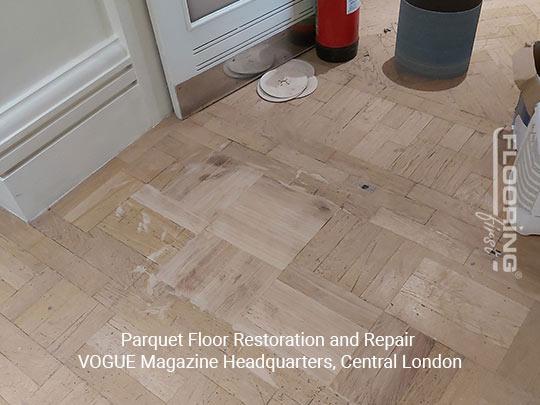
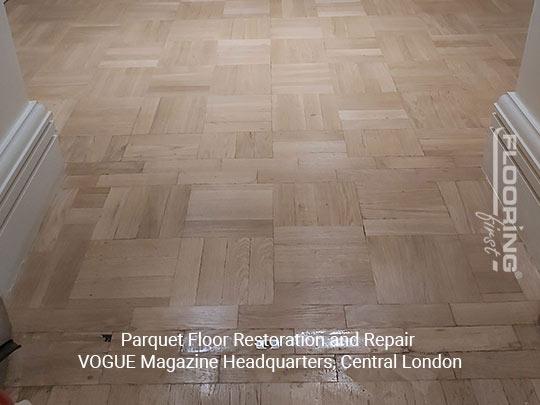
This parquet floor restoration and repair project was carried out at the offices of VOGUE Magazine in Central London. The work focused on the corridor leading to the Board Meeting Room, a high-profile area that sees regular use by staff, visitors, and senior management. The parquet floor in this section had developed gaps between the blocks, the surface finish had dulled and worn, and in a few areas the blocks had begun to lift slightly. Given the setting, the work had to be done to an exceptional standard and with minimal disruption to office operations. Commercial parquet restoration in Central London falls broadly in the £70 to £100 per square metre range, though scope variations affect the final cost.
The Challenge
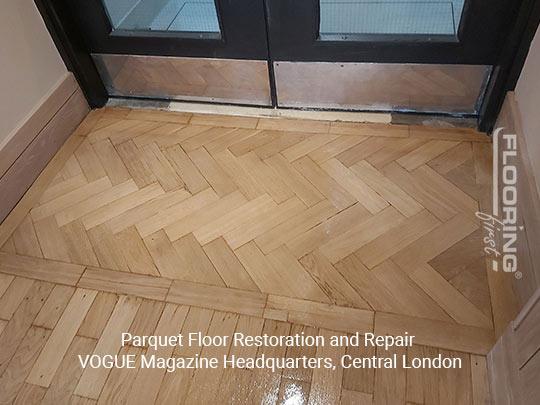
Working in an occupied commercial environment brings constraints that do not apply in domestic settings. The work had to be scheduled to avoid disrupting key meetings and office hours, which meant phased working and strict dust control were essential. Parquet floor sanding produces fine dust that can travel considerable distances in an air-conditioned office if not contained properly. In addition, the corridor was narrow, which limited the size of equipment that could be used, and any marks or scuffs to the freshly painted walls would have been unacceptable. The floor's herringbone pattern also demanded diagonal sanding technique, as always with parquet, requiring experience and care to avoid any cross-grain damage.
Our Approach
- Condition inspection: We carried out a thorough assessment of the corridor floor, noting every loose block, every gap wider than one millimetre, and every section of worn finish before agreeing on the scope of work with the facilities team.
- Block re-gluing and replacement: Loose blocks were individually lifted, cleaned, re-glued, and pressed back into position. A small number beyond repair were replaced with matching oak stock.
- Gap filling: All significant gaps were filled using a resin and wood-dust mixture matched to the floor's existing colour, producing a natural-looking result rather than a contrasting filler line.
- Dust containment: Before sanding began, we sealed the corridor with polythene sheeting at both ends and covered all ventilation grilles. A dust extraction system was connected directly to the sanding machine to keep airborne particles to a minimum.
- Sanding: The floor was sanded diagonally through three grit stages using equipment sized to fit the corridor width. Edge sanding was completed carefully to avoid marking the walls or skirting.
- Finishing: Two coats of a hard-wearing commercial-grade lacquer were applied, chosen for its quick drying time to minimise disruption. The finish was buffed between coats for a consistently smooth result.
The Result
The corridor floor looked considerably better after treatment. The gaps were filled, the surface finish was even and clean, and the overall appearance of the space was noticeably improved. The work was completed within the agreed schedule without disruption to the building's operations. Maintaining parquet floors in commercial settings to a high standard requires periodic professional attention, and this project is a good example of how a targeted restoration can significantly extend a floor's useful life without the cost and disruption of replacement.
Frequently Asked Questions
Can parquet floor sanding be done in an occupied commercial building?
Yes, with the right preparation. Dust containment is the main concern. We use direct-extraction sanding equipment and seal off the work area to prevent dust spreading into adjacent offices. Work is typically scheduled outside core business hours or in phases to keep disruption to a minimum.
How often does a commercial parquet floor need professional maintenance?
In a high-traffic commercial corridor, the finish will wear faster than in a domestic setting. A maintenance coat applied every two to three years can extend the time between full sanding and refinishing jobs. Full sanding and refinishing on a well-maintained commercial floor is typically needed every eight to fifteen years.
What type of finish is best for a high-traffic commercial parquet floor?
A commercial-grade lacquer with a hard surface film is generally the most practical choice for high-traffic areas. It provides strong scratch and wear resistance, is easy to clean, and is available in a range of sheen levels from matt to high gloss. Oil finishes, while beautiful, require more frequent maintenance and are less suited to very high-traffic commercial use.