Parquet Floor Sanding & Restoration in London
Floor Sanding & Restoration in London — At a Glance
- Price range: £25–£45 per sqm
- Typical duration: 1–2 days for an average room
- Free site visit: Yes — book online or call 020 8830 9782
- Customer rating: 4.5/5 (590+ reviews)
- Experience: 22 years, established 2004
Pull back the carpet in an older London home and you will sometimes find a parquet floor underneath it, sitting exactly where it was laid decades ago. Original block floors from the 1930s to 1970s were built to last, and most of them still can. Before writing one off as beyond saving, it is worth knowing that parquet floor restoration in London is something our team carries out regularly, on everything from slightly tired boards to floors that have been under carpet since the 1980s.
The process takes time and skill, but the result is a floor with genuine character that no new installation can replicate. This guide explains what is involved, what kinds of floors we work on, and what you can expect to pay.
Is your parquet looking dull, loose, or damaged? Call our London specialists today on 020 8830 9782 or book a free site visit and we will assess the floor and recommend the right approach.
Types of Parquet Flooring We Restore in London
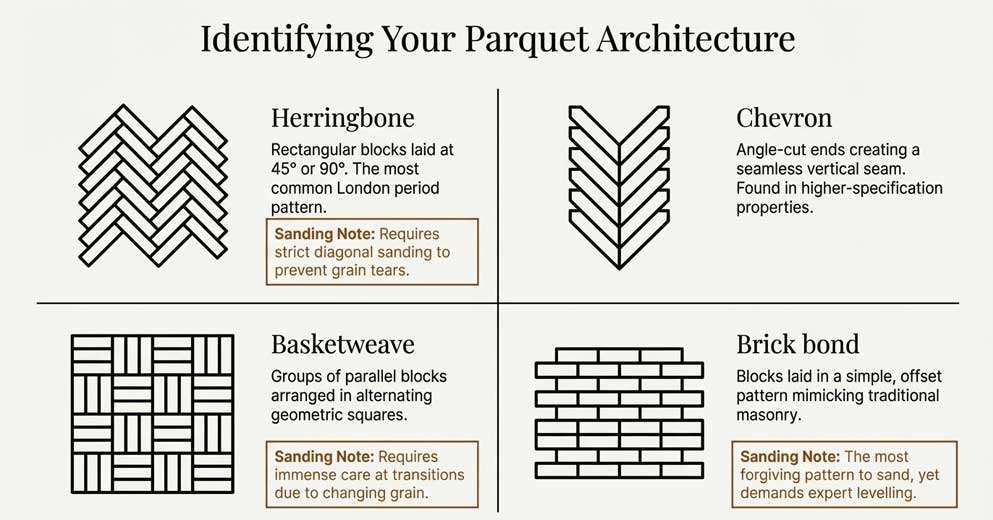
Parquet is not one thing. The word covers several distinct laying patterns, and each responds slightly differently to restoration work. Knowing which you have will help you understand what the job involves.
- Herringbone is the most common pattern in London period homes. Rectangular blocks are laid at 45 or 90 degrees to form a zigzag. Sanding must follow the pattern diagonally to avoid tearing the grain on alternate blocks.
- Basketweave uses small groups of parallel blocks arranged in alternating squares. The effect is subtle, and the grain directions change frequently, so machine sanding requires care at transitions.
- Chevron looks similar to herringbone but the block ends are cut at an angle so they meet precisely at the centre line. It is less common and tends to appear in higher-specification properties.
- Brick bond lays blocks in a simple offset pattern, like brickwork. It is more forgiving to sand than the angular patterns but still benefits from experienced handling.
Most original London parquet floors are solid hardwood, typically oak or pine, laid over a timber or concrete subfloor using bitumen adhesive. Modern floating or engineered parquet can also be restored, though the approach differs because the boards are thinner and cannot be sanded as many times.
Common Parquet Floor Problems
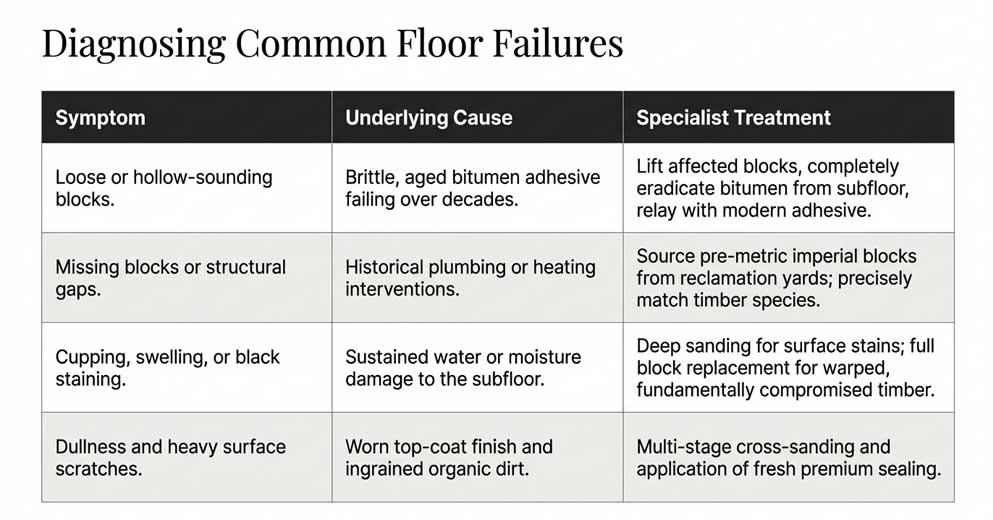
Most restoration jobs in London start with the same handful of issues. Some are cosmetic; others need structural attention before any sanding can begin.
- Loose or hollow blocks are one of the most frequent problems. Bitumen adhesive becomes brittle with age, and blocks gradually detach from the subfloor. You can usually identify them by pressing down and listening for a hollow tap or feeling slight movement underfoot.
- Missing blocks often result from plumbing or heating work over the years. Replacement blocks need to match the original in species, thickness, and grain direction. Reclamation yards are a good source; we can also cut new blocks from matching timber.
- Water damage causes swelling, cupping, or staining. Minor moisture damage can often be sanded back, but if the subfloor has been wet for a sustained period the blocks may have warped beyond recovery and will need replacing.
- Discolouration and staining from old finish layers, ingrained dirt, or bleaching near windows is almost always removed by sanding, provided the blocks have enough material left to work with.
- Adhesive failure in bitumen-laid floors can affect large sections at once. When multiple blocks in an area are loose, we lift, clean, and relay that section before sanding the whole floor.
- Surface scratches and worn finish are the simplest problem to resolve. Light sanding, fresh finish, and the floor looks new.
Our Parquet Floor Restoration Process
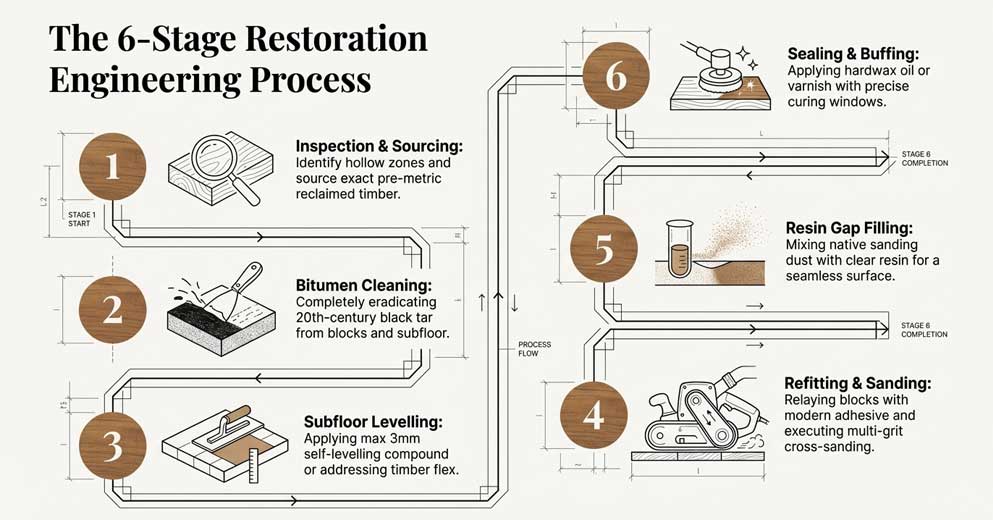
Missing, Damaged or Loose Blocks
The first step in any parquet restoration is a careful inspection. Walk the floor slowly, pressing each block to check for movement, and tap systematically to identify hollow areas. Mark anything that needs attention before the sanding crew arrives.
For tongue-and-groove blocks, removal needs to be done carefully to avoid loosening adjacent blocks unnecessarily. Damaged sections can sometimes be sourced from an inconspicuous area of the same property, such as a built-in cupboard, or from architectural salvage yards. Before sourcing replacements, measure the existing blocks precisely. Pre-metric parquet from the mid-20th century was made in imperial dimensions, and modern metric timber will not sit flush.
Match the wood species as closely as possible. If a replacement oak block sits next to original pine, the difference will show even after staining.
Cleaning the Blocks and Subfloor
Old parquet floors across London were almost universally laid in bitumen, a black tar-based adhesive that was the standard for most of the 20th century. It is no longer used, but its residue affects how well modern adhesive bonds when blocks are relaid.
Any bitumen on the back of lifted blocks and on the subfloor surface must be cleaned off thoroughly. A floor laid back onto bitumen residue will take far longer to bond correctly, sometimes over 24 hours rather than the usual 6 to 8, and the bond quality will be compromised. Take the time to clean both surfaces properly before proceeding.
Levelling the Subfloor
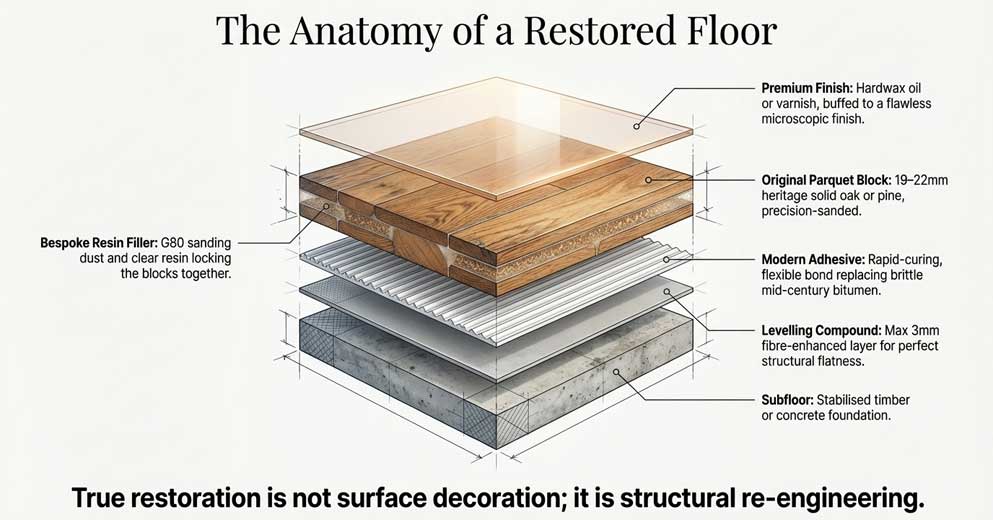
Lifting damaged blocks often reveals an uneven subfloor beneath. This may be due to the original installation, or because removing old bitumen has taken material with it. Concrete subfloors can be levelled with a self-levelling compound, applied in coats of no more than 3mm. Use a fibre-enhanced product for better durability, and allow it to dry completely before the blocks go back down.
For timber subfloors, check for any flexing or movement in the boards below. Any movement at subfloor level will work its way through to the parquet over time.
Refitting the Blocks
Once the subfloor is clean and level, blocks are relaid using modern adhesive. Allow the full curing time before sanding begins. Starting with G24 grit, sand with the belt sander across the whole floor, working in parallel passes from one wall to the other. At 90 degrees to the first direction, repeat the process. This cross-sanding method levels any height differences between old and replacement blocks.
Follow with G40 on the edge sander for the areas the belt machine cannot reach, then move the whole floor to G80. Keep the dust bag from the G80 pass, as you will need it later for mixing filler.
Gap Filling
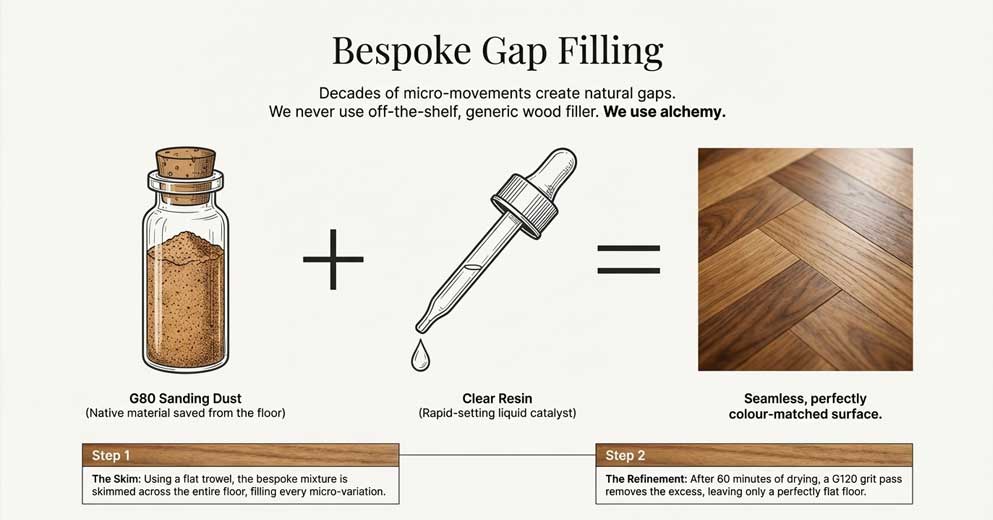
Parquet blocks shift slightly over decades, and gaps between them are normal. To fill them, mix the G80 sanding dust with a resin wood filler. Work in small batches because the mixture sets quickly. Larger gaps can be filled generously; the excess will be removed in the next sanding pass.
For a tighter finish overall, you can skim a thin layer of filler across the entire floor using a flat trowel, filling minor surface variations and small gaps in one pass. Leave it to dry for 30 to 60 minutes depending on depth, then sand with G120 to remove the excess and bring the surface to a smooth, even finish ready for sealing. Vacuum thoroughly before moving to the next stage.
Can You Change the Colour of Parquet Flooring?
Yes, parquet flooring can be stained during restoration. Once the surface is sanded back to bare wood, it accepts stain in the same way any other solid hardwood does. Lighter finishes, mid-tones, and darker shades are all achievable depending on the species and the starting colour of the wood.
There are a few things worth knowing before committing to a stain. Oak responds well to almost any tone. Pine absorbs stain unevenly because of its grain structure, which can produce a patchy result, particularly with very dark colours. Mixed floors where replacement blocks sit alongside originals may show colour variation even after staining.
We recommend testing any stain on a small, inconspicuous area before proceeding. For more detail on the options available, see our wood floor staining page.
Application of the Sealer
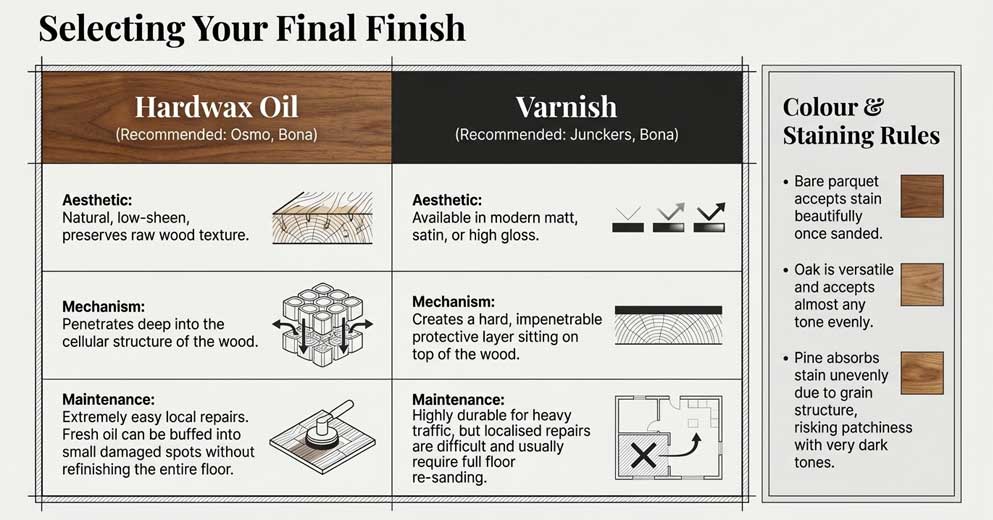
Two types of finish are commonly used on restored parquet floors in London: hardwax oil and varnish.
Hardwax oil penetrates the wood surface rather than sitting on top of it. The result is a natural, low-sheen appearance that works well with older parquet and preserves the texture of the grain. It is easier to repair in small sections if the floor gets damaged later, because fresh oil can be worked into specific areas without refinishing the whole floor.
Varnish creates a harder protective layer on the surface and comes in matt, satin, or gloss. It is more durable than oil in high-traffic areas and requires less ongoing maintenance. The trade-off is that localised repairs are more difficult, and the full floor usually needs sanding back when it eventually wears.
For both products, we use and recommend Osmo, Bona, and Junckers finishes, available from specialist wood flooring suppliers. These come in 5-litre containers for varnish or 2.5-litre for oil, each sufficient for approximately one coat across 50 square metres. Always follow the manufacturer's instructions for application and drying times.
How Much Does Parquet Floor Restoration Cost in London?
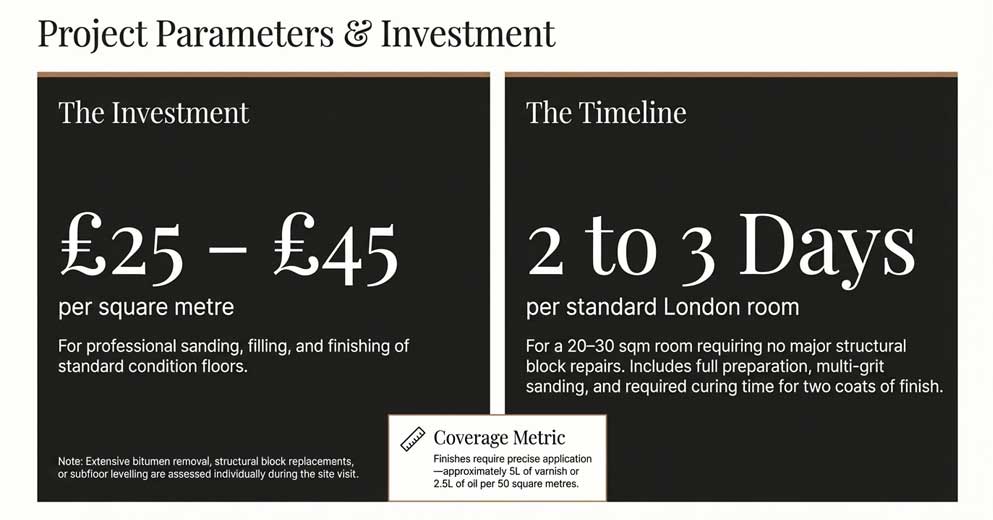
Parquet restoration costs in London vary depending on the condition of the floor, the size of the area, and whether any block repairs or replacement is needed before sanding can begin.
As a general guide, prices typically range from £25 to £45 per square metre for sanding, filling, and finishing an existing parquet floor in reasonable condition. Floors with significant block repairs, extensive bitumen residue, or subfloor levelling work will fall towards the higher end or beyond it.
The cost of replacement blocks varies depending on the species and source. Reclaimed blocks from salvage yards tend to cost less than new timber cut to match, but availability can be unpredictable for less common parquet sizes.
We provide a fixed-price quote after a free site visit, so there are no surprises once work begins. Call 020 8830 9782 to arrange an assessment, or book online.
The Perfect Finish
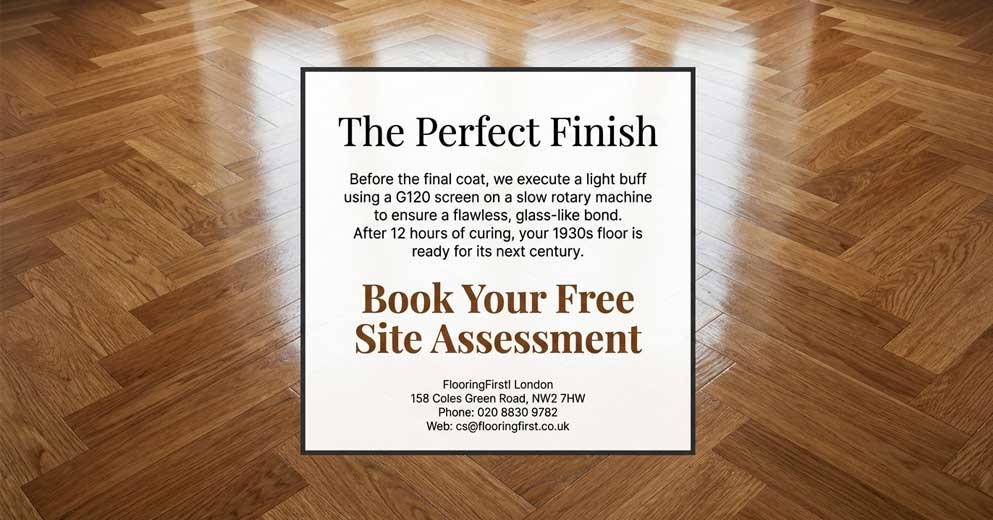
The final step is a light buff between the penultimate and last coats of finish. Using a G120 screen or G150 fine sanding disc on a slow rotary machine, run over the cured first coat to knock back the raised grain and remove any dust nibs. This gives the final coat a surface to bond to cleanly, and the difference in the finished result is noticeable.
Once the final coat is applied, leave the floor for at least 12 hours before moving furniture back in. For oil finishes that require two or three coats, allow the full curing time between each coat as specified by the product manufacturer.
Frequently Asked Questions About Parquet Floor Restoration in London
Can old parquet floors be restored?
Yes, even heavily worn or neglected parquet floors can usually be brought back. Restoration preserves the original pattern and material in a way that replacement cannot. The main limits are block thickness (there needs to be enough wood left to sand) and structural condition of the subfloor.
What if some parquet blocks are loose or missing?
We repair or replace damaged and missing blocks before sanding begins. Wherever possible, we source matching timber in the right species and dimensions for a result that is consistent across the whole floor after finishing.
Will sanding damage the parquet pattern?
No. Professional parquet sanding uses the correct equipment and technique for each pattern type. Herringbone and chevron floors are sanded diagonally, which protects the grain on alternating blocks. The pattern is not affected.
How many times can a parquet floor be sanded?
Solid parquet blocks from the mid-20th century are typically 19 to 22mm thick and can be sanded several times over their lifetime. How many depends on the wear layer above the tongue, which varies by block. During our site visit, we can assess how much material remains.
How long does parquet floor restoration take?
A standard London room of 20 to 30 square metres with no major block repairs will normally take two to three days, including preparation, sanding, and two coats of finish. Larger floors or those needing significant block replacement will take longer.
Do you work across London?
Yes. We carry out parquet floor restoration throughout London, including central, north, south, east, and west London, as well as surrounding areas. Contact us to confirm coverage for your postcode.