Floor Sanding & Fitting
Book Free Visit Price Guide 020 88309782
Monday - Friday 07:30 - 17:30, Saturday 07:30 - 16:00
cs@flooringfirst.co.uk
020 88309782
Monday - Friday 07:30 - 17:30, Saturday 07:30 - 16:00
cs@flooringfirst.co.uk
  • Book Free Visit
  • Home
  • Floor Sanding
  • Floor Fitting
  • Floor Repairs
  • Aftercare
    • Wooden Floors
    • Cleaning & Polishing
    • Re-Oiling Wooden Floors
    • Vinyls & Linoleum
    • Vinyl Floor Polishing
    • Get a Quote...
  • For Businesses
  • Gallery
  • Service Guide
  • Shop
  • Book Free Visit

Our Wood Flooring Resource

Find Your Way Around...

Floor Sanding Case Studies

See how FlooringFirst solved flooring challenges

WHY CHOOSE US
CASE STUDIES
PRICE GUIDE
OFFERS
GALLERY
ASK EXPERT
WHY CHOOSE US
CASE STUDIES
PRICE GUIDE
OFFERS
GALLERY
ASK EXPERT
  • Home
  • Case Studies
Engineered Wood Floor Sanding, Repair and Re-Oiling in Pimlico — Full Case Study

Project Overview This engineered wood floor in Pimlico had been in place for several years and was beginning to show a range of problems: a handful of damaged boards, gaps opening between others, and a finish that no longer offered any meaningful protection. The owner wanted the floor restored to a standard fit for a Pimlico flat, and the combination of targeted board repairs, gap filling and a f...

Project Overview

This engineered wood floor in Pimlico had been in place for several years and was beginning to show a range of problems: a handful of damaged boards, gaps opening between others, and a finish that no longer offered any meaningful protection. The owner wanted the floor restored to a standard fit for a Pimlico flat, and the combination of targeted board repairs, gap filling and a full sand and re-oil achieved exactly that. The total scope of work was larger than a straightforward refinish but smaller than a full floor replacement, and the result justified the decision to restore.

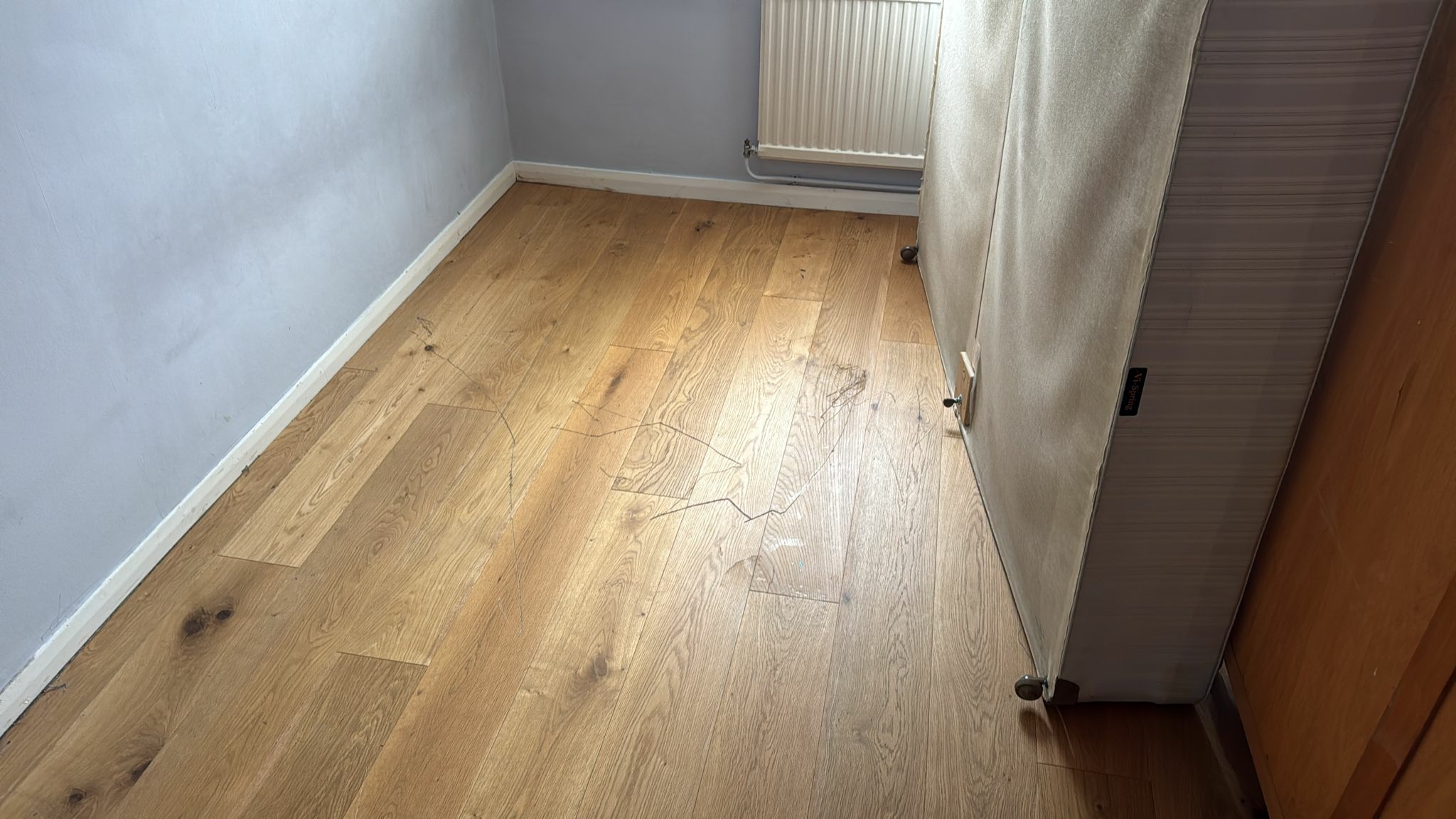
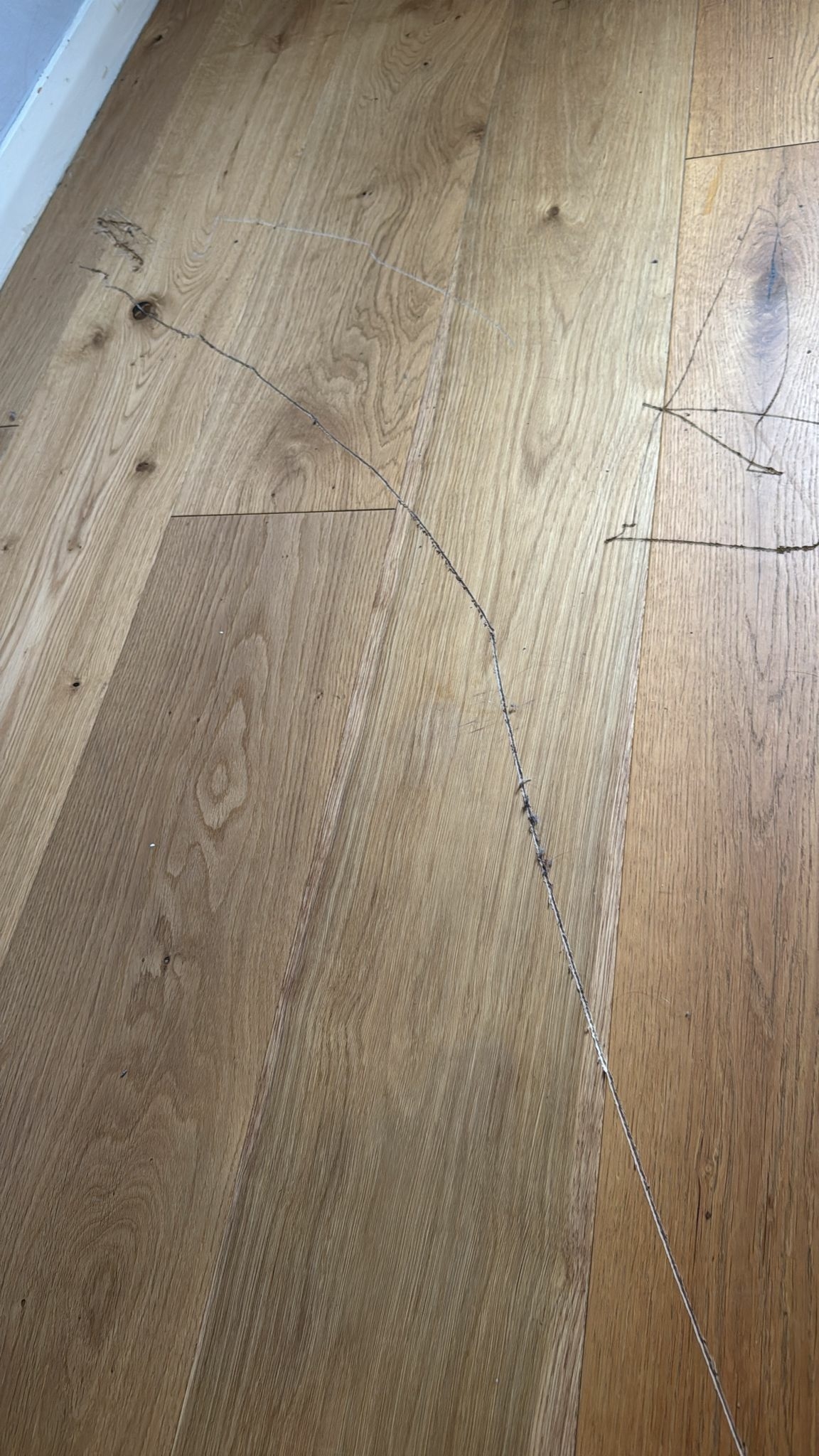
Engineered wood floor before repair and sanding in Pimlico

The Challenge

The combination of repairs, gap filling and refinishing on an engineered floor is more technically demanding than any one of those tasks in isolation. The repaired boards need to sit perfectly flush with the surrounding floor before sanding, or the sanding machine will either leave a ridge at the junction or sand through the new board more quickly than the surrounding original material. The gap filling compound also needed to be applied carefully to avoid contaminating the surface of the boards on either side of the gap, which would show up as patchy discolouration under the oil finish. Getting all three elements right in the correct sequence is the difference between a tidy, professional result and one that looks patchwork.

Damaged boards identified before repair in Pimlico

Our Approach

Board repairs first. Damaged boards were removed and replaced with matching engineered boards. Any boards that were simply loose or squeaking were re-secured with flooring adhesive and left to cure before sanding began.

Gap filling. Gaps between boards were filled with a flexible resin compound mixed with wood dust to match the floor colour. The filler was applied, allowed to cure, and then lightly sanded flush with the surface.

Sanding. The floor was sanded using a controlled sequence of grits appropriate for engineered wood. Starting with a medium grit to remove the old finish and flatten all repairs, progressing to fine grits for a smooth, consistent surface throughout. Edge sanding completed the perimeter.

Oil finish application. An oil finish was applied in two coats. Oil was chosen because it penetrates into the wood's structure rather than sitting on top, providing protection from within and giving a natural, warm appearance that suits the character of the property.

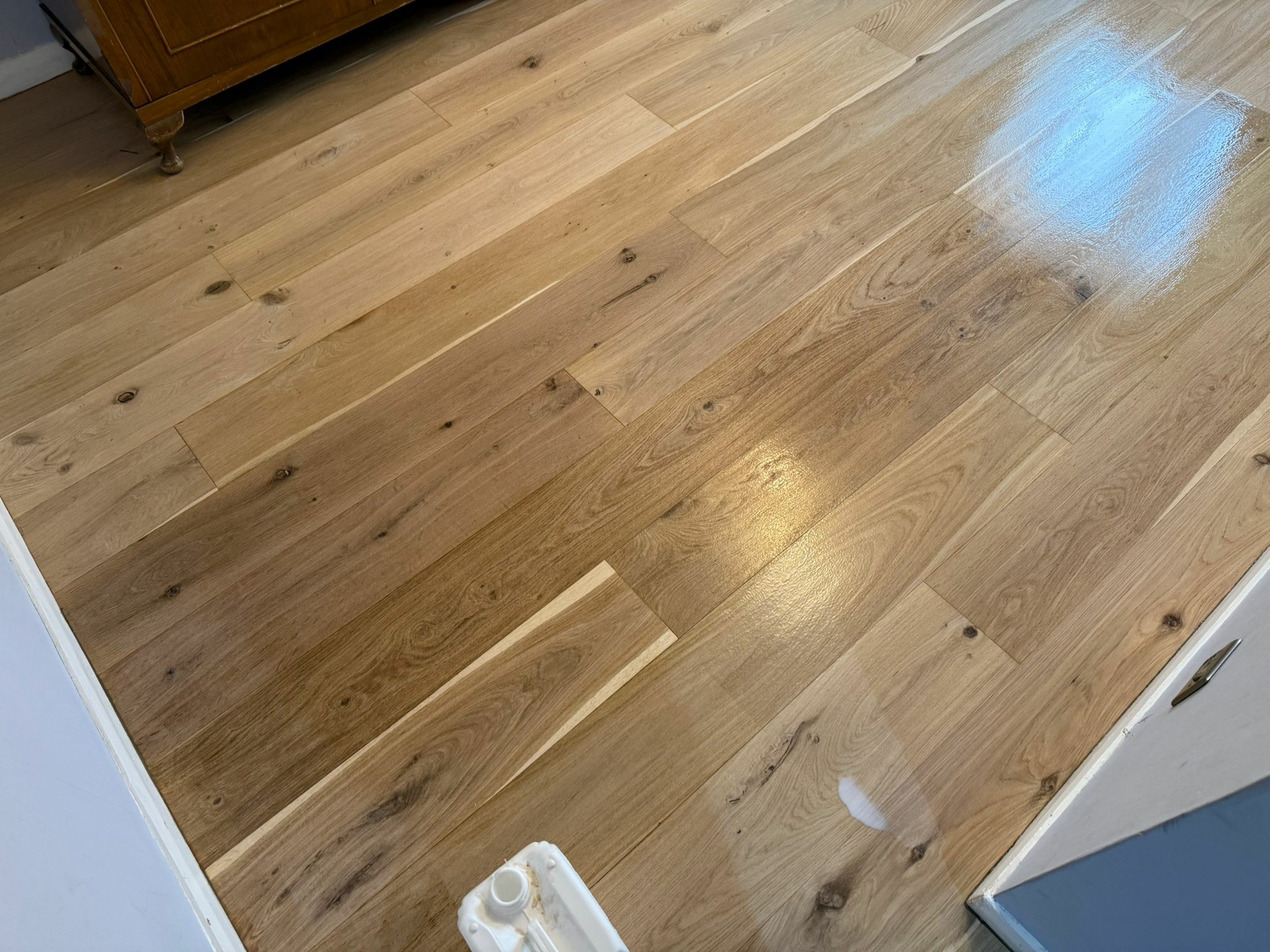
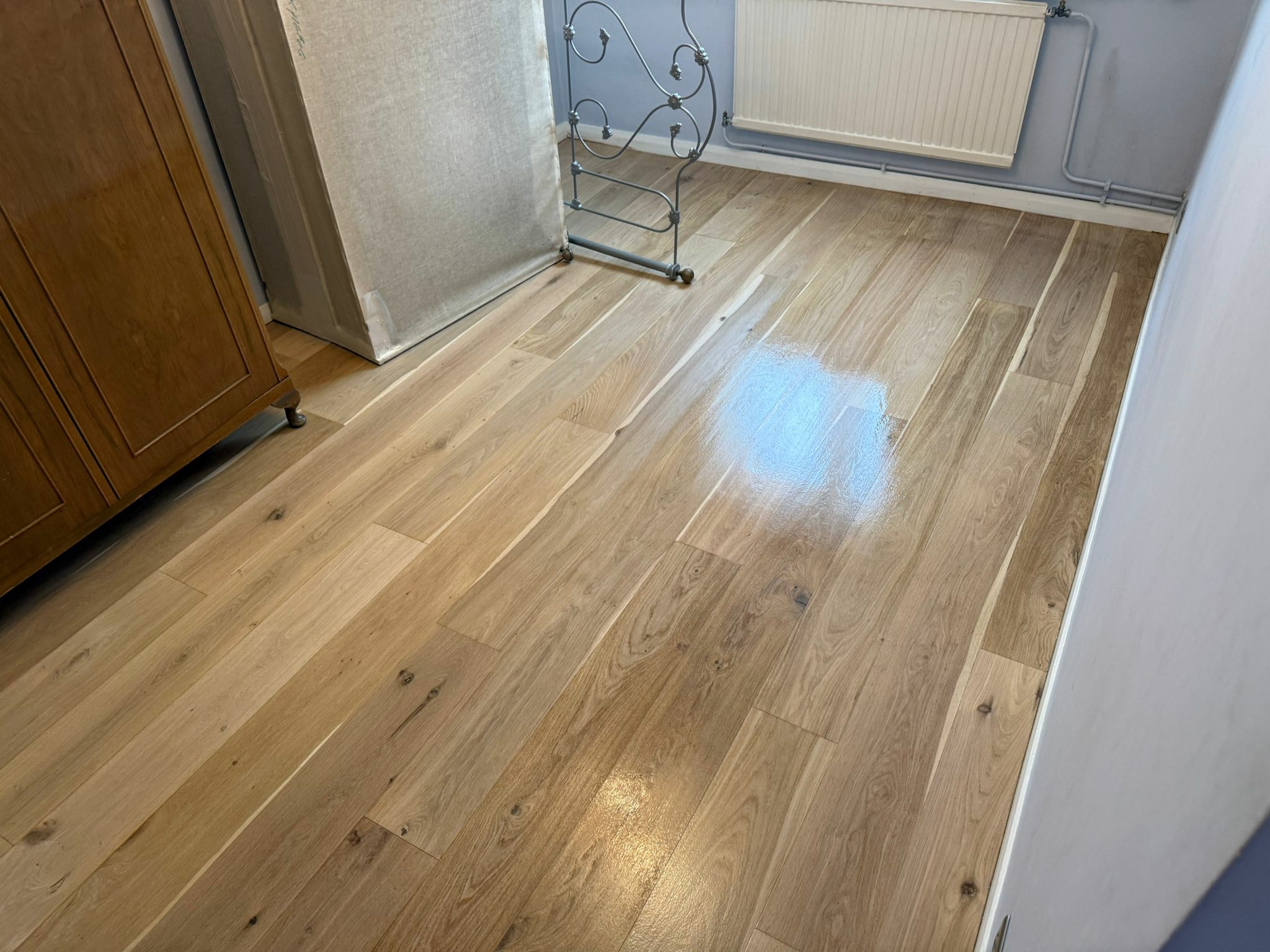
Sanding the engineered wood floor in Pimlico

The Result

The repaired and refinished floor looked clean, uniform and well-maintained. The replacement boards blended effectively after sanding, the gaps were eliminated, and the oil finish gave the whole surface a warm, natural appearance. The owner now has a floor that is structurally sound, properly protected and considerably more attractive than it was when we arrived. Oil finishes do need re-applying periodically, but maintenance is straightforward and does not require any sanding between top-up coats.

Frequently Asked Questions

Can damaged engineered boards be replaced without replacing the entire floor?
Yes, in most cases. As long as matching boards can be sourced, individual damaged boards can be removed and replaced. The whole floor is then sanded, which ensures a uniform appearance across old and new boards.

What is the difference between oil and lacquer for engineered floors?
Lacquer sits on top of the wood as a hard film, while oil penetrates into the grain. Lacquer is more scratch-resistant in the short term; oil looks more natural and is easier to maintain and spot-repair. Both are suitable finishes depending on the use and preference of the owner.

How often does an oiled engineered floor need maintenance?
In a well-used residential property, an oiled floor usually benefits from a maintenance oil coat every one to two years. This does not require sanding; the existing oil is lightly buffed and a new coat applied on top.

Have a similar project? Call us on 020 88309782 or Book a Free Site Visit

Show more
Herringbone Vinyl Flooring Installation in Bow — Full Case Study

Project Overview This fitting project in Bow involved the installation of a luxury vinyl floor in a herringbone pattern across the main living areas of a residential property. The clients had selected a vinyl product designed to replicate the look of real wood parquet and wanted the classic herringbone layout that is popular in period London interiors. Modern luxury vinyl flooring has improved dr...

Project Overview

This fitting project in Bow involved the installation of a luxury vinyl floor in a herringbone pattern across the main living areas of a residential property. The clients had selected a vinyl product designed to replicate the look of real wood parquet and wanted the classic herringbone layout that is popular in period London interiors. Modern luxury vinyl flooring has improved dramatically in quality and realism, and a well-installed herringbone vinyl floor can be a very attractive and practical alternative to real parquet at a significantly lower cost. Fitting costs for vinyl in London typically run from £35 to £60 per square metre for a standard installation, though herringbone layouts require additional time due to the precision involved in setting out the pattern.

Room before vinyl flooring installation in Bow

The Challenge

A herringbone pattern is the most layout-sensitive of all floor designs. If the starting point is not precisely set, the pattern will drift visibly towards one wall by the time you reach the other side of the room. Setting out requires careful measurement of the room's geometry, identifying the true centre point and establishing a perfectly square reference grid before any plank is clicked into place. This room also had several doorways and an alcove that required the pattern to be carefully cut and maintained through the transitions without losing the herringbone rhythm. Getting the cut at each doorway to align correctly with the incoming planks took considerable care.

Subfloor preparation before vinyl installation in Bow

Our Approach

Subfloor preparation. The existing subfloor was checked for levelness and any high spots were addressed. Vinyl flooring is less forgiving than carpet over subfloor irregularities, because imperfections can telegraph through the planks and cause the clicks to work loose over time.

Setting out the pattern. We measured the room carefully and established the central axis and reference lines in pencil before starting. The first planks were laid from the centre outward to ensure the pattern was balanced on both sides of the room.

Laying the planks. The click-together vinyl planks were laid progressively outward from the centre, cutting each perimeter plank precisely to maintain the herringbone angle at the edges. Doorways and transitions were handled individually to ensure clean, tight joins.

Finishing touches. Beading was fitted around the perimeter to cover the expansion gap and give a clean edge. Threshold strips were fitted at doorways to protect the cut edges of the floor and provide a tidy transition to other floor surfaces.

Herringbone vinyl floor being laid in Bow

The Result

The finished floor looked considerably better than the clients had anticipated. The herringbone pattern ran consistently and crisply across the whole room, the perimeter beading gave a neat finish to the edges, and the threshold strips looked tidy at each doorway. The floor had the visual impact of a real parquet floor at a fraction of the cost, and the vinyl material is far more resilient to spills and moisture than real wood, which is a practical benefit in a busy London home.

Frequently Asked Questions

Is professional fitting necessary for herringbone vinyl, or is it a DIY job?
The click system makes the planks themselves easy to handle, but achieving a precise herringbone layout requires accurate setting-out that most DIY installers struggle with. A pattern that starts slightly off-square will visibly skew by the time it reaches the far wall. Professional fitting ensures the pattern looks right across the whole room.

Can luxury vinyl herringbone be fitted over existing flooring?
In many cases yes, provided the existing floor is sound, level and firmly bonded to the subfloor. Vinyl should not be fitted over a floor that has any give or movement, as this will cause the click joints to work loose over time.

How does luxury vinyl compare to real parquet in terms of durability?
Vinyl is generally more resistant to moisture and spills than real wood and does not require any sanding or refinishing over its lifetime. Real wood parquet, however, can be sanded and restored many times and tends to last much longer overall. The right choice depends on the client's budget and priorities.

Have a similar project? Call us on 020 88309782 or Book a Free Site Visit

Show more
Engineered Wood Floor Sanding and Lacquering in St Albans — Full Case Study

Project Overview This engineered wood floor in St Albans had accumulated significant surface wear over the years and had reached the point where the old lacquer finish offered little protection and the floor simply looked tired. The owners contacted us for a professional sanding and relacquering service to restore the floor to its original condition. Engineered wood floors can be sanded and refin...

Project Overview

This engineered wood floor in St Albans had accumulated significant surface wear over the years and had reached the point where the old lacquer finish offered little protection and the floor simply looked tired. The owners contacted us for a professional sanding and relacquering service to restore the floor to its original condition. Engineered wood floors can be sanded and refinished when the wear layer above the ply core is thick enough, and in this case there was sufficient material to carry out a full sand. The project was completed with minimal disruption and the results were exactly what the owners were looking for.

Engineered wood floor before sanding in St Albans

The Challenge

One of the most important aspects of sanding an engineered wood floor is controlling the amount of material removed. The top hardwood layer on this floor was sufficient for a full sand, but the operation still required careful machine setup and consistent passes to avoid removing too much material in any one area. The previous finish had also been applied quite thickly in places, meaning the initial passes needed to be thorough enough to cut through the old lacquer completely, without going too deep into the underlying wood. Achieving a completely even surface across a full room, including the areas near walls where the large drum sander cannot reach, is always a test of technique.

Surface of engineered floor before sanding in St Albans

Our Approach

Condition assessment. We checked the thickness of the wear layer at several points and confirmed the floor could take a full sand. We also noted the areas of heaviest wear and the state of the previous finish to plan the grit sequence appropriately.

Main floor sanding. Starting with a medium grit to cut through the old finish and surface imperfections, we worked progressively through finer grits to produce a smooth, consistent surface. The advanced sanding equipment used collects the vast majority of dust during the process, leaving very little residue to clean up afterwards.

Edge and corner work. The perimeter was sanded with an edge sander, and corners were completed by hand scraper to ensure no finish remained near the walls.

Lacquer finish. Two coats of lacquer were applied with full curing time between coats. The lacquer creates a hard, clear film on the surface that protects against scratches and everyday wear while allowing the natural appearance of the wood to show clearly.

Sanding the engineered floor in St Albans

The Result

The floor looked completely renewed after the sanding and lacquering. The surface was even and smooth throughout, the lacquer gave a clear, consistent sheen, and all the scratches and scuff marks from the previous years of use had been removed. The owners were very pleased with the outcome, and the floor is now well-protected for many years of continued use before another sand will be needed.

Frequently Asked Questions

How do I know if my engineered floor has enough wear layer left for sanding?
The safe way to check is to have a professional measure the thickness of the top layer before starting. Most engineered floors with a 3mm or thicker wear layer can take at least one full sand. Floors with a 2mm layer can usually manage a light buff and re-coat but not a full sand.

Does professional sanding equipment create a lot of dust?
Modern professional sanding equipment is fitted with dust extraction systems that collect most of the material during sanding. There is always some fine dust that settles in the room, but the quantity is significantly less than older belt sander systems, and a quick clean-up is all that is needed after the job.

How long does a professional sanding and lacquering job take?
A standard room of 20 to 30 square metres typically takes one day for sanding and the application of the first lacquer coat, and a second visit the following day for the final coat. The floor can usually be walked on lightly within 24 hours of the last coat.

Have a similar project? Call us on 020 88309782 or Book a Free Site Visit

Show more
Engineered Wood Floor and Stairs Sanding and Refinishing in Dalston — Full Case Study

Project Overview This Dalston property had engineered wood flooring throughout the main rooms and a wooden staircase connecting the floors. Both had reached a state where the finish was worn, scratches were visible across most of the surface, and the overall appearance let down an otherwise well-presented home. The owners wanted everything done in a single job to get a consistent result and avoid...

Project Overview

This Dalston property had engineered wood flooring throughout the main rooms and a wooden staircase connecting the floors. Both had reached a state where the finish was worn, scratches were visible across most of the surface, and the overall appearance let down an otherwise well-presented home. The owners wanted everything done in a single job to get a consistent result and avoid the disruption of two separate visits. Combining floor and stair sanding is the most practical approach and ensures the finish matches across the whole property.

Engineered wood floor and stairs before sanding in Dalston

The Challenge

Engineered wood floors have a real hardwood top layer over a plywood core, which means the number of times they can be sanded is limited by the thickness of that layer. This floor had been sanded once previously, so care was needed to ensure we did not go through the wear layer during this second sand. The staircase presented additional challenges: the treads were heavily worn in the centre, particularly on the landing and the three steps immediately below it. Sanding these areas down to match the worn but less-used edges required careful grading to avoid creating a concave shape across the tread surface.

Worn staircase treads before sanding in Dalston

Our Approach

Assessment and grit selection. We measured the remaining wear layer on the engineered floor and confirmed that a medium-grit approach was appropriate. Going in with coarser grit would have been unnecessarily aggressive given the condition of the floor.

Floor sanding. The floor was sanded across multiple passes with progressively finer grits to remove the old finish and surface marks without taking more material than necessary. Edges and corners were hand-finished to match.

Stair sanding. Each tread was sanded individually using appropriate equipment for the tread width. The worn centres of the busiest treads were brought down gradually using medium grit to blend with the less-worn areas, creating an even surface across each tread without any obvious dip.

Lacquer application. The floor and stairs were both finished with two coats of lacquer, applied in the correct sequence to avoid walking over freshly finished surfaces during application. Lacquer was the right choice for both because of its hard-wearing properties in high-traffic conditions.

Floor and staircase during restoration in Dalston

The Result

The finished floor and staircase were consistent in appearance and well-protected. The lacquer gave both surfaces the same clear, clean finish, and the scratches and worn areas that had been so visible before were completely gone. The owners commented that the staircase in particular looked better than they had expected, given how heavy the wear had been. The property as a whole looked noticeably smarter once the floor and stairs were in good condition.

Frequently Asked Questions

How many times can an engineered wood floor be sanded?
This depends entirely on the thickness of the top hardwood layer. A 6mm wear layer can typically support three or four full sanding cycles. A 3mm layer may only allow one or two. Each time the floor is sanded, a professional should assess how much material remains before proceeding.

How are heavily worn stair treads repaired during sanding?
Worn treads are sanded progressively to reduce the high spots around the edges down to the level of the worn centre. The key is to work gradually and check frequently to avoid creating a dip in the tread surface. In extreme cases, a filler or levelling compound may be used before sanding begins.

Is it possible to use the stairs during a floor sanding job?
During the sanding and lacquering process, access is usually restricted for periods to allow the finish to cure. The sequence of work is planned so that the stairs remain accessible for at least one direction of travel until the lacquer is dry enough for foot traffic.

Have a similar project? Call us on 020 88309782 or Book a Free Site Visit

Show more
Engineered Wood Floor Sanding and Lacquering in Harrow — Full Case Study

Project Overview This engineered wood floor in Harrow was in need of a professional sanding and refinishing service after years of daily use had taken their toll on the finish. The floor itself was structurally sound; the issue was entirely cosmetic and protective, with the old lacquer worn through in places and the surface showing scratches and dull patches throughout. The owners had done their ...

Project Overview

This engineered wood floor in Harrow was in need of a professional sanding and refinishing service after years of daily use had taken their toll on the finish. The floor itself was structurally sound; the issue was entirely cosmetic and protective, with the old lacquer worn through in places and the surface showing scratches and dull patches throughout. The owners had done their research and understood that engineered wood floors, unlike laminate, are made from real wood and can be sanded and refinished to restore them. We were asked to sand the floor and apply a high-quality lacquer appropriate for the level of traffic in the property.

Engineered wood floor before sanding in Harrow

The Challenge

The primary challenge on this job was the choice of finishing product. The property had a busy household with children and pets, meaning the floor needed a lacquer that could genuinely handle the demands placed on it. Standard lacquers vary considerably in hardness and durability, and not all of them are suitable for very high traffic conditions. Choosing the wrong product would mean the finish showing wear again within a year, which would be a waste of the sanding work. We also needed to ensure the sanding was thorough enough to remove all traces of the old finish, because any remaining old lacquer under the new coat creates a weak bond that causes the new finish to peel or flake prematurely.

Worn lacquer visible on engineered floor before sanding in Harrow

Our Approach

Surface preparation check. We tested whether the existing finish had fully failed or just worn in patches. Where old lacquer remained, the sand had to be deep enough to remove it completely before the new finish was applied.

Progressive sanding. Starting at medium grit to cut through the old finish and bring the entire surface back to bare wood, we progressed through finer grits to achieve a smooth, consistent finish ready for coating. Edge sanding and hand scraping completed the perimeter.

Product selection. For this project we used Bona Traffic HD matt, a commercial-grade lacquer designed specifically for floors subject to high traffic. It is harder than standard domestic lacquers and maintains its protective properties for considerably longer under heavy use.

Lacquer application. Two coats were applied in full accordance with the manufacturer's guidelines, with the recommended interval between coats to allow proper curing before the second coat was laid on top.

Sanding the engineered wood floor in Harrow

The Result

The floor looked outstanding once completed. The Bona Traffic HD matt gave a clean, low-sheen finish that showed the natural beauty of the wood without the high-gloss appearance some people find too formal. The surface was smooth and uniform throughout, and the hardness of the lacquer means this floor will stand up to the demands of a busy household for several years before needing any further treatment. The owners were very happy with both the appearance and the practical durability of the result.

Frequently Asked Questions

What makes Bona Traffic HD different from standard lacquer?
Bona Traffic HD is a two-component commercial lacquer that is significantly harder than most single-component domestic lacquers. It is designed for use in commercial and high-traffic residential settings where standard finishes would show wear too quickly. The main practical difference is that it maintains its protective properties for much longer under heavy daily use.

Can all engineered wood floors be sanded regardless of thickness?
No. The number of sanding cycles available depends on the thickness of the hardwood top layer. Floors with a 2mm or thinner wear layer cannot be sanded without risk of breaking through to the plywood core. A professional assessment of the remaining thickness is always the first step.

How long does Bona Traffic HD take to fully cure?
The floor can take light foot traffic within about 24 hours, but full hardness is not reached for five to seven days. During this curing period, furniture should not be placed back on the floor and the surface should not be cleaned with water or cleaning products.

Have a similar project? Call us on 020 88309782 or Book a Free Site Visit

Show more
Hardwood Floor Sanding and Lacquering in Chelsea — Full Case Study

Project Overview This hardwood floor in Chelsea covered the main living areas of a well-appointed residential property. The floor was original to the building, made from quality timber that simply needed proper attention after years of use. In addition to the main floor, the kitchen had solid wood worktops that had also deteriorated and needed refinishing. Both the floor and the worktops were tre...

Project Overview

This hardwood floor in Chelsea covered the main living areas of a well-appointed residential property. The floor was original to the building, made from quality timber that simply needed proper attention after years of use. In addition to the main floor, the kitchen had solid wood worktops that had also deteriorated and needed refinishing. Both the floor and the worktops were treated in the same visit, using different products appropriate for each surface. Hardwood floor sanding in London is priced from around £25 to £45 per square metre for standard work, with additional elements like worktop refinishing quoted separately based on the scope involved.

Hardwood floor before sanding in Chelsea

The Challenge

The kitchen worktops presented a particular challenge because they required a different product to the floor. Floor lacquers are formulated for horizontal foot traffic; worktops need a food-safe, heat-resistant and water-resistant finish that can handle the specific demands of food preparation and kitchen use. The existing worktop finish had failed significantly, with water damage visible around the sink area and heat marks near the hob. The floor itself was in moderately poor condition with deep scratches in the highest-traffic areas and a finish that had completely worn through in several places, exposing bare wood that was starting to absorb dirt and staining.

Worn hardwood floor in Chelsea before restoration

Our Approach

Floor inspection and planning. The full extent of the finish failure was mapped across the floor before sanding. The deeply worn areas near doorways required slightly more passes to ensure all traces of the old lacquer were removed down to bare wood.

Floor sanding sequence. The floor was sanded in three stages: initial medium-grit passes to remove the old finish and deep scratches, then progressively finer grits to refine the surface. Edging and corners were completed by hand.

Lacquer application to floor. Two coats of a quality clear lacquer were applied to the floor, with curing time between coats and a light buff before the final coat to ensure the best possible surface.

Worktop refinishing. The kitchen worktops were sanded back individually using hand and detail sanders, then finished with Osmo Oil Clear matt, which is food-safe, water-resistant and designed specifically for use on wood surfaces that come into contact with food and liquids.

Chelsea hardwood floor before sanding showing extent of wear

The Result

Both the floor and the worktops came up to a very high standard. The floor had a clean, even lacquer finish that brought out the depth and character of the hardwood, and every scratch and worn patch from the previous years of use had been completely removed. The worktops looked as good as they did when new, with the Osmo oil giving a natural, low-sheen finish that suited the kitchen perfectly. The whole property benefited from the work, and the owners now have a floor and worktops that are properly protected and easy to maintain.

Frequently Asked Questions

Can solid wood kitchen worktops be refinished in the same way as floors?
Yes, but they require a different product. Floor lacquers are not appropriate for worktops because they are not food-safe. Wood worktops are best refinished with a specialist food-safe oil such as Osmo Oil, which penetrates the grain and provides water and heat resistance without creating a surface film that can chip or peel.

How many times can a hardwood floor be sanded over its lifetime?
A solid hardwood floor of typical 20mm thickness can usually be sanded eight to ten times, removing approximately 1mm to 2mm of wood per full sanding cycle. This means a well-maintained hardwood floor can last well over a century with periodic professional care.

What is the best finish for a hardwood floor in a busy Chelsea property?
Lacquer is the most practical choice for properties where the floor receives heavy use and where a durable, easy-to-clean surface is a priority. For a more natural look and feel, an oil finish is an excellent alternative, though it requires more frequent maintenance.

Have a similar project? Call us on 020 88309782 or Book a Free Site Visit

Show more
Engineered Wood Floor Installation in Holborn — Full Case Study

Project Overview This engineered wood floor installation project in Holborn covered the main living spaces of a residential property that was being updated as part of a broader renovation. The clients had chosen a quality engineered wood floor that offered the warmth and character of real wood with the added practical advantage of better moisture resistance compared to solid hardwood. Engineered ...

Project Overview

This engineered wood floor installation project in Holborn covered the main living spaces of a residential property that was being updated as part of a broader renovation. The clients had chosen a quality engineered wood floor that offered the warmth and character of real wood with the added practical advantage of better moisture resistance compared to solid hardwood. Engineered flooring installation in London typically costs between £35 and £60 per square metre for fitting, with the total project cost depending on the floor chosen and any subfloor preparation required. This project involved a careful subfloor assessment and a floating installation method that suited the existing conditions well.

Room before engineered wood floor installation in Holborn

The Challenge

The existing subfloor in this property was an old wooden floor, which raised a number of questions at the outset. Old wooden subfloors can be excellent bases for engineered flooring, providing good insulation and a firm base, but they have to be carefully checked for levelness, moisture, and structural integrity. Any boards that are loose, squeaky, or raised need to be secured before the new floor goes on top, because movement in the subfloor will eventually telegraph through the new floor and cause problems at the click joints. The room also had several doorways that required the engineered planks to be cut and fitted around without breaking the pattern or leaving gaps at the threshold.

Old subfloor before engineered floor installation in Holborn

Our Approach

Subfloor preparation. We walked the old wooden subfloor systematically to identify loose or squeaking boards and secured them. Any raised nails or screws were punched flush or removed. The floor was checked for level using a straight edge and any high spots were addressed.

Moisture check. A moisture reading was taken from the subfloor to confirm it was within the acceptable range for engineered wood. Readings above the threshold would require either a vapour barrier or a delay in installation until the subfloor dried out.

Floating installation. The engineered boards were installed using the floating method, clicking together over the prepared subfloor without any adhesive or nails. This method is quick, non-invasive and allows the floor to expand and contract naturally with seasonal changes in humidity.

Accessories and finishing. Matching beading and threshold strips were fitted around the perimeter and at doorways to finish the installation cleanly and protect the expansion gap around the edges of the floor.

Engineered wood floor being laid in Holborn

The Result

The finished floor was a significant improvement on the old subfloor and completed the look of the newly renovated rooms. The engineered boards clicked together tightly with no visible gaps, the beading and thresholds gave a clean, professional finish at all the edges and doorways, and the floor felt solid and stable underfoot. The clients were very pleased with the result and with how well the chosen floor complemented the rest of the decoration. Engineered wood floors installed to this standard will perform well for decades with normal care.

Frequently Asked Questions

What is the difference between floating and glued-down engineered floor installation?
A floating floor clicks together and rests on the subfloor without being fixed to it, allowing natural movement. Glued-down floors are bonded directly to the subfloor using flooring adhesive, which gives a firmer feel underfoot and is often preferred for larger areas or where underfloor heating is installed. The right method depends on the subfloor type and the client's requirements.

Can engineered wood be installed over underfloor heating?
Yes, engineered wood is suitable for use with underfloor heating because the ply core construction is more dimensionally stable than solid wood under the effects of heat. The floor must be conditioned to room temperature before installation and the heating system must be gradually brought up to operating temperature after fitting.

How long does an engineered wood floor last?
A good-quality engineered wood floor with a 4mm or thicker wear layer, properly installed and cared for, will last many decades. It can be sanded and refinished multiple times over its life, which extends its useful life considerably beyond that of most other types of flooring.

Have a similar project? Call us on 020 88309782 or Book a Free Site Visit

Show more
Parquet Re-Oiling and Gap Filling in Walthamstow — Full Case Study

Project Overview This parquet floor in Walthamstow had an oil finish that had not been maintained for several years and was showing the typical signs of a depleted oil coat: the surface had become dry and dull, the wood had lost its natural warmth, and minor gaps had opened between some of the blocks. Rather than a full sand, which would not have been necessary given the condition of the underlyi...

Project Overview

This parquet floor in Walthamstow had an oil finish that had not been maintained for several years and was showing the typical signs of a depleted oil coat: the surface had become dry and dull, the wood had lost its natural warmth, and minor gaps had opened between some of the blocks. Rather than a full sand, which would not have been necessary given the condition of the underlying wood, the right treatment was a targeted gap fill followed by a re-oil. This approach preserved the existing surface, required no heavy machinery, and was completed with far less disruption than a full sanding job. Re-oiling costs considerably less per visit than a full sanding cycle, making it a cost-effective part of any regular parquet maintenance programme.

Parquet floor before re-oiling and gap filling in Walthamstow

The Challenge

The gaps in this parquet floor were relatively minor but distributed across a large area of the floor. Filling them required care because the gap fill had to sit flush with the surface of the blocks rather than proud of them, and the colour had to be a reasonable match for the existing wood. On an oiled floor where the surface is not being sanded down to bare wood, the filler cannot be matched by mixing it with fresh sanding dust, so the colour match relies entirely on selecting the right resin product. The re-oiling also needed to be done in stages rather than all at once, to allow each coat to be absorbed properly by the wood rather than pooling on the surface.

Parquet floor showing minor gaps before treatment in Walthamstow

Our Approach

Initial inspection. We inspected the full floor to confirm that no blocks were loose and that the wood itself was in good condition beneath the depleted oil finish. No blocks required re-gluing, and no deeper sanding was needed.

Gap filling. The gaps between parquet blocks were filled with a natural resin compound selected for compatibility with an oiled finish. The filler was pressed into the gaps, allowed to cure, then lightly sanded flush with a fine abrasive pad to ensure a level surface before the oil was applied.

Surface preparation. The whole floor was lightly buffed with a fine pad to remove any surface contamination and open the wood's pores slightly, which helps the oil absorb evenly.

Oil application. Two coats of Osmo Polyx Hardwax Oil were applied, working in the direction of the block grain where possible. This product was selected for its combination of oil and wax, which gives a natural, lustrous finish and provides both penetrating protection from within the wood and a light surface hardness from the wax component.

Applying oil finish to parquet floor in Walthamstow

The Result

The floor came back to life after the re-oiling. The natural warmth and colour of the parquet wood returned fully once the Osmo oil was applied, the gaps were closed and invisible, and the surface had a consistent, healthy sheen throughout. The owners now have a parquet floor that is properly protected and will remain in good condition with a re-oil every year or two. On a well-maintained oiled parquet floor, the need for a full sand can be pushed back considerably by keeping up with regular re-oiling, making this a practical long-term maintenance strategy.

Frequently Asked Questions

How often does an oiled parquet floor need re-oiling?
In a busy household, re-oiling every one to two years is usually appropriate. Lightly used rooms may go three years between treatments. The floor itself gives clear signals when re-oiling is due: the surface looks dry, the colour becomes flat, and water no longer beads on the surface as it should on a well-oiled floor.

Does re-oiling require sanding the parquet first?
Not for a routine maintenance re-oil. A light buff with a fine pad to remove surface contamination and open the pores is usually all that is needed. Sanding is only necessary if the floor has scratches that have gone through the oil finish into the bare wood, or if the surface needs significant correction.

What is Osmo Polyx Hardwax Oil and why is it used on parquet floors?
Osmo Polyx is a combination of natural oils and hard waxes that penetrates the grain of the wood while leaving a light protective layer on the surface. It is popular for parquet floors because it gives a natural appearance that enhances the character of the wood pattern, it is hard-wearing for a penetrating oil, and it can be re-applied without stripping the old finish.

Have a similar project? Call us on 020 88309782 or Book a Free Site Visit

Show more
Parquet Floor Sanding and Restoration in Bromley - Full Case Study

Project Overview St Johns the Evangelist Church in Bromley approached us for a large-scale parquet floor restoration covering 5,000 square feet of original wood block flooring. The church had been planning the project for some time, wanting experienced contractors who could handle the scale without disrupting services. We were commissioned to sand, gap fill, and refinish the entire floor to commer...

Project Overview

St Johns the Evangelist Church in Bromley approached us for a large-scale parquet floor restoration covering 5,000 square feet of original wood block flooring. The church had been planning the project for some time, wanting experienced contractors who could handle the scale without disrupting services. We were commissioned to sand, gap fill, and refinish the entire floor to commercial-grade standard.

Parquet floor before sanding at St Johns the Evangelist Church, Bromley

The Challenge

A project of this size in a public building brings its own set of difficulties. The floor had years of accumulated wear from daily foot traffic, regular events, and general use. Gaps had opened up between the blocks, the finish was dull and flaking in patches, and the surface had lost the consistency you want to see across a floor of this quality. Because parquet blocks are laid in a herringbone pattern at 45 degrees, sanding against the grain would have caused damage rather than resolved it. Planning the correct sanding sequence across 5,000 square feet, while keeping disruption to the church to a minimum, required careful scheduling and a clear method from the start.

Worn parquet before treatment, Bromley church

Our Approach

Floor Inspection

Before any machinery was brought in, we carried out a thorough inspection of the full floor. Every section was assessed for loose blocks, significant gaps, and areas of more serious surface damage. This stage determined exactly what preparation work was needed before sanding could begin.

Gap Filling

All gaps between the parquet blocks were filled using a mixture of natural resin and wood dust. This method is the preferred approach for gap filling on wood floors because the resin remains slightly flexible when cured, meaning it will not crack or shrink back over time. The filled surface was left to fully harden before we moved on.

Multi-Stage Sanding

We worked through a multi-stage sanding programme, starting with coarser grits to remove the old finish and surface damage, then working progressively finer to achieve a smooth, even surface across the full 5,000 square feet. For parquet, the direction of each sanding pass is critical, so we carefully followed the grain of each section rather than working in a single direction across the floor.

Sanding in progress at St Johns Church, Bromley

Refinishing with Commercial-Grade Lacquer

Once sanding was complete, the floor was coated with Pallmann Pal-X Trend, a two-component lacquer designed specifically for heavy-traffic environments. It provides hard-wearing protection that is appropriate for a building used by the public on a daily basis. Multiple coats were applied, with light buffing between each one, to achieve a consistent and durable finish.

The Result

The finished floor looks completely different from how it appeared when we started. All surface imperfections were removed, the gaps are no longer visible, and the parquet pattern reads clearly across the whole space. The church now has a floor that is protected for years of continued heavy use. For commercial sanding projects of this kind in the Bromley area, pricing typically runs from around £25 to £45 per square metre depending on the condition of the floor and the finish specified.

Frequently Asked Questions

How long does a commercial floor sanding project of this scale take?
A 5,000 square foot project requires several days of continuous work. We plan the schedule to minimise the number of sessions needed and to allow each coat of finish to cure properly before the next one is applied. The total duration depends on the condition of the floor and the number of coats required.

Can parquet floors be sanded as many times as solid wood floors?
Parquet blocks are generally shallower than solid timber planks, so the number of times they can be fully sanded is more limited. However, a professional assessment will confirm how much material remains and what sanding approach is appropriate. Many parquet floors can be fully restored without reaching that limit.

What finish is best for a church or public building floor?
A two-component oil-based or water-based commercial lacquer is the standard choice for public premises. Products like Pallmann Pal-X Trend are designed for exactly this kind of environment and provide the durability needed to withstand daily foot traffic without requiring frequent maintenance.

Have a similar project? Call us on 020 88309782 or Book a Free Site Visit

Show more
Parquet Floor Sanding and Re-Oiling in Notting Hill - Full Case Study

Project Overview This Notting Hill property had a classic herringbone parquet floor that had been in the home for decades. The owners had been putting off a full sanding and re-oiling for a while, but the floor had reached the point where the old oil finish was worn through in the main walkways and the wood had lost its warmth and depth. They wanted the floor brought back to a natural, open-graine...

Project Overview

This Notting Hill property had a classic herringbone parquet floor that had been in the home for decades. The owners had been putting off a full sanding and re-oiling for a while, but the floor had reached the point where the old oil finish was worn through in the main walkways and the wood had lost its warmth and depth. They wanted the floor brought back to a natural, open-grained oil finish rather than a lacquered look, which suited the character of the property well.

Parquet floor before sanding in Notting Hill

The Challenge

Parquet floors require a different approach to sanding compared to standard strip boards. The blocks are laid at opposing angles in a herringbone pattern, which means that following a simple straight sanding line across the floor would mean working against the grain on half the blocks at any given point. Do that with a heavy drum sander and you risk tearing the fibres and leaving scratch marks that are very difficult to remove. The other challenge was the floor's existing oil finish, which had built up unevenly over the years and needed to be stripped back completely before a new application could be done correctly.

Worn parquet blocks before treatment, Notting Hill

Our Approach

Initial Assessment

We started by walking the full floor to check for any loose or raised blocks, and to assess the depth of remaining timber above the tongue. This confirmed there was enough material to sand back without any risk to the structural integrity of the blocks.

Diagonal Sanding Passes

To sand a herringbone parquet correctly, you work at 45 degrees to the main pattern, which puts the machine at roughly the same angle to the grain of each alternating block. We worked through multiple grit stages, starting coarser to remove the old finish and level the surface, then finishing finer to prepare the wood for oiling. A belt edger and hand scrapers were used close to the skirting boards and in corners.

Sanding in progress on Notting Hill parquet floor

Dust Removal and Preparation

Before oiling, the floor was thoroughly vacuumed and tack-cloth wiped to remove all residual dust. Even small amounts of dust trapped under an oil finish will affect the final appearance and durability.

Oil Application

We applied a hardwearing natural wood oil in two coats, buffing the first coat into the wood and allowing it to cure before the second application. Oil finishes suit parquet particularly well because they penetrate the wood rather than sitting on top, giving the floor a more natural feel underfoot and making localised touch-ups easier in the future.

The Result

The finished floor looks genuinely transformed. The herringbone pattern shows clearly, the wood grain is visible, and the oil finish gives the blocks a warm, natural tone that suits the property. The owners were particularly pleased with how consistent the result was across the whole room. Floor sanding projects in London typically cost between £25 and £45 per square metre, with parquet at the upper end of that range due to the additional care required during sanding.

Frequently Asked Questions

How often does an oiled parquet floor need re-oiling?
In a domestic setting with normal use, a fully sanded and re-oiled parquet floor typically needs a maintenance coat every one to two years. This is a much quicker process than a full sand and does not require furniture removal or extended drying times.

Is oil or lacquer better for a herringbone parquet floor?
Both are suitable, and the choice comes down to the look and feel you want. Lacquer gives a more protective hard surface and is easier to keep clean in busy households. Oil gives a more natural, matte appearance and can be touched up in small areas without resanding. Parquet in older properties often suits oil better aesthetically.

Can a parquet floor be repaired if some blocks are damaged or missing?
Yes, individual blocks can be replaced. We source matching timber where possible, and after sanding the full floor the repaired sections blend in well. If the original wood species is unusual, sourcing a close match takes longer, but it is rarely impossible.

Have a similar project? Call us on 020 88309782 or Book a Free Site Visit

Show more
  • 1
  • 2
  • 3
  • 4
  • 5
  • 6
  • 7
  • 8
  • 9
  • 10
  • 11
  • 12
  • 13
  • 14
  • 15
  • 16
  • 17
  • 18
  • 19
  • 20
  • 21
  • 22
  • 23
  • 24
  • 25
  • 26
  • 27
  • 28
  • 29
  • 30
  • 31
  • 32
  • 33
  • 34
  • 35
  • 36
  • 37
  • 38
  • 39
  • 40
  • 41
  • 42
  • 43
  • 44
  • 45
  • 46
  • 47
  • 48
  • 49
  • 50
  • 51
  • 52
  • 53
  • 54
  • 55
  • 56
  • 57
  • 58
  • 59
  • 60
  • 61
  • 62
  • 63
  • 64
  • 65
  • 66
  • 67
  • 68
  • 69
  • 70
  • 71

Our Flooring Company

Contacts & Showroom Book Free Site Survey About Our Flooring Company Join Our Team Work as a Contractor

Service Information

Terms of Service Terms of Sales Deliveries & Charges Cookie Settings Returns Policy

Help

FAQs Case Studies Sitemap Glossary
FlooringFirst! Services
158 Coles Green Road
London, NW2 7HW
T: 020 88309782
Floor Sanding Services: Central London, East London, Near London, North London, Northwest London, Southeast London, Southwest London, West London
Wood Foor Installation Service: Central London, East London, Near London, North London, Northwest London, Southeast London, Southwest London, West London

  • Flooring Services
  • Floor Sanding
    • Wood Floor Staining
    • Wood Floor Gap Filling
    • Commercial Floor Sanding
    • Engineered Floor Sanding & Refinishing
  • Wood Floor Fitting
    • Parquet Floor Installation
    • Laminate Floor Installation
    • Engineered Wood Floor Installation - Supply & Fit
    • Solid Wood Floor Fitting - Supply & Fit
    • LVT Floor Installation - Supply & Fit
  • Floor Repairs
    • Parquet Floor Repair and Restoration
    • Engineered Wood Floor Repairs
    • Wood Floor Scratch Repair
    • Floorboards Replacement
  • Care & Maintenance
    • Re-Oiling & Recoating Oiled Floors
    • Vinyl & Linoleum Cleaning
    • Hardwood Floor Buffing
    • Wood Floor Polishing
  • Shop
  • Shop
  • Gallery
  • Service Guide
  • Bookings
  • Book Free Survey
  • Service Advice
  • Product Advice