Floor Sanding & Fitting
Book Free Visit Price Guide 020 88309782
Monday - Friday 07:30 - 17:30, Saturday 07:30 - 16:00
cs@flooringfirst.co.uk
020 88309782
Monday - Friday 07:30 - 17:30, Saturday 07:30 - 16:00
cs@flooringfirst.co.uk
  • Book Free Visit
  • Home
  • Floor Sanding
  • Floor Fitting
  • Floor Repairs
  • Aftercare
    • Wooden Floors
    • Cleaning & Polishing
    • Re-Oiling Wooden Floors
    • Vinyls & Linoleum
    • Vinyl Floor Polishing
    • Get a Quote...
  • For Businesses
  • Gallery
  • Service Guide
  • Shop
  • Book Free Visit

Our Wood Flooring Resource

Find Your Way Around...

Floor Sanding Case Studies

See how FlooringFirst solved flooring challenges

WHY CHOOSE US
CASE STUDIES
PRICE GUIDE
OFFERS
GALLERY
ASK EXPERT
WHY CHOOSE US
CASE STUDIES
PRICE GUIDE
OFFERS
GALLERY
ASK EXPERT
  • Home
  • Case Studies
Parquet Flooring Sanding and Restoration in Chingford, E4 - Full Case Study

Before the Work The parquet floor at this Chingford, E4 property had accumulated years of wear. Surface scratches and a dull, patchy finish had dulled the appearance of what was clearly a good quality original floor. Gaps had also opened between the blocks — a common issue in East London properties where older parquet was laid directly onto a screed or timber subfloor that has since moved s...

Before the Work

The parquet floor at this Chingford, E4 property had accumulated years of wear. Surface scratches and a dull, patchy finish had dulled the appearance of what was clearly a good quality original floor. Gaps had also opened between the blocks — a common issue in East London properties where older parquet was laid directly onto a screed or timber subfloor that has since moved slightly with age. The full condition of the timber, block adhesion, gap sizes and finish were assessed during the initial site visit before any work was agreed.
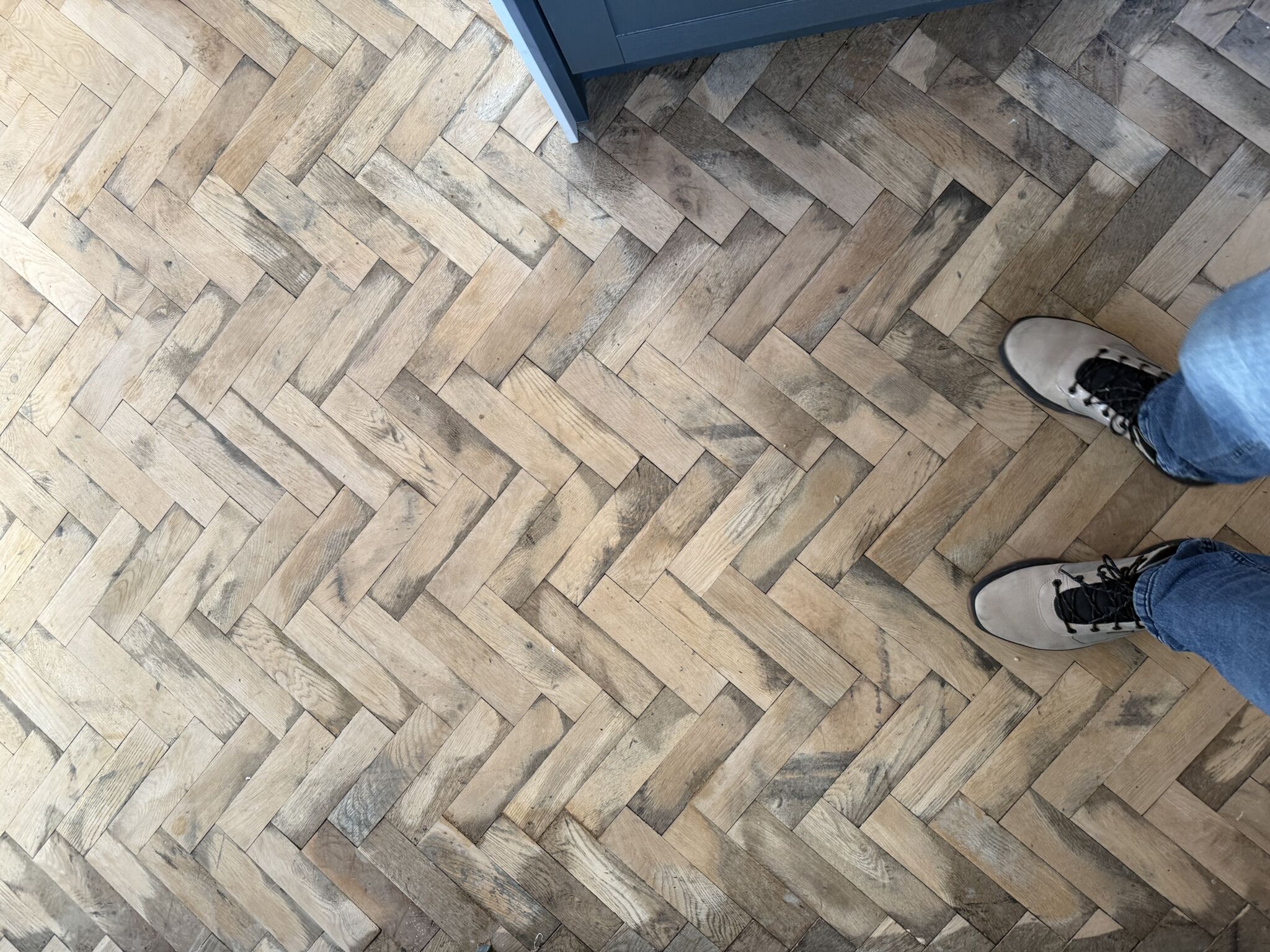
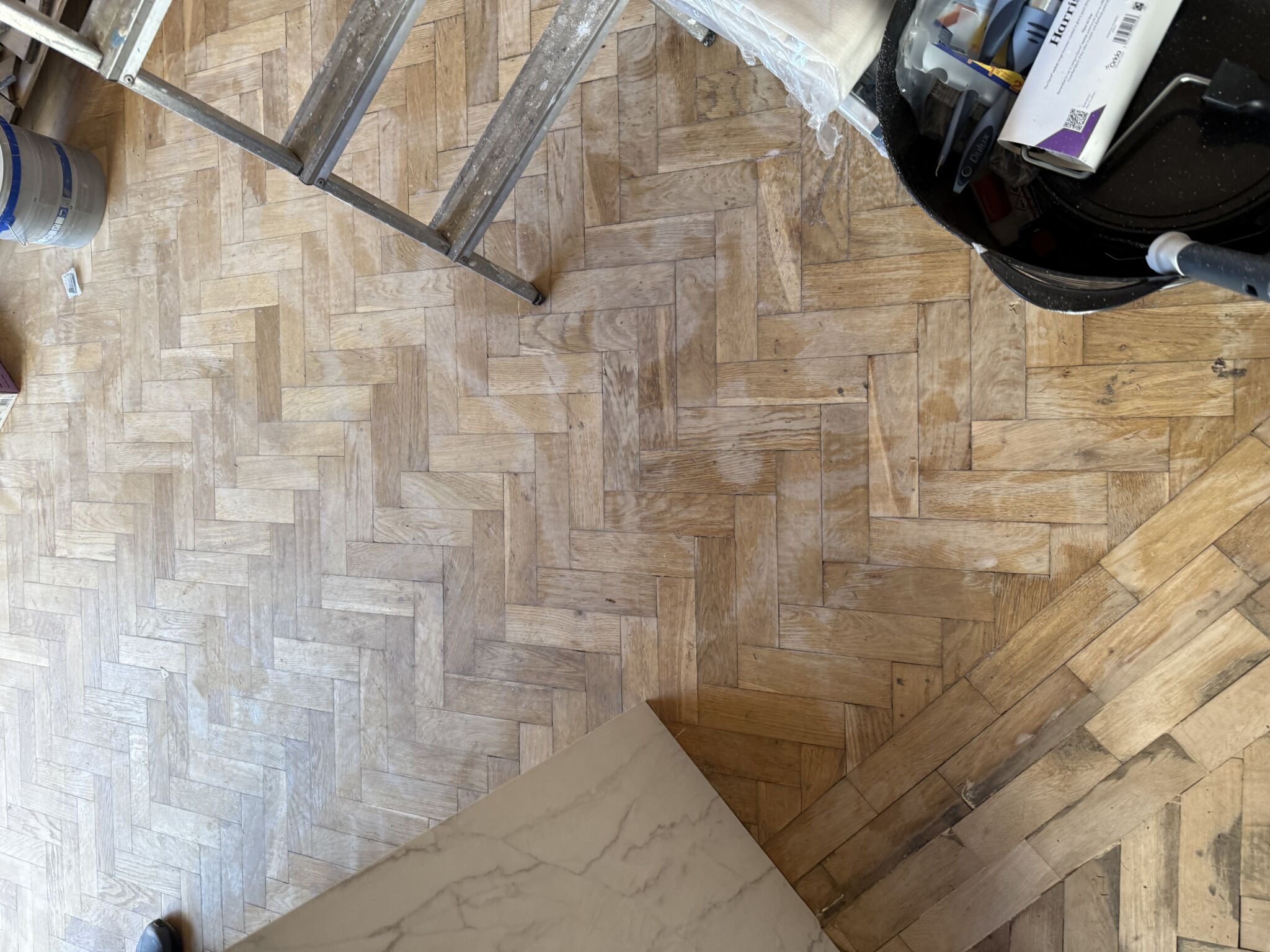
Floor condition before work, Chingford Floor condition before work, Chingford

Our Approach

Before sanding began, the gaps between parquet blocks were filled using a flexible wood filler, colour-matched to the timber to blend into the finished floor rather than read as visible repairs. Filling before sanding is important — it allows the filler to be sanded flush with the surface rather than applied as a cosmetic top-up after the fact.

With gaps filled and cured, the floor was sanded using a rotary machine working in the direction that best followed the block pattern. Parquet requires more care than straight-run floors because the blocks run in multiple directions — sanding with the wrong approach leaves visible cross-grain scratches that show clearly under lacquer. The surface was then buffed with a fine pad to create a consistent, smooth base before lacquering.

Three coats of water-based lacquer were applied, with a light sand between each coat. Water-based lacquer dries quickly, has minimal odour and does not yellow over time — practical advantages in a lived-in home.

The Result
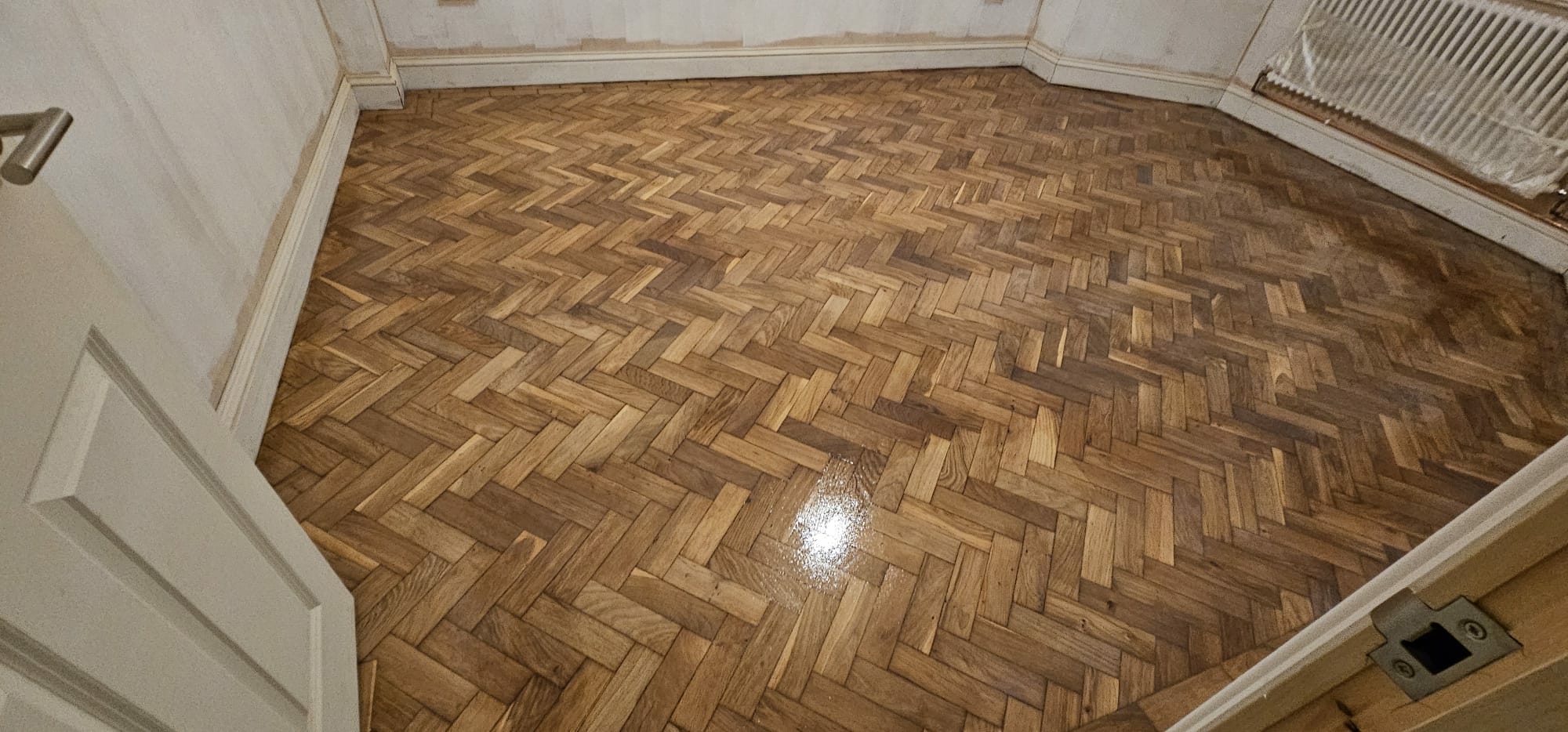
 

The restored parquet floor looks as it should — clean, even and full of the natural warmth that makes this type of floor worth preserving. The grain and colour variation across the blocks is clearly visible now that the old build-up of finish has been removed. Gaps are filled and flush, the lacquer coat is smooth and consistent, and the edges and transitions complete the room properly. All work was signed off by the client on the day. Typical costs for parquet sanding and restoration in East London range from £25 to £45 per square metre depending on block condition, gap filling requirements and finish selected.

Frequently Asked Questions

Is parquet flooring common in Chingford and the E4 area? Yes. A large proportion of properties in Chingford and across East London were built in the interwar and postwar periods, and many still have their original parquet floors beneath carpets or later coverings. These floors are almost always worth restoring — the timber is typically good quality and the blocks, once properly sanded and finished, outlast most modern flooring alternatives.

How do you fill gaps in parquet without it looking obvious? We use a flexible wood filler that is colour-matched to the species and tone of the timber. The filler is applied before sanding so it can be levelled flush with the surface during the sanding process. Under a coat of lacquer, well-matched gap filling is not noticeable at normal viewing distance.

How many times can parquet be sanded? Most original parquet blocks are thick enough to be sanded several times over their lifetime. Typical block thickness is 18 to 22mm, which allows for multiple full restorations. We check block thickness and condition during the initial survey so we can give an honest assessment before any work begins.

Do you carry out parquet restoration in Chingford and nearby areas? Yes. We work regularly across E4 and the surrounding postcodes including Highams Park, Walthamstow, Woodford and Loughton. Call us on 020 88309782 or book a free site visit to discuss your parquet floor.

Have a similar project? Call us on 020 88309782 or Book a Free Site Visit

Show more
Fitting Laminate Flooring in NW4 - Full Case Study

Before the Work The property in Hendon, NW4 had existing carpets across the rooms being fitted. These were lifted and disposed of before work began. The subfloor was checked for stability and levelness, and door frames were measured for trimming to accommodate the new floor height. All scope, materials and finishing details were agreed with the client during the initial site visit. Our Appro...

Before the Work

The property in Hendon, NW4 had existing carpets across the rooms being fitted. These were lifted and disposed of before work began. The subfloor was checked for stability and levelness, and door frames were measured for trimming to accommodate the new floor height. All scope, materials and finishing details were agreed with the client during the initial site visit.

Our Approach

The existing carpets and laminates were lifted and removed cleanly before fitting began. Door frames were undercut to allow the new boards to slide underneath for a clean finish at each doorway, and doors were trimmed to the correct clearance height. The laminate was then laid in a herringbone pattern across 19m² — a more time-intensive layout than straight laying, as each board requires precise angled cutting and positioning to keep the pattern consistent and square across the room. Beading was installed along the perimeter walls to cover expansion gaps, and thresholds were fitted at all room transitions and doorways to complete the job properly.

The Result

The finished herringbone laminate floor looks sharp and well-considered throughout. The pattern runs consistently without breaks or misalignment, edges are clean, and all transitions between rooms are neatly completed. Doors open and close correctly over the new floor height. All work was completed to specification and signed off by the client on the day. Typical costs for laminate installation in North West London range from £35 to £60 per square metre for supply and fitting, depending on pattern complexity, area size and the product selected.

Frequently Asked Questions

Is herringbone laminate a good choice for Hendon properties? It works well in the types of properties common across NW4 — whether you're updating a 1930s semi or a modern flat near Brent Cross. The pattern adds visual interest to larger open rooms and works particularly well in hallways and living areas. The main consideration is that herringbone takes longer to fit than straight laying due to the angled cuts involved, which is reflected in the labour cost.

Do door frames always need trimming when fitting laminate in NW4? Almost always, yes. Laminate boards plus underlay typically raise the floor height by 10 to 15mm. Without trimming the frames, you either lose the expansion gap or end up with a visible gap at the doorway. It is a standard part of a properly finished installation and something we include as part of the job.

How much does herringbone laminate installation cost in Hendon? For supply and fitting in the NW4 area, expect to pay between £35 and £60 per square metre depending on the product, pattern and any preparation work required. Herringbone layouts sit toward the higher end of that range due to the additional cutting and fitting time involved. We provide a full written quote after a free site visit with no obligation.

Do you work in Hendon and the surrounding NW4 area? Yes. We cover Hendon and the wider NW4 postcode regularly, including Brent Cross, Golders Green, Mill Hill and Cricklewood. Call us on 020 88309782 or book a free site visit to get a quote for your project.

Have a similar project? Call us on 020 88309782 or Book a Free Site Visit

Show more
Engineered Wood Flooring Installation in Brixton, SW9 - Full Case Study

Before the Work The property in Brixton, SW9 had carpets across the main rooms and stairs that needed to be fully lifted and disposed of before the new engineered floor could go down. Door frames were measured for undercutting to ensure the boards would slide cleanly underneath rather than butting against the architrave. The subfloor was assessed for levelness and stability, and the full scop...

Before the Work

The property in Brixton, SW9 had carpets across the main rooms and stairs that needed to be fully lifted and disposed of before the new engineered floor could go down. Door frames were measured for undercutting to ensure the boards would slide cleanly underneath rather than butting against the architrave. The subfloor was assessed for levelness and stability, and the full scope of work including stair fitting was agreed with the client before anything began.

Our Approach

The existing carpets and laminates were lifted and removed from all areas. Door frames were undercut using a flush-cut multi-tool with a board offcut as a depth guide — this gives a clean, professional finish at every doorway and avoids the need for unsightly cover strips. Doors were trimmed to the correct height to open freely over the new floor.

The engineered boards were then installed throughout the main floor areas, laid with staggered joints and expansion gaps maintained at all walls and fixed points. Beading was fitted along the perimeter to cover those gaps neatly, and thresholds were installed at all room transitions.

The stair steps were fitted with engineered wood to match the main floor, giving a continuous look from the hallway up the staircase. Stair fitting requires precise measurement and cutting at each nosing and riser — done well it ties the whole job together; done poorly, it draws the eye immediately. All trims were colour-matched to the floor throughout.

The Result

The finished engineered wood floor runs consistently from room to room and up the stairs, giving the property a cohesive, well-considered look throughout. Edges are clean, joins are tight, and every transition — whether a doorway, threshold or stair nosing — is properly finished. All work was completed to specification and signed off by the client on the day. Typical costs for engineered wood floor fitting in South London range from £35 to £60 per square metre for labour, depending on area size, complexity and whether stair fitting or additional preparation work is required.

Frequently Asked Questions

Is engineered wood a good choice for Brixton properties? It suits the mix of property types found across SW9 very well. Brixton has a large stock of Victorian and Edwardian terraces alongside converted flats and newer builds — engineered wood handles the varying subfloor conditions in these properties better than solid wood, as it is more dimensionally stable in response to changes in temperature and humidity. It also comes in a wide range of species, widths and finishes, making it easy to match the character of older period properties or complement a more contemporary interior.

Do you fit engineered wood on stairs in Brixton? Yes. Stair fitting is something we include alongside main floor installations where required. We fit engineered wood to the treads and finish the nosings and risers to match, giving a continuous look from the hallway up the staircase. It is one of those details that makes a significant difference to how the finished job reads as a whole.

How much does engineered floor fitting cost in Brixton or SW9? Labour for engineered wood installation in South London typically runs from £35 to £60 per square metre depending on the scope of work, subfloor condition and whether stair fitting or additional preparation is needed. We provide a full written quote after a free site visit so you know exactly what is included before work begins.

Do you cover Brixton and the surrounding SW9 area? Yes. We work regularly across SW9 and the surrounding postcodes including Stockwell, Clapham, Herne Hill and Streatham. Call us on 020 88309782 or book a free site visit to discuss your project.

Have a similar project? Call us on 020 88309782 or Book a Free Site Visit

Show more
Floor Sanding and Restoration in Crystal Palace, SE19 - Full Case Study

Before the Work The floorboards at this SE19 property were in mixed condition. Some sections showed standard wear — surface scratches, gaps and a finish that had dulled over years of daily use. Other sections had boards that were too damaged to restore and needed to be lifted and replaced before any sanding could take place. Crystal Palace has a high concentration of Victorian and Edwar...

Before the Work

The floorboards at this SE19 property were in mixed condition. Some sections showed standard wear — surface scratches, gaps and a finish that had dulled over years of daily use. Other sections had boards that were too damaged to restore and needed to be lifted and replaced before any sanding could take place. Crystal Palace has a high concentration of Victorian and Edwardian terraces, and original floorboards in these properties vary considerably in condition depending on how they have been maintained and what has been laid over them in the intervening decades. A thorough assessment was carried out during the initial visit to map the full extent of the work before anything was agreed or priced.

Our Approach

The damaged floorboards were lifted first and disposed of cleanly. Reclaimed floorboards were sourced and installed onto the existing joists in their place — reclaimed timber is the right choice for this type of work because it is already aged and dimensionally stable, meaning it sits naturally alongside the original boards without standing out once sanded and finished. New timber in an old floor rarely blends as well.

With the replacement boards in place and secure, gaps across the wider floor were filled using a flexible wood filler mixed with the dust from the first sanding pass — this produces a colour match that is far closer to the surrounding timber than any off-the-shelf product. The floor was then sanded progressively through finer grits, buffed smooth, and finished with three coats of water-based lacquer with a light sand between each coat.

The Result


The finished floor reads as one consistent surface throughout. The reclaimed boards sit flush with the original timber, the grain and colour variation blend naturally across the whole floor, and the lacquered finish is smooth and even from wall to wall. Edges and visible transitions were completed cleanly so the room looks properly restored rather than patched. All work was signed off by the client on the day. Typical costs for floorboard restoration including board replacement in South East London range from £25 to £45 per square metre for sanding and finishing, with board replacement quoted separately depending on the extent of work required.

Frequently Asked Questions

Are reclaimed floorboards the right choice for Victorian properties in Crystal Palace? In most cases, yes. The majority of period properties in SE19 and across Crystal Palace were built between 1880 and 1920, and their original floorboards are typically pine or Douglas fir of a width and thickness that is difficult to match with new timber. Reclaimed boards from the same era are already aged, dried and stable, which means they blend far more naturally with the surrounding original floor once sanded and finished. New timber tends to shrink slightly as it acclimatises, opening gaps that then need filling again.

Can badly damaged floorboards always be replaced rather than the whole floor? Usually, yes — provided the joists beneath are in good condition and the surrounding boards are structurally sound. Selective board replacement combined with a full sand and finish is a cost-effective way to restore a floor that has isolated areas of damage without replacing everything. We assess each case individually and will always tell you honestly if full replacement is the more practical option.

How much does floor restoration with board replacement cost in Crystal Palace? Sanding and finishing in the SE19 area typically runs from £25 to £45 per square metre. Board replacement — whether with reclaimed or new timber — is quoted as a separate cost based on the number of boards and the sourcing required. We provide a full written breakdown after a free site visit so there are no surprises on the day.

Do you cover Crystal Palace and the surrounding SE19 area? Yes. We work regularly across SE19 and the nearby postcodes including Gipsy Hill, Norwood, Penge and Sydenham. Call us on 020 88309782 or book a free site visit to discuss your floor.

Have a similar project? Call us on 020 88309782 or Book a Free Site Visit

Show more
Engineered Floor Restoration in Fulham — Full Case Study

Project Overview This project involved restoring a solid engineered oak floor in a London living room. The floor had accumulated years of daily wear — surface scratches across the main walking routes, and deeper structural damage in one concentrated spot where a large piano had stood for an extended period. The client wanted to avoid a full replacement and was keen to see how much of the or...

Project Overview

This project involved restoring a solid engineered oak floor in a London living room. The floor had accumulated years of daily wear — surface scratches across the main walking routes, and deeper structural damage in one concentrated spot where a large piano had stood for an extended period. The client wanted to avoid a full replacement and was keen to see how much of the original character could be saved.

Engineered Oak Flooring with scratches for Restoration

The Challenge

Upon inspection, the floor displayed a combination of superficial scuffs and deep gouges in high-traffic and load-bearing areas. The most significant damage was located beneath the piano, where the legs had left visible, concentrated indentations over time.

Engineered flooring comes with a wear layer of varying thickness — typically between 3mm and 6mm on quality boards. Before any sanding begins, that wear layer has to be measured carefully. Sand too aggressively and you risk breaking through to the core. The piano indentations added a further complication: simple sanding alone would not be enough to level them out.

Deep Scratches on Oak Engineered Flooring Fixed by FlooringFirst

Our Approach

We started with a detailed inspection under raking light to map every scratch, scuff, and indentation. This let us prioritise areas that needed filler work before sanding started.

The piano leg depressions were treated first. We applied a two-part wood filler, colour-matched to the oak, building it slightly proud of the surface so that subsequent sanding could bring it flush. The filler was left to cure fully — rushing this step leads to shrinkage and a visible repair. Once set, we feathered the edges with a detail sander so the repair blended into the surrounding grain.

With the deep repairs done, we moved to the main floor. We used a Bona belt sander with a fine-to-medium sequence, working with the grain throughout. Because engineered wear layers are thinner than solid wood, we kept passes controlled and checked depth regularly. The surface scratches came out cleanly through this process.

After sanding, we buffed the entire floor with a fine mesh pad to create a consistent surface ready for finishing. The client opted for a mid-sheen water-based lacquer, which was applied in three coats with light sanding between each. Water-based products dry quickly, have low odour, and do not yellow over time — a practical choice for a frequently used living room.

Newly Restored Engineered Oak Flooring

The Result

Following the restoration, the floor exhibited a dramatic improvement in both appearance and feel underfoot. All surface scratches were eliminated, and the areas previously damaged by the piano legs were expertly filled and blended to match the surrounding finish.

The client commented that the floor looked better than it had in years. Total project time was two days: one for repairs and sanding, one for the three lacquer coats. The floor was ready for light use 24 hours after the final coat.

Frequently Asked Questions

How many times can engineered flooring be sanded?
That depends on the thickness of the wear layer. Most quality engineered boards have a 3mm to 6mm layer, which allows between one and three full sandings. Boards with a 2mm layer can usually only be lightly buffed rather than properly sanded. We always check wear layer depth before quoting, so there are no surprises.

Can piano or heavy furniture indentations be repaired without replacing boards?
In most cases, yes. If the indentation has not cracked the board or compressed the wood fibres beyond repair, a two-part filler approach works well. The repair is not invisible under close inspection, but at standing height and in normal light it is not noticeable. If the board is severely crushed, board replacement is the cleaner option.

What does engineered floor restoration cost in Fulham?
For a standard living room, floor sanding and restoration typically runs between £25 and £45 per square metre in London, depending on the condition, finish choice, and whether any board repairs are needed. Repair work such as filler treatment for deep marks is usually quoted as a separate fixed cost on top of the sanding rate.

Have a similar project? Call us on 020 88309782 or Book a Free Site Visit

Show more
Parquet Restoration in Kensington — Full Case Study

Project Overview This restoration project covered two distinct and historically significant parquet styles in a single property: Versailles oak panels and walnut mosaic finger parquet. Both required careful, sympathetic treatment to bring them back to the standard the client expected. Projects combining different parquet formats are less common and require switching approach mid-job, so planning ...

Project Overview

This restoration project covered two distinct and historically significant parquet styles in a single property: Versailles oak panels and walnut mosaic finger parquet. Both required careful, sympathetic treatment to bring them back to the standard the client expected. Projects combining different parquet formats are less common and require switching approach mid-job, so planning was essential before work began.

Worn Walnut Mosaic Fingers Before Restoration

The Challenge

The original flooring comprised two distinct styles: a classic walnut mosaic finger parquet and elegant Versailles oak panels. Over time, both had suffered noticeable wear and tear, diminishing their visual appeal and structural integrity.

In the walnut mosaic area, the surface showed multiple scuff marks and scratches, with visible dullness due to accumulated grime and fading finish. The parquet blocks had shifted slightly in places, and some sections were uneven or loose, clear signs of age and prolonged use.

The Versailles panels presented a different set of problems. The geometric pattern of these panels means that sanding must follow the grain of each section separately, or cross-grain scratches become visible in the finish. Previous coats of finish had also darkened unevenly, making some sections appear blotchy.

Scratches on Versailles Panels before Restoration

Our Approach

We began with the walnut mosaic area. Loose and shifted blocks were lifted, cleaned, and re-glued with a suitable parquet adhesive before anything else happened. Trying to sand over a loose or uneven block risks catching the sander and damaging the block edge, so this preparation step was not optional.

Once the blocks were secure and adhesive cured, we sanded the walnut mosaic using a rotary machine fitted with fine abrasive, working in the direction that best followed the finger pattern. Walnut is a dense hardwood and holds its grain well, so it responds cleanly to careful sanding. The surface came up with good colour contrast and natural depth.

The Versailles panels were handled differently. We used a combination of a drum sander along the main grain direction and a detail sander for the internal mitre sections of each panel. This takes longer than sanding a straight-run floor, but it is the only way to avoid visible scratch patterns across the grain. Each panel was treated individually and checked before moving on.

Both floor areas were finished with a hard-wax oil chosen to complement the different tones of oak and walnut without making one look artificially darker than the other. Two coats were applied, with a light buff between coats.

Amazing Result after FlooringFirst brought new life to this floor

The Result

Following a complete restoration process, the transformation of both the Walnut Mosaic Finger Parquet and the Versailles Oak Panels is nothing short of remarkable. The walnut mosaic flooring has been revived with renewed depth and richness. Each individual finger block was cleaned, re-secured, and refinished, restoring the natural warmth and contrast of the walnut grain. The surface is now smooth, even, and finished with a durable, low-sheen protective coat that improves both appearance and longevity.

The Versailles panels, meanwhile, regained their geometric clarity and the warm honey tones that define good-quality oak. The client described it as looking "the way it must have looked when it was first laid."

Frequently Asked Questions

Can walnut parquet and oak Versailles panels be finished with the same product?
It depends on the desired result. Walnut is naturally darker than oak, so the same oil or lacquer will read differently on each. We typically choose a neutral or lightly tinted finish that works across both species, then adjust by applying an additional coat to the lighter areas if needed to balance the tones.

How do you handle loose parquet blocks before sanding?
Loose blocks are lifted, the old adhesive is cleaned from both the block and the subfloor, and they are re-glued with a specialist parquet adhesive. We then weight them and allow full cure time before sanding. Sanding over loose blocks causes uneven results and can crack the block edges.

What does parquet restoration cost in Kensington?
Parquet sanding and finishing runs from around £30 to £50 per square metre in Kensington, depending on species, pattern complexity, and condition. Versailles panels and other geometric formats typically fall at the higher end because of the time required to sand them correctly without cross-grain marks.

Have a similar project? Call us on 020 88309782 or Book a Free Site Visit

Show more
Fitting Engineered Wood Flooring in South Kensington, SW7 - Full Case Study

Before the Work The property in South Kensington, SW7 had existing hardwood flooring across the rooms being refitted. This was lifted and disposed of before the new installation began. South Kensington properties are predominantly large Victorian and Edwardian terraces and mansion flats where original subfloors can be uneven and require careful preparation before any new floor goes down. The subf...

Before the Work

The property in South Kensington, SW7 had existing hardwood flooring across the rooms being refitted. This was lifted and disposed of before the new installation began. South Kensington properties are predominantly large Victorian and Edwardian terraces and mansion flats where original subfloors can be uneven and require careful preparation before any new floor goes down. The subfloor was assessed for levelness and stability, furniture was relocated from the working areas, and the full scope of work including underlay specification, beading and thresholds was agreed with the client during the initial visit.

Our Approach

Furniture was moved safely from the working areas before any lifting began. The existing hardwood flooring was lifted and disposed of cleanly, giving full access to the subfloor beneath. The subfloor was checked and prepared to ensure it was flat, dry and suitable for the new installation.

Duralay Timbermate Excel Silver underlay was laid across 15 square metres before board fitting. This is a quality 3.6mm wood floor and laminate underlay that provides good sound reduction, thermal insulation and helps bridge minor subfloor imperfections — a sensible specification for a property of this type where noise transmission between floors is a common consideration.

The engineered boards were then fitted over the underlay, with staggered joints and expansion gaps maintained at all walls and fixed points. Beading was installed along the perimeter to cover the expansion gaps cleanly, and thresholds were fitted at all room transitions and doorways to complete each junction properly. All furniture was returned to its position once the floor was ready.

The Result

Completed floor, South Kensington Completed floor, South Kensington

The finished engineered floor sits flat, stable and consistent throughout the property. The beading and thresholds give the installation a properly completed appearance, and the Duralay underlay provides a noticeably solid, well-cushioned feel underfoot. All work was completed to specification and signed off by the client on the day. Typical costs for engineered wood floor fitting in South Kensington range from £35 to £60 per square metre for labour, depending on area size, complexity and preparation required.

Frequently Asked Questions

Is engineered wood a good choice for South Kensington properties? It is one of the most practical choices for the type of properties found across SW7. Victorian and Edwardian terraces and mansion flats in South Kensington typically have original timber subfloors that have moved and settled over more than a century — engineered wood handles this far better than solid wood due to its greater dimensional stability. It also comes in wide plank formats and a range of oak species and finishes that complement the scale and character of period rooms well.

Do you need specialist underlay in older SW7 properties? A good quality underlay makes a significant difference in older properties, particularly in mansion flats and converted terraces where sound transmission between floors is a genuine concern. Duralay Timbermate Excel Silver provides meaningful sound reduction alongside its thermal and levelling properties, and is a specification we recommend regularly for properties of this type in South Kensington and the surrounding area.

How much does an engineered floor fitting cost in South Kensington? Labour for engineered wood installation in SW7 typically ranges from £35 to £60 per square metre, depending on the scope of work, subfloor condition and any preparation required. Underlay, beading and thresholds are included in our quotes so there are no hidden costs. We provide a full written quote after a free site visit with no obligation.

Do you cover South Kensington and the surrounding SW7 area? Yes. We work regularly across SW7 and the nearby postcodes, including Chelsea, Knightsbridge, Earls Court and Kensington. Call us on 020 88309782 or book a free site visit to discuss your project.

Have a similar project? Call us on 020 88309782 or Book a Free Site Visit

Show more
Vinyl Flooring Installation in Hendon, NW4 - Full Case Study

This project involved floor sanding and restoration at a property in NW4, NW4 1SA. The client required a professional service and chose us after reviewing local options. Work was carried out by our experienced team with minimal disruption to the household. Before the Work The property in Hendon, NW4 required a thorough assessment before any work could begin. Several floorboards had shifted...

This project involved floor sanding and restoration at a property in NW4, NW4 1SA. The client required a professional service and chose us after reviewing local options. Work was carried out by our experienced team with minimal disruption to the household.

Before the Work

Floor condition before work, NW4

Floor condition before work, NW4

The property in Hendon, NW4 required a thorough assessment before any work could begin. Several floorboards had shifted and were flexing underfoot, the fireplace hearth sat proud of the surrounding floor level, and surface damage was visible across the main walkways. Floor condition, subfloor stability and the full scope of work were agreed with the client during the initial site visit before anything was touched.

Our Approach

We started by refitting and re-gluing the loose floorboards, bringing them back flush and securing them properly. The boards were then sanded level with the surrounding floor areas to remove the height differences that had built up over time. The fireplace hearth was treated with a self-levelling compound to bring it flush with the rest of the room — a critical step to prevent the vinyl from bridging or cracking at that transition point. Once the subfloor was flat, stable and consistent throughout, we laid the new vinyl using Osmo MS TRADE Wood Flooring Adhesive, a professional-grade product that provides a firm, flexible bond well suited to older timber subfloors. All edges and transitions were finished cleanly throughout.

The Result

The finished floor is flat, stable and consistent from wall to wall. The vinyl sits without movement or bridging, the fireplace hearth transitions cleanly into the main floor, and the previously loose boards are secure and silent underfoot. All work was completed to specification and signed off by the client on the day with no snagging required. Typical costs for this type of combined subfloor preparation and vinyl installation in North West London range from £25 to £45 per square metre, depending on area size, condition and the vinyl product selected.

Frequently Asked Questions

Does vinyl need a perfectly flat subfloor? Yes. Vinyl will follow the shape of whatever is underneath it. Any unevenness, board edges or level changes will show through over time, and high spots will cause premature wear. Proper subfloor preparation is what determines how long the finished floor lasts.

Can loose floorboards be fixed without replacing them? In most cases, yes. Where boards have simply shifted or the adhesive has failed, re-gluing and re-securing them is usually sufficient. Boards that are split, badly warped or structurally compromised may need replacing, but this is less common than it appears.

How much does vinyl floor installation cost in Hendon or NW4? For a project involving subfloor preparation and vinyl installation in North West London, costs typically range from £25 to £45 per square metre, depending on the extent of preparation work, area size and the vinyl product selected. We provide a full written quote after a free site visit with no obligation.

Do you cover Hendon and nearby areas? Yes. We work regularly across NW4 and the surrounding postcodes including Brent Cross, Golders Green, Mill Hill and Cricklewood. Call us on 020 88309782 or book a free site visit to discuss your project.

Have a similar project? Call us on 020 88309782 or Book a Free Site Visit

Show more
Replacement and Fitting of Engineered Wood in Aldgate, E1 — Full Case Study

Project Overview This project involved the professional installation of engineered wood flooring at a property in Aldgate, E1. The client required a quality floor that would stand up to daily use and complement their interior. Our fitting team assessed the subfloor condition, carried out any necessary preparation work, and fitted the new floor to a high standard. Before the Work Prior to inst...

Project Overview

This project involved the professional installation of engineered wood flooring at a property in Aldgate, E1. The client required a quality floor that would stand up to daily use and complement their interior. Our fitting team assessed the subfloor condition, carried out any necessary preparation work, and fitted the new floor to a high standard.

Before the Work

Prior to installation, the existing floor covering was inspected and the subfloor was prepared to ensure it was flat, dry, and suitable for the new engineered wood. Any existing floor covering was lifted and disposed of cleanly before the fitting work began.

Survey photos showing the floor condition before work:

Floor condition before work at E1 Floor condition before work at E1 Floor condition before work at E1

Our Approach

The following services were carried out as part of this project:

  • Engineered Flooring Installation
  • Lift Existing Flooring
  • Skirting Supply & Delivery

The Result

The completed engineered wood installation looked clean and finished throughout. Joins are tight, edges are neat, and the floor sits flat and stable. Beading and threshold strips were fitted where required to complete the job properly. The client was pleased with both the quality of the work and the appearance of the new floor.

Photos of the completed work:

Engineered Wood floor after fitting work in E1 Engineered Wood floor after fitting work in E1 Engineered Wood floor after fitting work in E1

Frequently Asked Questions

How long does engineered wood installation take?
Most fitting jobs are completed within one to two days. Larger areas or more detailed layouts such as herringbone patterns take longer due to the additional cutting and positioning involved.

Do I need underlay?
Yes, underlay is required for most floor types and helps with insulation, sound deadening, and levelling minor subfloor imperfections. We can supply and fit appropriate underlay as part of the installation.

How much does floor fitting cost in London?
Fitting costs typically range from £35 to £60 per square metre depending on floor type and complexity. We provide a full written quote before starting any work.

Have a similar project? Call us on 020 88309782 or Book a Free Site Visit

Show more
Engineered Wood Floor Fitting in Camden Town — Full Case Study

Project Overview A residential property in Camden Town needed new flooring throughout several rooms. The existing floor was outdated and in poor condition, and the client had selected an engineered wood product to replace it. The brief included removing the old floor, preparing the subfloor, fitting the engineered boards, and completing all the finishing details: door frame trimming, beading alon...

Project Overview

A residential property in Camden Town needed new flooring throughout several rooms. The existing floor was outdated and in poor condition, and the client had selected an engineered wood product to replace it. The brief included removing the old floor, preparing the subfloor, fitting the engineered boards, and completing all the finishing details: door frame trimming, beading along the walls, and thresholds at room transitions.

Engineered Wood Floor Installation 1

The Challenge

The rooms originally had an outdated and worn floor that no longer matched the desired aesthetic. The space lacked a smooth transition between areas, and the doors and frames required adjustments to accommodate the newly engineered flooring. Additionally, without proper beading and thresholds, the edges of the room felt unfinished.

To begin the transformation, we carefully assessed the space, ensuring the subfloor was suitable for engineered flooring installation. The door frames and doors needed trimming to ensure a perfect fit once the new floor was in place. Without these adjustments, the new flooring would not have lain flat, leading to an uneven and impractical finish.

Camden Town properties are often older period buildings with subfloors that have settled unevenly over time. This one was no exception. Before any boards could go down, the subfloor had to be checked with a long straight-edge and any high spots ground back and low spots filled with a self-levelling compound.

Engineered Wood Floor Installation 2

Our Approach

Old flooring was carefully lifted and removed first. We checked for any damaged or soft sections in the subfloor and made repairs before proceeding. The self-levelling compound was mixed and poured, then left to set overnight.

Door frames were undercut using a multi-tool with a flush-cut blade, with a spare board offcut used as a depth guide. This ensures the board slides neatly under the frame rather than butting against it, which gives a much cleaner look at doorways. The doors themselves were also trimmed to account for the new floor height.

Engineered boards were then laid floating over a foam underlay, starting from the most prominent wall and working across the room. Each row was staggered at least 300mm from the previous to avoid any H-joint pattern forming. Expansion gaps were maintained at all walls and fixed points.

Once the boards were down, Scotia beading was fitted around the perimeter to cover the expansion gaps. At doorways, transition thresholds were fitted to bridge the level change between rooms. All trims were colour-matched to the floor where possible.

Engineered Wood Floor Installation 5

The Result

The engineered flooring installation completely revitalised the space. Each plank was carefully placed, ensuring a smooth and uniform appearance that improved the room's warmth and feel underfoot. The engineered wood provides a durable, practical foundation that suits everyday life while still looking good.

The doors and frames were trimmed to align perfectly with the new flooring height, creating clean transitions between rooms. Beading was installed along the edges, covering expansion gaps with a neat finish. Thresholds at room boundaries completed the job, giving a consistent and well-finished result throughout.

Frequently Asked Questions

How long does engineered floor installation take in a typical Camden Town flat?
A two-to-three bedroom flat typically takes two to three days: one day for subfloor preparation and one to two days for fitting, depending on the complexity of the layout and how many doorways, alcoves, or obstacles need working around.

Do door frames always need trimming when fitting new flooring?
Almost always, yes. Adding a new floor raises the height by the thickness of the board plus underlay, usually around 12 to 15mm. Without trimming the frames, you either leave an ugly gap at the doorway or the board cannot slide under and you lose the expansion gap. Undercutting the frames is standard practice and a clean way to handle it.

What does engineered floor fitting cost in Camden Town?
Fitting rates in North London typically run between £35 and £55 per square metre for labour only, not including materials. That covers subfloor preparation, laying, door trimming, beading, and thresholds. The board itself is a separate cost and varies widely by product.

Have a similar project? Call us on 020 88309782 or Book a Free Site Visit

Show more
  • 1
  • 2
  • 3
  • 4
  • 5
  • 6
  • 7
  • 8
  • 9
  • 10
  • 11
  • 12
  • 13
  • 14
  • 15
  • 16
  • 17
  • 18
  • 19
  • 20
  • 21
  • 22
  • 23
  • 24
  • 25
  • 26
  • 27
  • 28
  • 29
  • 30
  • 31
  • 32
  • 33
  • 34
  • 35
  • 36
  • 37
  • 38
  • 39
  • 40
  • 41
  • 42
  • 43
  • 44
  • 45
  • 46
  • 47
  • 48
  • 49
  • 50
  • 51
  • 52
  • 53
  • 54
  • 55
  • 56
  • 57
  • 58
  • 59
  • 60
  • 61
  • 62
  • 63
  • 64
  • 65
  • 66
  • 67
  • 68
  • 69
  • 70
  • 71
  • 72
  • 73
  • 74
  • 75
  • 76
  • 77
  • 78

Our Flooring Company

Contacts & Showroom Book Free Site Survey About Our Flooring Company Join Our Team Work as a Contractor

Service Information

Terms of Service Terms of Sales Deliveries & Charges Cookie Settings Returns Policy Privacy Policy

Help

FAQs Case Studies Sitemap Glossary
𝕏
FlooringFirst! Services
158 Coles Green Road
London, NW2 7HW
T: 020 88309782
Floor Sanding Services: Central London, East London, Near London, North London, Northwest London, Southeast London, Southwest London, West London
Wood Floor Installation Service: Central London, East London, Near London, North London, Northwest London, Southeast London, Southwest London, West London

  • Flooring Services
  • Floor Sanding
    • Wood Floor Staining
    • Wood Floor Gap Filling
    • Commercial Floor Sanding
    • Engineered Floor Sanding & Refinishing
  • Wood Floor Fitting
    • Parquet Floor Installation
    • Laminate Floor Installation
    • Engineered Wood Floor Installation - Supply & Fit
    • Solid Wood Floor Fitting - Supply & Fit
    • LVT Floor Installation - Supply & Fit
  • Floor Repairs
    • Parquet Floor Repair and Restoration
    • Engineered Wood Floor Repairs
    • Wood Floor Scratch Repair
    • Floorboards Replacement
  • Care & Maintenance
    • Re-Oiling & Recoating Oiled Floors
    • Vinyl & Linoleum Cleaning
    • Hardwood Floor Buffing
    • Wood Floor Polishing
  • Shop
  • Shop
  • Gallery
  • Service Guide
  • Bookings
  • Book Free Survey
  • Service Advice
  • Product Advice