Back to Floor Sanding
Can You Sand a Wood Floor Over Underfloor Heating?
Yes, a wood floor over underfloor heating can be sanded — but the process needs more care than sanding a standard floor, because the heating system itself changes how the wood behaves before, during, and after the work. Get the timing and preparation wrong and you risk gaps, cracking, or a finish that doesn't cure properly. For a broader look at how the process works in general, our floor sanding London overview is a useful starting point alongside this guide.
Why Underfloor Heating Changes the Process
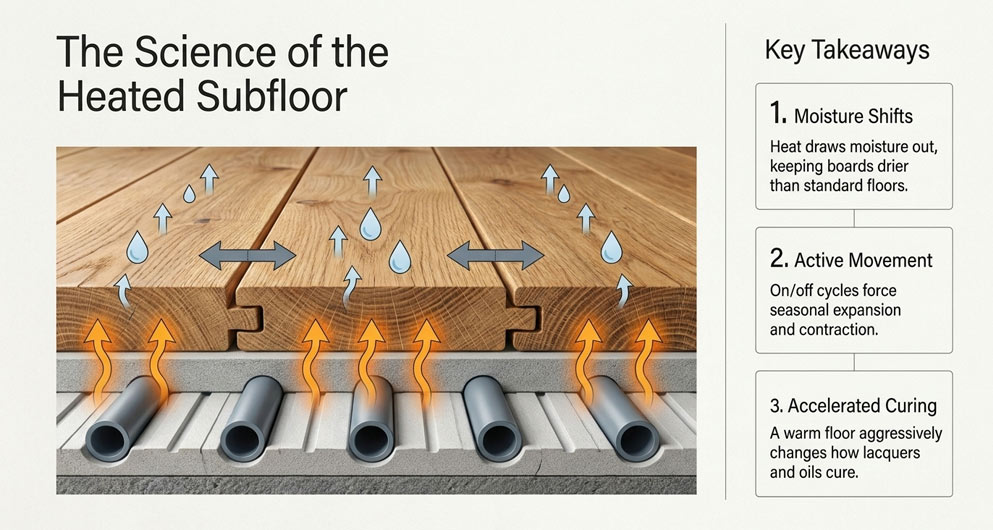
Wood is constantly reacting to temperature and moisture, and underfloor heating puts it through a more consistent, more direct heat cycle than most floors experience. That has a few knock-on effects worth understanding before any sanding work begins:
The wood's moisture content shifts with the heating cycle. Boards over active underfloor heating naturally sit slightly drier than boards over an unheated subfloor, because the heat draws moisture out of the timber from below. This affects how the wood behaves during sanding and how a finish cures once applied.
Boards move more than usual with heating cycles. Turning the system on and off, or adjusting it seasonally, causes the wood to expand and contract more than a floor without underfloor heating beneath it. This is normal, but it means gap filling and finish choice both need to account for a floor that moves more than most.
Heat affects finish curing times. A warm floor changes how quickly a lacquer, oil, or hard-wax finish cures, which matters both for getting an even result and for knowing how long to leave the heating off after the job.
None of this means sanding over underfloor heating is a problem — it's done routinely — but it does mean the standard process needs a few extra steps built in.
Is Your Floor Suitable for Sanding?
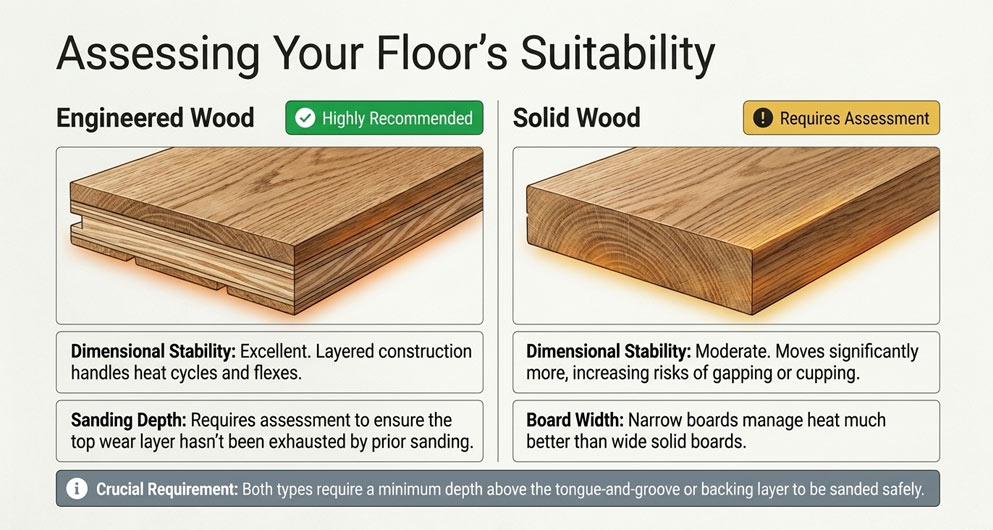
Engineered wood floors are generally the better-suited option over underfloor heating. Their layered construction gives them more dimensional stability than solid wood, meaning they cope better with the repeated expansion and contraction that comes with a heating cycle. Most engineered floors have a wear layer thick enough to be sanded and refinished at least once, sometimes more, depending on the original specification — you can read more about how we approach sanding engineered wood floors specifically.
Solid wood floors can also be sanded over underfloor heating, but they move more than engineered boards do, which increases the risk of gapping or, in more extreme cases, cupping if temperature and moisture aren't properly managed. Narrower boards generally cope better with underfloor heating than wide solid boards, since the movement across a narrower board is smaller in absolute terms.
Either way, the floor's wear layer or overall board thickness needs enough depth remaining to sand safely without going through to the tongue-and-groove or backing layer — something worth having properly assessed before work begins, particularly if the floor has been sanded before.
Before Sanding: Preparing the Floor and the Heating System
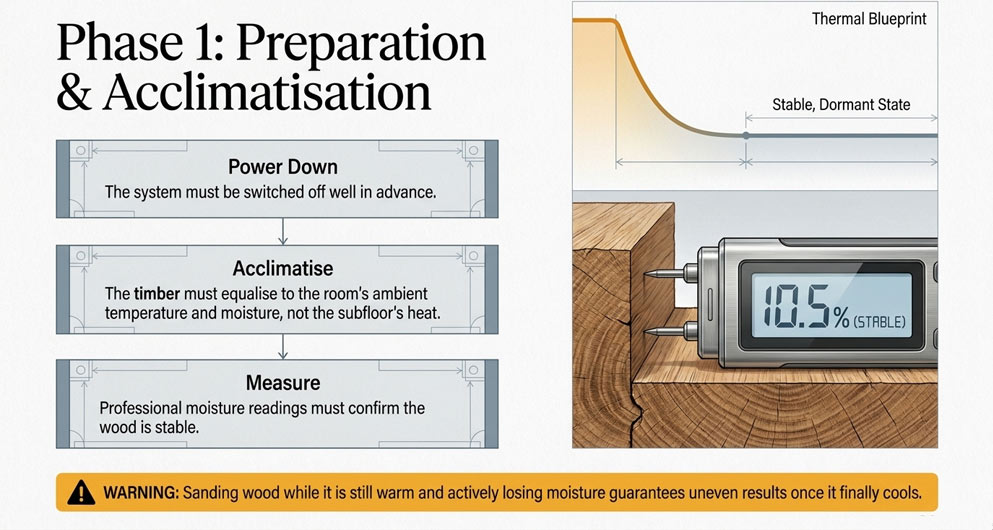
Turn the heating off in advance. The system should be switched off and the floor allowed to cool and stabilise before sanding starts — this is one of the most important steps, since sanding a floor that's still warm and actively losing moisture can lead to an uneven result once the floor fully settles afterwards.
Give the floor time to acclimatise. Rather than sanding immediately after switching the heating off, the floor needs time to reach a stable temperature and moisture level consistent with the room, not just the heated subfloor beneath it.
Check moisture levels before starting. A professional assessment at this stage should confirm the wood's moisture content is within a safe, stable range for sanding, rather than assuming the floor is ready simply because the heating has been off for a set period.
During Sanding
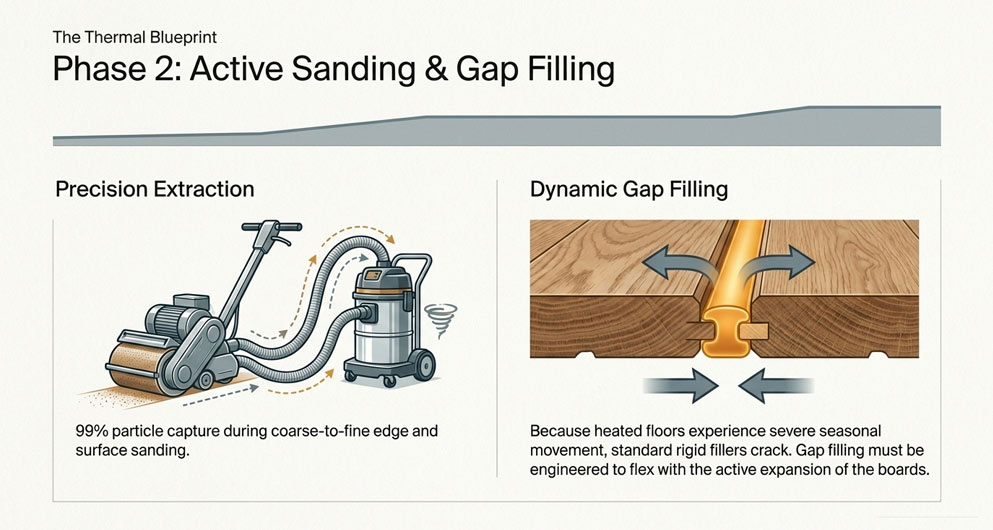
The sanding process itself follows the same general approach as any wood floor — coarse to fine grits, edge sanding to match the main floor area, and dust-free sanding throughout, capturing up to 99% of particles. The main difference is being mindful of the floor's current moisture state and not assuming it will behave identically to a floor without underfloor heating beneath it, particularly around board edges where movement is most noticeable.
Standard gap filling between floorboards is applied where needed once sanding is complete, but because floors over underfloor heating move more through the seasons, gap filling here needs to account for a floor that will keep experiencing seasonal movement more actively than a standard floor would.
Choosing a Finish Suitable for Underfloor Heating
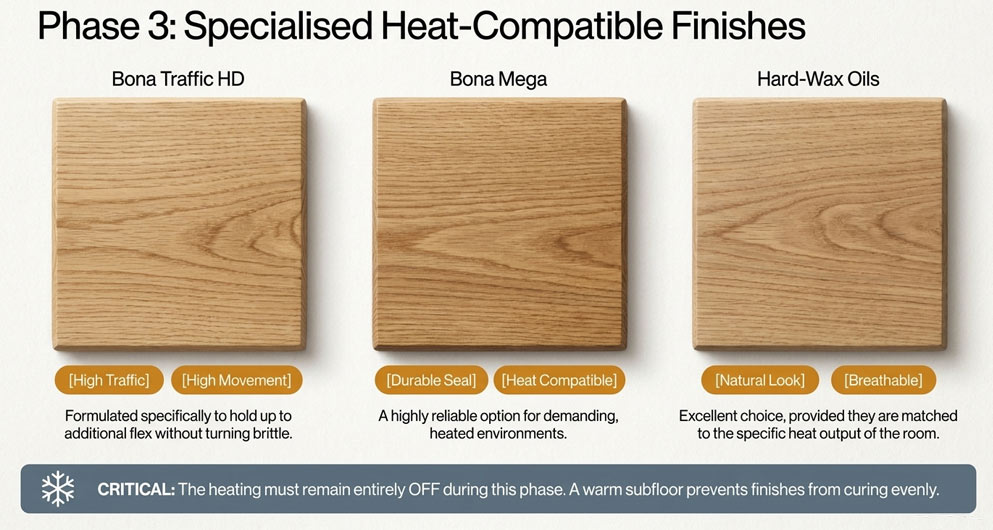
Not every finish is well-suited to a floor that will be regularly heated from below, since some can become brittle or lose adhesion with repeated heat cycles. Finishes such as Bona Traffic HD are specifically formulated to cope with higher-traffic, higher-movement floors and are a common choice for underfloor-heated rooms because of how well they hold up to the additional flex. Bona Mega is another option used on floors that need a durable, heating-compatible seal. A hard-wax oil finish can also work well, provided it's suited to the specific heating and usage conditions of the room.
Whichever finish is used, drying and curing times are affected by the fact the heating needs to stay off during this stage — a warm subfloor can interfere with a finish curing evenly, so the system typically needs to remain off through the full drying period, not just during the sanding itself.
After Sanding: Bringing the Heating Back On
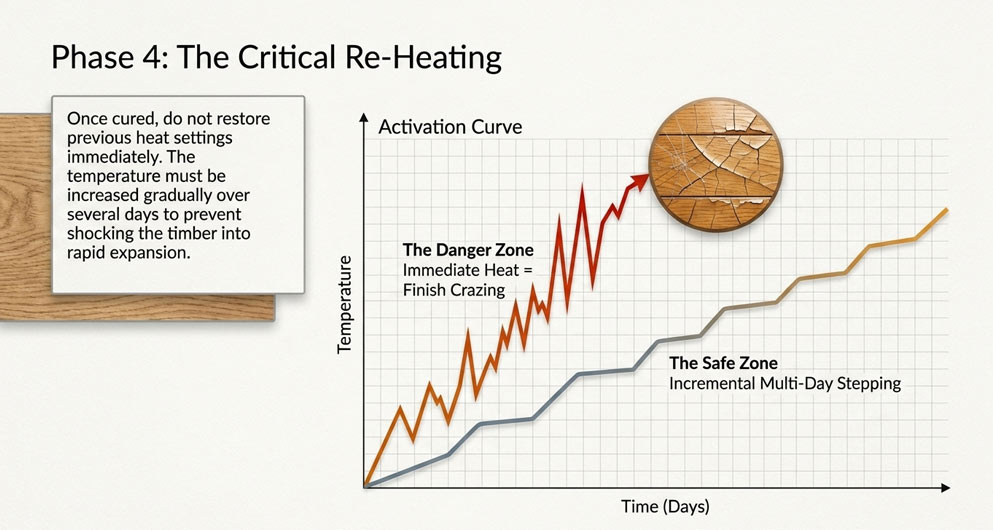
This is the step that catches people out most often. Once the finish has fully cured, the heating shouldn't simply be switched back on to its previous setting straight away. Gradually increasing the temperature over several days, rather than restoring full heat immediately, gives the wood and the new finish time to adjust without shocking the boards into rapid expansion. Turning the heating up too quickly after refinishing is one of the more common causes of cracking or an uneven finish shortly after a sand.
Common Problems If the Process Is Rushed
- Gapping that's more pronounced than expected, if the floor wasn't given proper time to stabilise before sanding
- An unevenly cured finish, if the heating was switched back on before the finish had fully hardened
- Cracking or crazing in the finish, typically from bringing the heating back up too quickly rather than gradually
- Sanding through the wear layer, particularly on engineered floors that have already been sanded once or twice before
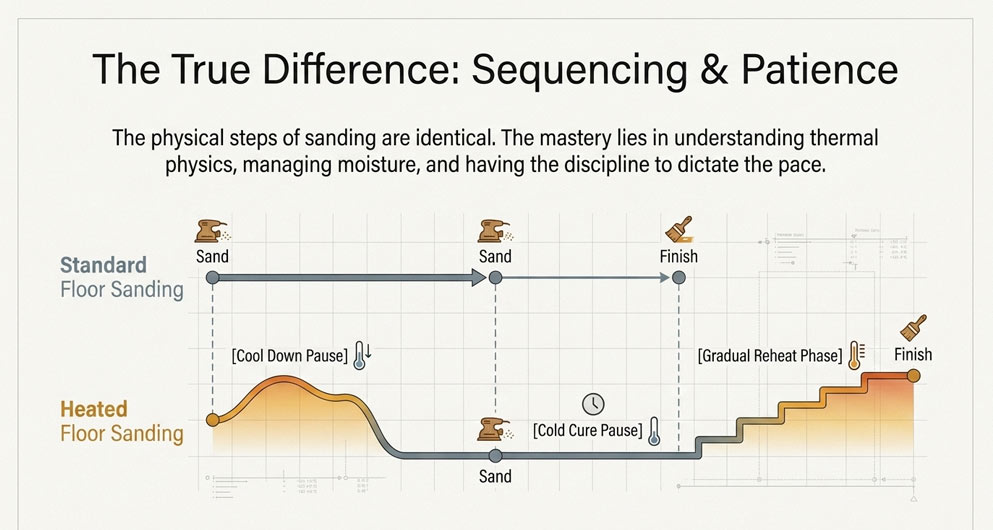
Each of these is avoidable with the right preparation and timing, which is really the core difference between sanding a floor over underfloor heating and sanding a standard floor — the steps are largely the same, but the sequencing and patience required are not.
Getting It Assessed Properly
Because moisture content, board type, and finish choice all need to work together on a floor with underfloor heating, this is a job where a proper in-person assessment makes a real difference to the result. We'll check your floor's suitability, moisture levels, and existing wear layer, and talk you through the right finish and timing for your specific system before any sanding begins. You can see examples of completed projects in our floor sanding gallery for a sense of the finished results.
Get your free quote — call 020 8830 9782 to arrange an assessment for your underfloor-heated floor.