Project Overview
A client in Peckham wanted parquet flooring fitted in their living space. The project covered subfloor preparation, door frame trimming, laying the parquet blocks in pattern, fitting beading around the perimeter, and installing thresholds at room transitions. It was a complete installation from an empty room with an uneven substrate through to a finished floor ready for use.
The Challenge
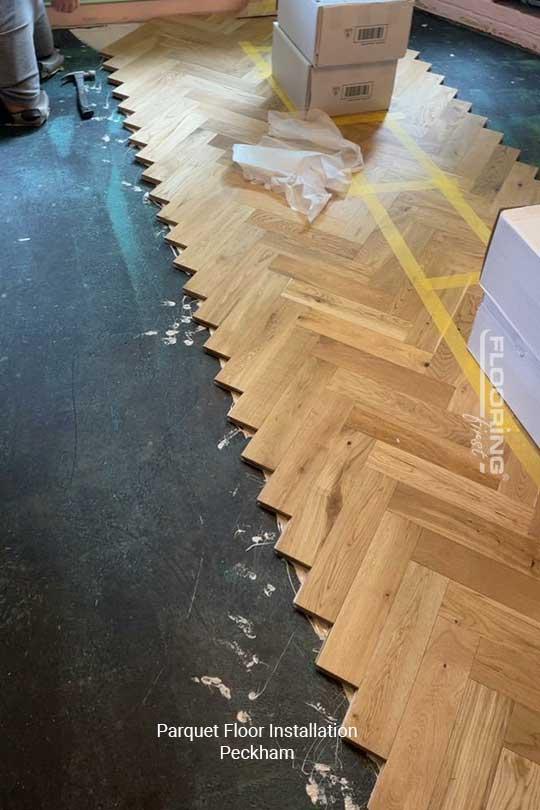
The room initially presented a variety of challenges that needed addressing before achieving the desired parquet floor. The subfloor was in less-than-ideal condition, uneven and in need of thorough preparation. The doors and their frames were not properly aligned with the intended flooring height, which would have created an unsightly and impractical result.
Parquet blocks are typically 15 to 22mm thick and are glued directly to the subfloor. Any unevenness in the subfloor transmits directly to the surface of the finished floor, creating peaks and hollows that are visible and will cause wear patterns to develop quickly at high points. Getting the subfloor flat before laying is not optional — it determines the quality of everything that follows.
Our Approach
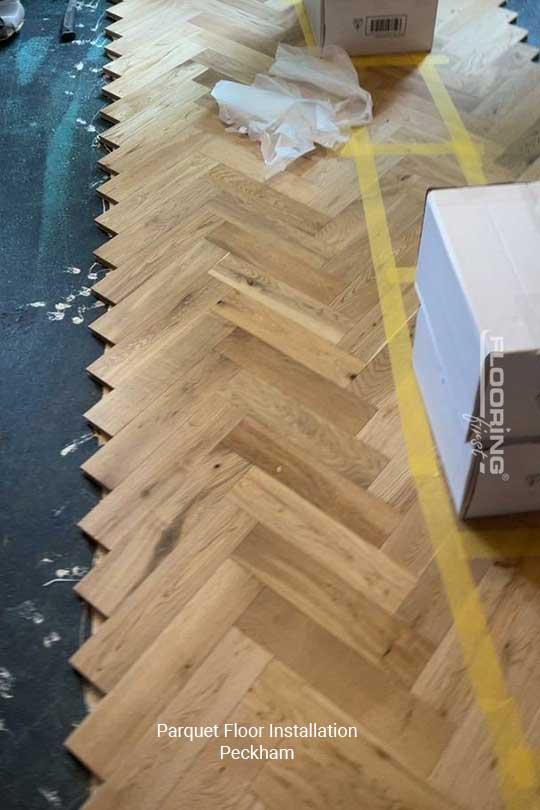
Subfloor preparation was the first phase of work. We checked the floor with a long straight-edge, marking high and low spots. Ridges and bumps were ground back and low areas were filled with a floor levelling compound, which was mixed and poured in sections, feathering at the edges for a gradual transition. We allowed this to cure overnight before proceeding.
Door frames were undercut using an oscillating multi-tool with a flush-cut attachment, with a block offcut used as a guide to set the correct height. This step is important: it allows the parquet blocks to slide neatly under the architrave rather than leaving a visible gap at the doorway. The doors themselves were also trimmed to clear the new floor height.
With the subfloor ready and doorways prepared, block laying began. The room was set out first by finding the centre point and establishing the main laying lines. The adhesive was spread with a notched trowel in manageable sections, and blocks were pressed firmly into place, maintaining consistent joint widths. The herringbone or straight-lay pattern was checked regularly with a square as the work progressed.
Once the adhesive had cured, the floor was sanded lightly to even the surface and remove any height variation between individual blocks. Beading was then fitted around the perimeter, and thresholds were installed at each doorway to complete the job.
The Result
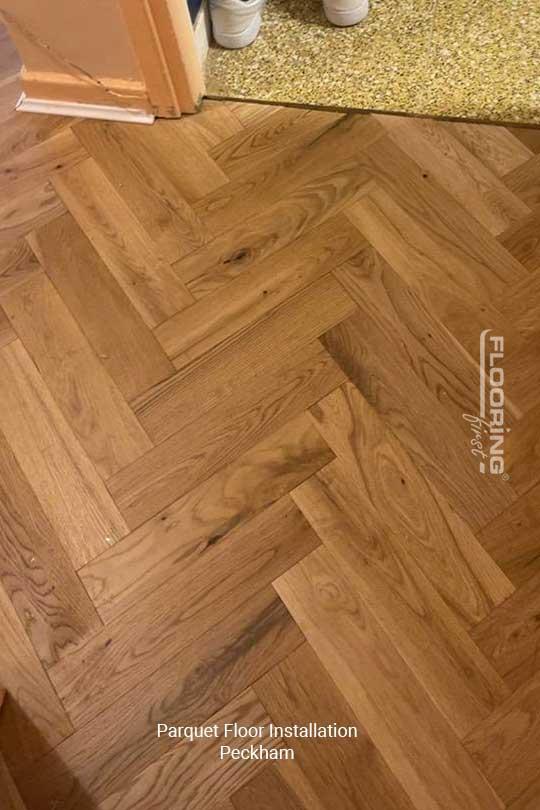
The parquet floor fitting was executed with precision, each block carefully placed to create a visually strong and uniform pattern. The results improved the room significantly, adding a quality and character that is hard to match with any other floor type. The subfloor preparation paid off: the surface is flat and even throughout, with no creaking or movement underfoot. Beading and thresholds finished the edges cleanly, and the doors now open and close freely over the new surface.
Frequently Asked Questions
How long does parquet block installation take in a typical room?
A standard living room of 20 to 30 square metres typically takes two days: one for subfloor preparation and allowing levelling compound to cure, and one for laying, adhesive curing, and fitting the trim. Larger rooms or more complex patterns take longer.
Can parquet be laid over an existing floor?
Sometimes. The existing floor needs to be stable, firmly fixed, and at the right height to allow for the extra thickness of the parquet. Floating floors, carpet, or floors with movement or dampness issues need to be removed first. We always check the subfloor conditions before advising on whether removal is necessary.
What does parquet floor fitting cost in Peckham?
Parquet fitting in Peckham and South East London generally runs from £40 to £60 per square metre for labour, including subfloor preparation, laying, and trim fitting. The blocks themselves are a separate cost. Prices vary depending on the pattern, block size, and subfloor condition.