Project Overview
This parquet floor fitting project was completed at a Victorian terrace in Peckham, South East London. The client had recently renovated the ground floor of the property and wanted a parquet floor to run through the hallway and front reception room. A traditional herringbone pattern in solid oak was chosen to suit the period character of the house. Parquet fitting is a skilled job that takes considerably longer than fitting straight-run boards, which is reflected in the price. For a professionally fitted, sanded, and finished solid parquet floor in London, clients should budget in the region of £70 to £100 per square metre, depending on the pattern chosen and the complexity of the layout.
The Challenge
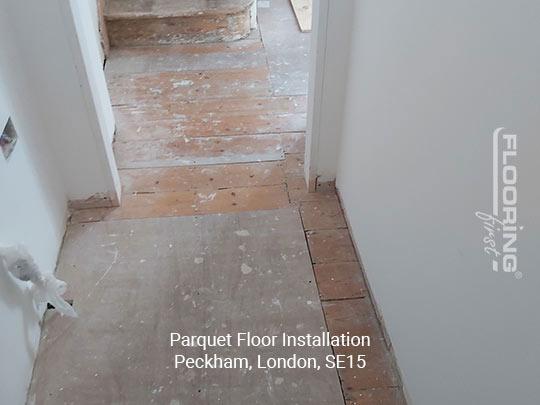
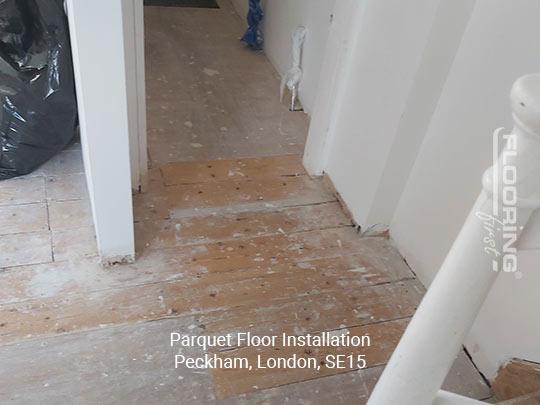
The main technical challenge on this project was the subfloor condition. The hallway had a suspended timber subfloor that had a slight spring to it, while the front room sat on a solid concrete base. Fitting parquet across two different subfloor types requires a consistent base level between them, which meant the junction between the hallway and the reception room needed careful attention. Any height difference would have been immediately visible as a step in the finished floor. The hallway joists also needed reinforcing in one section where they had dropped slightly, creating a low spot that would have produced a hollow sound underfoot had it been left.
Our Approach
- Subfloor assessment: We checked the level across both rooms and at the junction, measured the deflection in the timber subfloor, and identified the section with the dropped joist.
- Joist repair: A new noggin was fitted between the affected joists to restore support and eliminate the movement. The chipboard deck was re-screwed at closer centres to reduce flex to an acceptable level.
- Level transition: The concrete in the front room was slightly higher than the finished timber deck height. We used a thin ply packing layer on the timber side to bring both surfaces to exactly the same level at the junction.
- Pattern layout: Before any blocks were glued, we dry-laid the herringbone pattern across both rooms to confirm the alignment and ensure the pattern met correctly at the doorway between the two spaces.
- Block fitting: The parquet blocks were glued down with a flexible wood adhesive, starting from the centreline of the doorway and working outwards. Each block was pressed firmly and checked for level as it went down.
- Sanding and finishing: Once the adhesive had fully cured over 48 hours, the floor was sanded diagonally in two directions through three grit stages, then finished with three coats of a satin lacquer.
The Result
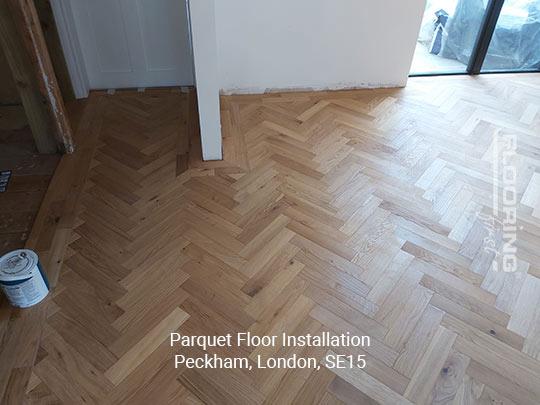
The finished floor ran through both rooms with a consistent, tight herringbone pattern and no visible transition at the junction between the two subfloor types. The satin lacquer gave the oak a warm, slightly understated finish that suited the renovation style. The client commented that the floor was the centrepiece of the whole ground-floor renovation. Parquet fitted over a correctly prepared subfloor and finished with a quality lacquer will look good for decades and can be re-sanded and refinished when it eventually shows wear.
Frequently Asked Questions
How long does it take to fit a parquet floor?
The fitting stage for a single room of average size typically takes one to two days, depending on the pattern complexity and the number of cuts required. Subfloor preparation adds time, as does the 48-hour adhesive cure period before sanding can begin. A complete parquet project from start to finish, including fitting, sanding, and three-coat lacquering, generally takes five to seven working days.
Can parquet be fitted over a suspended timber floor?
Yes, provided the timber floor is structurally sound and has minimal deflection. A suspended floor that flexes significantly underfoot is not a good base for glued parquet, as the movement can break the adhesive bond over time. Reinforcing the subfloor before fitting is a worthwhile investment that prevents problems later.
What is the best pattern for a small hallway?
Herringbone is the most popular choice for hallways because the diagonal lines draw the eye down the length of the space, making it feel longer. A straight-run or square-set parquet pattern can work well in wider hallways or where a simpler look is preferred. The scale of the block also matters: smaller blocks suit narrower hallways better than larger ones.