Project Overview
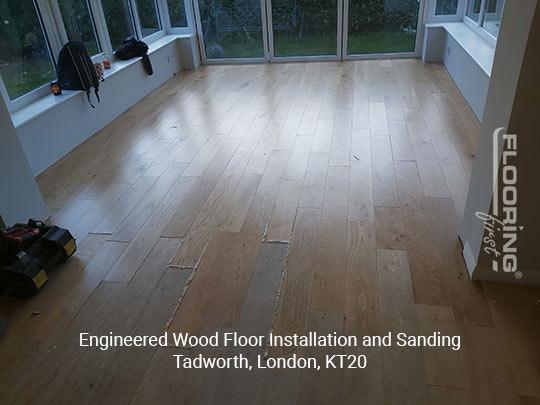
This Tadworth project combined engineered wood floor installation with sanding and finishing of the laid boards. The client was fitting a new unfinished engineered oak floor and wanted the sanding and finishing done on site after installation to achieve a consistent factory-flat result and their preferred finish specification. Installing unfinished engineered boards and sanding on site gives a higher quality finish than pre-finished boards, particularly at the board joints, and allows full control over the final colour and sheen level.
The Challenge
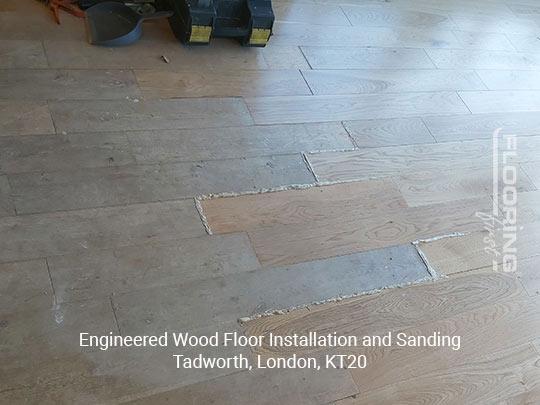
Installing unfinished engineered boards and then sanding on site requires careful sequencing. The boards must be fully fixed and the adhesive fully cured before any sanding machine is brought across the floor. Sanding too early can loosen boards or create movement at the joints. The other challenge is achieving a truly flat sanded result on a newly installed floor, where the boards may have slight height variation between individual planks. The sanding programme needs to address this levelling as well as producing the fine surface needed for finishing.
Our Approach
Subfloor Preparation and Board Installation
The subfloor was checked and prepared to the level of flatness required for a glued installation. The unfinished engineered boards were bonded down using a flexible wood floor adhesive and the full installation was completed before the floor was left to cure. No sanding or foot traffic was allowed on the new floor until the adhesive had fully set.
Levelling Sand
Once cured, we carried out an initial levelling sand to remove any height differences between adjacent boards and to open the grain of the wood consistently across the full floor. This pass uses a coarser grit than subsequent passes and focuses on getting the surface as flat as possible before moving to the finishing stages.
Finishing Sanding Passes
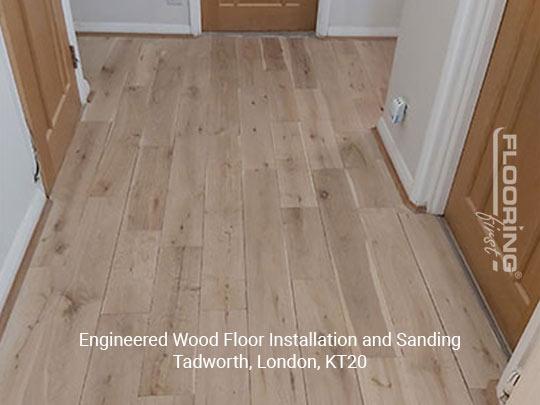
After the levelling pass, we worked through progressively finer grits to bring the surface to a smooth, consistent condition across the whole floor. Edge sanding was carried out alongside the main floor work to keep the full area progressing at the same pace.
Finish Application
The client had chosen a natural hardwax oil finish, which was applied in two coats with buffing between each. Hardwax oil gives a natural, open appearance to the wood and is a popular choice for newly installed floors where the client wants the wood to look and feel as close to its natural state as possible.
The Result
The finished floor was smooth and consistent throughout, with the hardwax oil finish giving the oak a warm, natural appearance. The joints between boards were flush and clean, which is the key benefit of sanding on site after installation. The client was very pleased with the result. For supply, fit, sand, and finish of an engineered floor in Surrey and the surrounding area, expect to budget from around £45 to £70 per square metre depending on the board specification and finish chosen.
Frequently Asked Questions
What is the advantage of installing unfinished engineered boards and sanding on site?
The main advantage is the finish quality at the board joints. Pre-finished boards have a small bevel at each edge, which creates a visible groove at every joint in the finished floor. On a site-sanded floor, the joints sand flat and the finish goes across them uniformly, giving a much cleaner overall appearance. It also allows full control over the colour, sheen level, and finish product used.
What is hardwax oil and how does it differ from lacquer?
Hardwax oil is a penetrating finish made from natural oils and waxes that soaks into the wood rather than forming a film on the surface. It gives the floor a more natural, matte appearance and a tactile feel that many clients prefer. It is easier to touch up in small areas if damage occurs. Lacquer sits on top of the wood as a protective film, giving a harder surface and a slightly more reflective finish. Both are durable and widely used.
Can an engineered floor installed with adhesive ever be lifted and reused?
This is difficult in practice. Glued-down boards are bonded firmly to the subfloor and removal typically damages both the boards and the subfloor surface. If future flexibility is important, a floating installation is a better choice. Glue-down is generally recommended when the best underfoot performance and stability are the priority.