Back to Floor Sanding
Dust-Free Floor Sanding Explained: How Clean Is It Really?
One of the first questions homeowners ask before booking a floor restoration is simple: how much mess is this actually going to make? The image of clouds of dust settling over furniture, curtains, and shelving is enough to put many people off having their floors refinished at all.
The good news is that dust-free floor sanding has changed that picture considerably. While no sanding process can ever be described as completely free of dust, modern equipment used by professional floor sanding specialists captures the overwhelming majority of the dust created during the job. For London homeowners weighing up whether to go ahead with a restoration, understanding exactly what "dust-free" means — and what it doesn't — makes the whole process far less daunting.
What Is Dust-Free Floor Sanding?
Traditional floor sanding relied on belt sanders and drum machines with little or no extraction. As the abrasive removed old varnish, paint, and worn timber, fine particles were thrown directly into the air, settling on every surface in the room and often drifting into neighbouring spaces. Anyone who has lived through an old-style sanding job will remember the layer of dust on windowsills, picture frames, and skirting boards days after the work was finished.
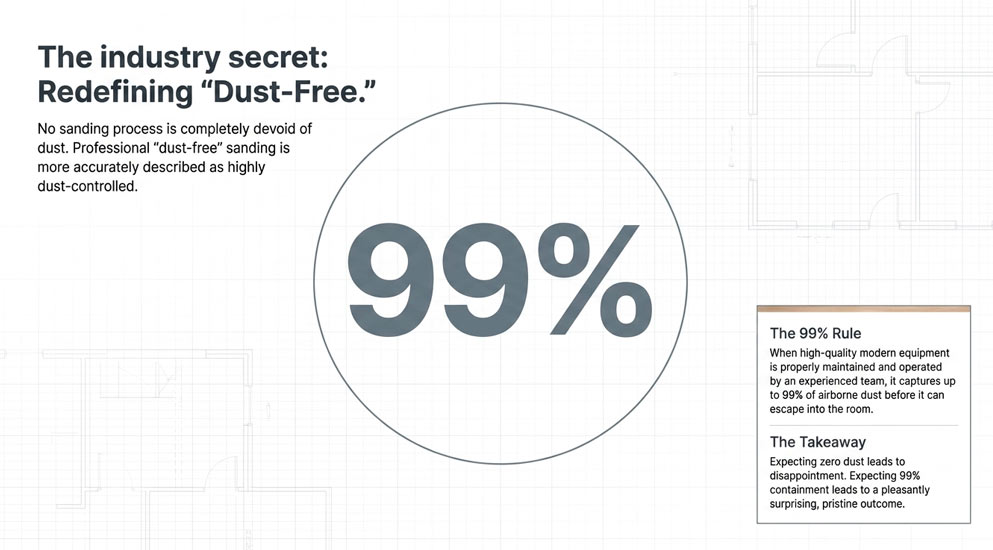
Modern equipment works very differently. Sanding machines are now built with sealed extraction systems that draw dust away at the point it's created, rather than letting it disperse into the room. This is what professionals mean when they talk about dust-free sanding — it's a more accurate description to call it dust-controlled rather than dust-free in the literal sense. No method can capture every last particle, but the difference between old and new techniques is dramatic enough that "dust-free" has become the standard industry term, even though it's slightly generous in its wording.
Understanding this distinction matters because it sets realistic expectations. Homeowners who expect absolutely zero dust may be disappointed by the small amount that remains; homeowners who understand that up to 99% of particles are captured by quality equipment tend to be pleasantly surprised by just how clean the process is in practice.
How Modern Dust Extraction Systems Work
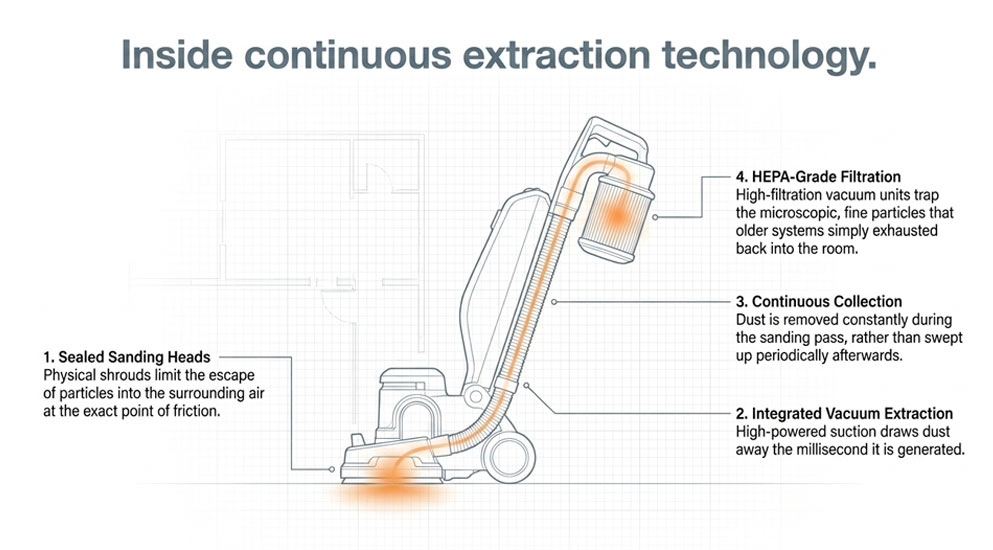
The technology behind dust-controlled sanding is built around a few key components working together:
- Integrated vacuum extraction built directly into the sanding machine, so dust is collected the moment it's generated rather than left to settle.
- Sealed sanding heads that limit how much dust can escape into the surrounding air during operation.
- Continuous collection throughout the sanding pass, rather than periodic clean-up afterwards.
- High-filtration vacuum units, often using HEPA-grade filters that trap fine particles other systems would let through.
- Collection bags and filtration units that need to be changed and maintained correctly to keep extraction rates high.
When this equipment is properly maintained and operated by an experienced team, it's realistic to expect up to 99% of airborne dust to be captured during sanding. That figure depends heavily on the quality of the machines used and how diligently the operator manages the equipment — which is exactly why it's worth asking a potential floor sanding contractor what machinery they use before booking the work.
How Much Dust Should You Actually Expect?
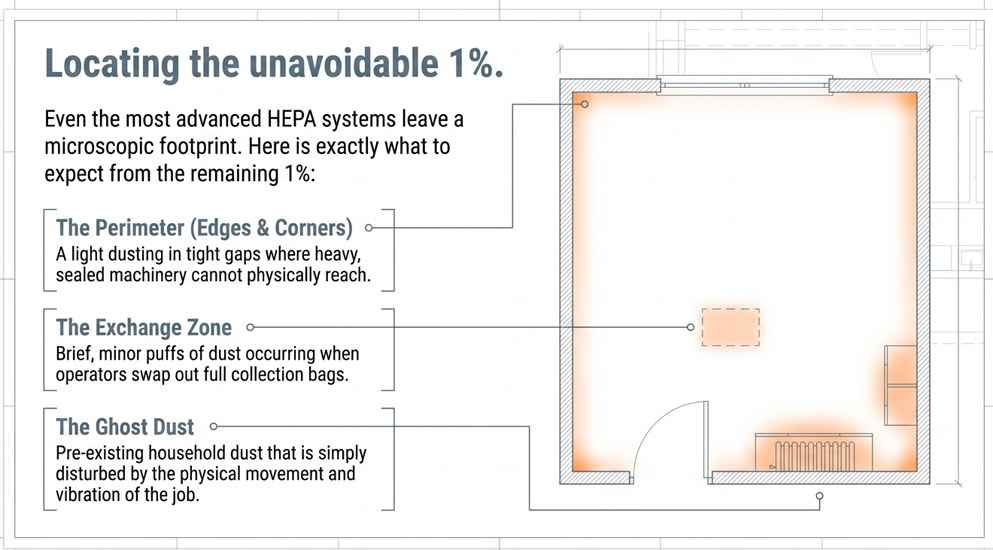
Even with the best equipment, a small amount of fine dust is unavoidable. A few things to expect:
- A light dusting may settle in the immediate work area, particularly in gaps, corners, and edges that machines can't reach as easily as open floor space.
- Brief puffs of dust can occur when an operator changes a collection bag, even with sealed systems.
- Existing dust already present in a room — on shelves, in curtains, behind furniture — can be disturbed simply by the activity of the job, regardless of how good the extraction is.
The contrast with older methods is still significant, and it's one of the reasons cleanup time is rarely a major factor in our floor sanding price guide. The table below sets out the practical difference homeowners notice between traditional and modern approaches.
| Traditional Sanding |
Modern Dust-Free Sanding |
| Heavy airborne dust |
Minimal airborne dust |
| Dust throughout home |
Dust largely contained |
| Extensive cleaning required |
Limited cleaning required |
| Poor indoor air quality |
Significantly improved air quality |
| Longer post-job cleanup |
Faster return to normal use |
What Areas Need Protection Before Floor Sanding?
Good preparation does more to limit mess than almost anything else, and it's a topic covered in more depth across our floor sanding advice hub. Before work begins, it's worth thinking through:
- Removing furniture from the room wherever possible, or moving it to one area covered with dust sheets.
- Taking down curtains, especially heavier fabrics that trap dust and are awkward to clean afterwards.
- Protecting electronics such as TVs, routers, and games consoles with covers or by relocating them entirely.
- Covering wardrobes and storage units so dust can't settle inside drawers or on stored clothing.
- Sealing adjacent rooms with temporary barriers where the sanding area opens onto a hallway or open-plan space.
- Protecting valuable or sentimental items, including artwork, books, and anything difficult to clean.
Most reputable companies will handle protective measures within the work area itself — sealing doorways, covering vents, and setting up barriers — but moving personal belongings and furniture out of the room is usually the homeowner's responsibility. A good contractor will tell you exactly what they expect from you before the day of the job, so there are no surprises.
Can Dust Spread to Other Rooms?
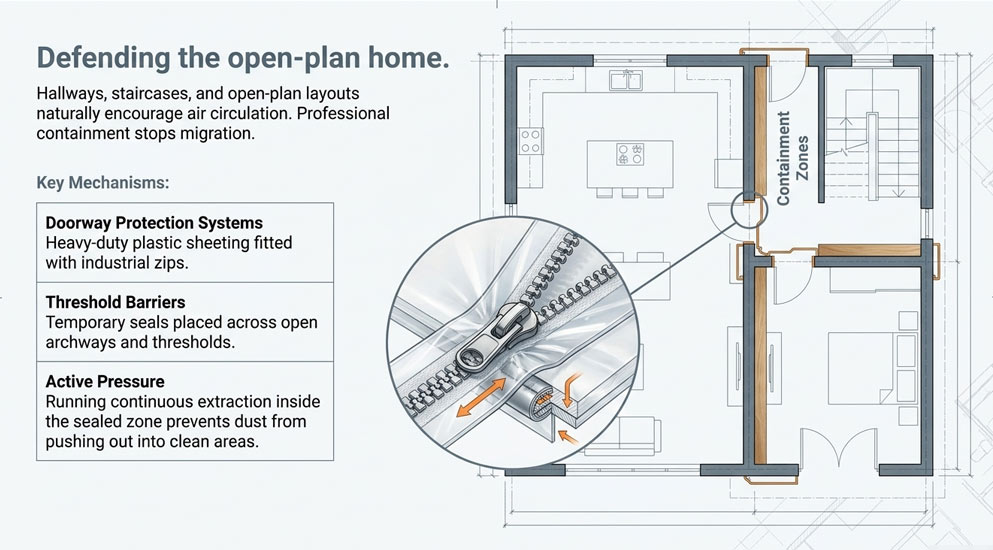
This is one of the most common worries, particularly in open-plan layouts where there's no door to close between the kitchen, living, and dining areas. Hallways and staircases are another pinch point, since they connect almost every room in the house and naturally encourage air circulation.
Experienced contractors manage this with doorway protection systems — typically heavy-duty plastic sheeting fitted with zips — along with temporary barriers across open thresholds. Sealing off the work zone this way, combined with running extraction continuously, keeps dust migration to a minimum even in homes with limited separation between rooms.
Is Dust-Free Floor Sanding Safe for Families, Children and Pets?

The improved air quality from modern extraction is a genuine benefit for households with young children, older relatives, or allergy sufferers, since fewer airborne particles means less irritation for sensitive respiratory systems. That said, "dust-free" doesn't mean the work area is suitable for anyone to wander through.
Children and pets should stay well away from the active work area throughout sanding. Machinery, trailing cables, sharp edges, and the sanders themselves all present genuine hazards regardless of how clean the air is. Keeping pets in a separate part of the house — or arranging for them to stay elsewhere for the day — is sensible practice on any sanding job.
Can You Stay in the House During Floor Sanding?
In most cases, yes — homeowners can remain in the property while floor sanding takes place, particularly for single-room jobs in larger homes. A few practical factors affect how comfortable that is:
- Noise levels during sanding are noticeably louder than everyday household activity, which can be disruptive if you're working from home or have young children napping.
- Access restrictions mean the room being sanded — and sometimes the route to it — will be off-limits for the day.
- Multi-room projects spanning several days may make it more practical to use unaffected parts of the house, or temporarily relocate if every room is being worked on in sequence.
- Drying and curing times after a finish is applied mean the room itself will need to stay closed off for a period afterwards, even once the sanding and extraction work is complete.
For most occupied homes, the practical answer is to plan around the room being out of action for the day, keep family members and pets clear of the work zone, and check timings with your contractor if the property is fully open-plan.
Questions to Ask Before Hiring a Floor Sanding Company
Before booking floor sanding, it's worth running through a short checklist with any contractor you're considering:
- Do you use dust-free sanding equipment?
- What percentage of dust does your system typically capture?
- Which sanding machines do you use, and how are they maintained?
- How do you protect adjoining rooms and shared spaces?
- What preparation is required from us before you arrive?
- How much cleaning will be needed once the job is finished?
A confident, specific answer to each of these is usually a good sign you're dealing with an experienced, professional team rather than someone working with outdated equipment — our golden rules for floor sanding cover several of these standards in more detail.
Why Professional Dust-Free Sanding Makes a Difference
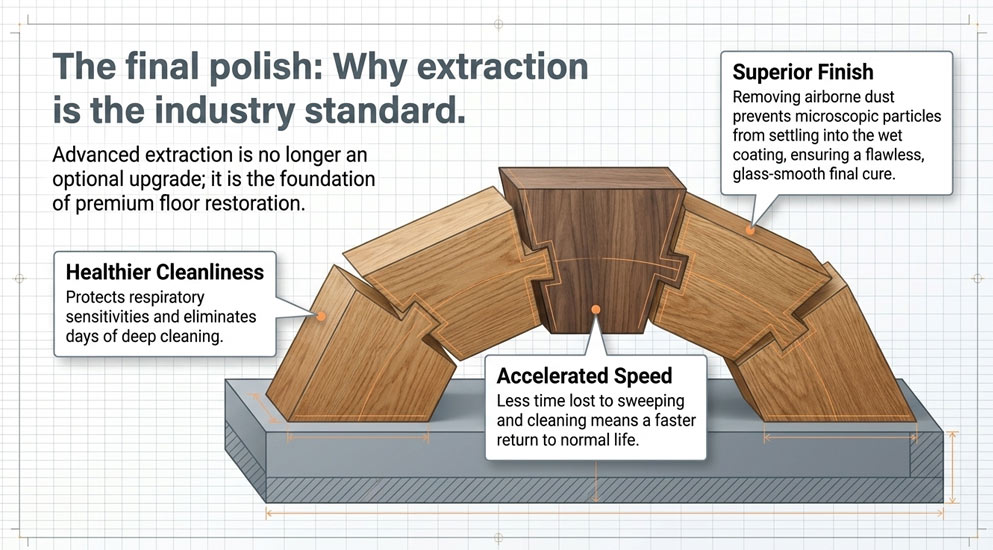
The advantages of proper dust extraction go well beyond a tidier living room. Homes stay genuinely cleaner throughout the project, and indoor air quality improves rather than deteriorates during the work — a real benefit for anyone managing allergies or respiratory sensitivities. Projects also tend to finish faster, since less time is lost to extensive post-job cleaning, and the floor itself often achieves a better finish, since dust contamination during coating can affect the final result.
This combination of speed, cleanliness, and finish quality is exactly why dust extraction has become the industry standard for professional floor restoration across the London boroughs we cover and beyond, rather than an optional upgrade.
Conclusion
Modern dust-free floor sanding is dramatically cleaner than the methods homeowners may remember from years past. No system can eliminate every last particle, but professional extraction equipment reliably captures up to 99% of dust generated during the process, making floor restoration far less disruptive than many people expect.
Before booking your own project, it's worth discussing preparation requirements and dust-control measures directly with your chosen floor sanding company — and if your floors only need a gentler approach, our light floor sanding service may be worth asking about too. The right questions upfront make for a far smoother job on the day.