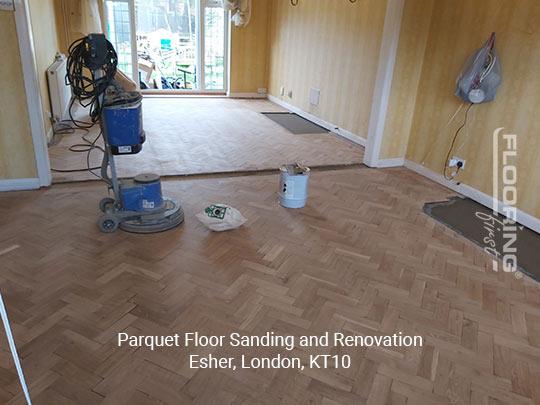
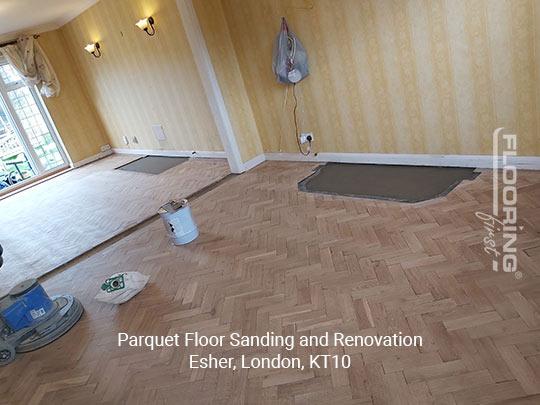
Project Overview
This parquet floor sanding and renovation project took place in a period property in Esher, Surrey. The floor had not been touched for well over a decade and was showing the wear that comes with years of daily use: a dull, scratched surface, gaps between blocks, and a finish that had broken down in heavy-traffic areas. The client wanted the floor restored to its original character without replacement. Parquet sanding typically costs between £70 and £100 per square metre when combined with gap filling and a full lacquer finish, and this project fell comfortably within that range.
The Challenge
Parquet floors cannot be sanded the same way as a standard plank floor. Each block runs at a different angle to its neighbour, depending on the pattern, so sanding straight along one axis risks tearing grain and leaving cross-grain scratches that are very difficult to remove. This floor had a traditional herringbone layout, which demands diagonal sanding passes and careful edging to avoid creating flat spots or rounding the block corners. On top of that, several blocks were loose and a handful had lifted slightly, which had to be sorted before any machine could go near the surface. The gaps between blocks were also uneven, making a uniform fill harder to achieve.
Our Approach
- Inspection and repair: We walked the entire floor, pressing each block to check adhesion, re-gluing loose ones and replacing two that had cracked beyond use with matching stock. All nails were punched below the surface.
- Gap filling: We mixed fine wood dust from the initial sanding passes with a two-part resin filler and pressed it into every gap. This approach produces a fill that is colour-matched to the actual wood rather than a generic filler tone.
- Coarse sanding: Using a drum sander with a medium-grit belt, we worked across the herringbone at 45 degrees in two opposing diagonal directions to flatten the surface evenly and remove the old finish without attacking any single block grain.
- Intermediate and fine sanding: We followed up with finer grits, progressively smoothing the surface, then used an edge sander in the corners and a detail tool around the door architraves.
- Buffing: A rotary buffer with a fine pad brought the surface to a consistent, smooth finish ready for coating.
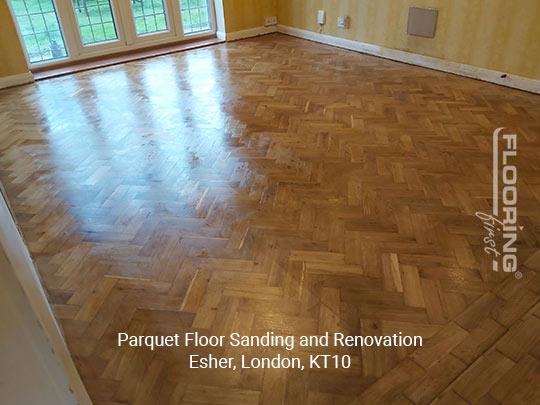
- Lacquering: Three coats of a hard-wearing water-based lacquer were applied, with a light buff between coats. The gloss finish brought out the warm tones of the oak blocks and gave the pattern strong visual definition.
The Result
The transformation was dramatic. The old, dull surface gave way to a floor with real depth and warmth, the herringbone pattern standing out clearly under the fresh lacquer. The gaps are gone, the surface is smooth and even, and the repaired blocks are indistinguishable from the originals. The client now has a floor that will comfortably last another 20 to 30 years before it needs professional attention again, provided it receives the occasional re-coat when the finish starts to show wear.
Frequently Asked Questions
How often does a parquet floor need to be professionally sanded?
A solid parquet floor can typically be sanded four to six times over its lifetime. In a family home with moderate traffic, full sanding is usually needed every 15 to 25 years. Re-coating the finish every five to ten years extends the time between full sanding jobs considerably.
Can you sand a parquet floor that has loose blocks?
Loose blocks must be fixed before sanding begins. Running a drum sander over a loose block can flip it, damage adjacent blocks, or damage the machine. Re-gluing is a straightforward job and adds very little to the overall project cost.
What finish is best for a herringbone parquet floor?
Lacquer is the most popular choice because it sits on top of the wood and provides a hard, protective layer that is easy to clean. Oil finishes are an alternative for those who prefer a more natural look, though they require more regular maintenance. For a high-use reception room or hallway, lacquer is usually the more practical option.