Back to Flooring Products
Hard-Wax Oil vs Lacquer for a High-Traffic Hallway
A hallway takes more punishment than almost any other floor in the house — shoes, pushchairs, pets, dropped keys, grit tracked in from outside. Choosing between hard-wax oil and lacquer for that kind of traffic isn't really a question of which is "better" — it's a question of which set of trade-offs suits how you actually live. For background on the sanding process itself before the finish goes on, our floor sanding London overview covers the basics. Here's an honest look at both, including what wear genuinely looks like over time.
How Hard-Wax Oil Performs in a High-Traffic Hallway
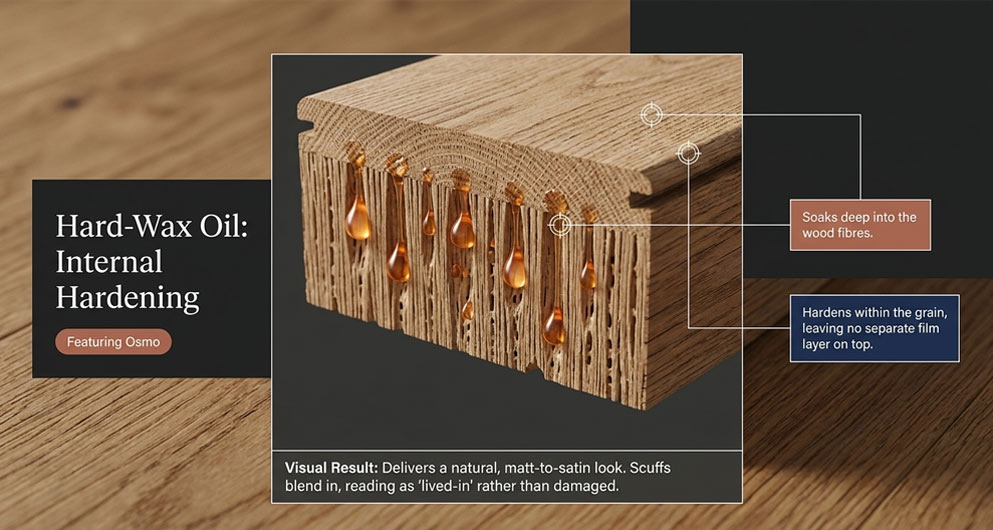
Hard-wax oil, such as the options available from Osmo, works by soaking into the wood and hardening within the grain, rather than sitting on top as a separate film layer. This gives the floor a natural, matte-to-satin look that many people prefer over the slightly more plasticky appearance of a heavy lacquer, and it tends to show scuffs and general wear in a way that reads as "lived-in" rather than "damaged."
Wear pattern
Because the oil is absorbed into the wood rather than forming a surface film, wear in a hard-wax oil floor tends to show up as gradual dulling and light surface marks across the most-walked areas, rather than a coating that visibly chips or peels. In a genuinely high-traffic hallway, this dulling is usually noticeable sooner than it would be with lacquer, simply because there's no separate protective layer taking the brunt of the abrasion first.
Maintenance
This is where hard-wax oil has a real practical advantage: worn patches can typically be spot-treated by cleaning the area and reapplying oil locally, without needing to sand and refinish the entire hallway. For a section of floor that takes disproportionate wear — right inside the front door, for instance — this makes ongoing upkeep considerably less disruptive than it would be with a full lacquer recoat.
Honest downside
In a genuinely busy hallway, hard-wax oil generally needs more frequent light maintenance than lacquer to keep looking its best — not necessarily a full refinish, but more regular spot attention. If you're not someone who'll keep on top of that, the floor can start to look tired in high-wear spots before you'd expect a lacquered floor to.
How Lacquer Performs in a High-Traffic Hallway
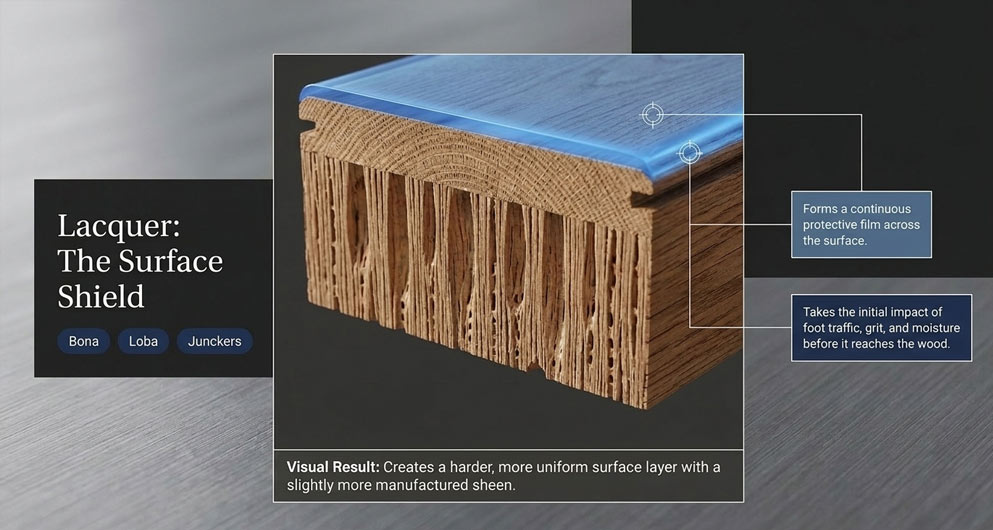
Lacquer — with options from brands including Bona, Loba, and Junckers — forms a continuous protective film across the surface of the wood, rather than soaking into it. This gives the floor a harder, more uniform surface layer that takes the initial impact of foot traffic, grit, and moisture before it ever reaches the wood underneath.
Wear pattern
Lacquer tends to hold its finish and sheen for a genuinely longer stretch under heavy traffic than hard-wax oil, since the film layer is doing the work of resisting scuffs and scratches. When lacquer does start to show wear, it's often more visible when it happens — light scratching or dulling across the whole surface, or in more extreme cases the film itself can show wear-through in the very highest-traffic strip of the hallway, such as directly in front of a door.
Maintenance
Unlike hard-wax oil, lacquer generally can't be spot-repaired in the same way — a worn or damaged patch usually needs the full room, or at least a clearly defined section, to be lightly abraded and recoated so the new lacquer blends with the old rather than sitting as a visible patch. This makes maintenance less frequent overall, but more involved when it is needed.
Durability options
For genuinely heavy-traffic areas, some lacquers are specifically formulated for higher durability — Bona Traffic HD, for example, is designed for exactly this kind of high-footfall application, and Bona Mega is another option used where a durable, long-lasting seal matters more than anything else. Not every lacquer performs the same way under heavy wear, so the specific product matters as much as the general finish type.
Honest downside
Lacquer's film layer, while durable, means any wear-through or damage exposes bare, unsealed wood at that specific point rather than a gradually dulling oiled surface — and because full-area recoating is the standard fix, a single problem patch often means treating a wider area than the patch itself to get an even result. You can read more about how a full wood floor recoat works when that stage is reached.
Wear Timelines: The Honest Comparison
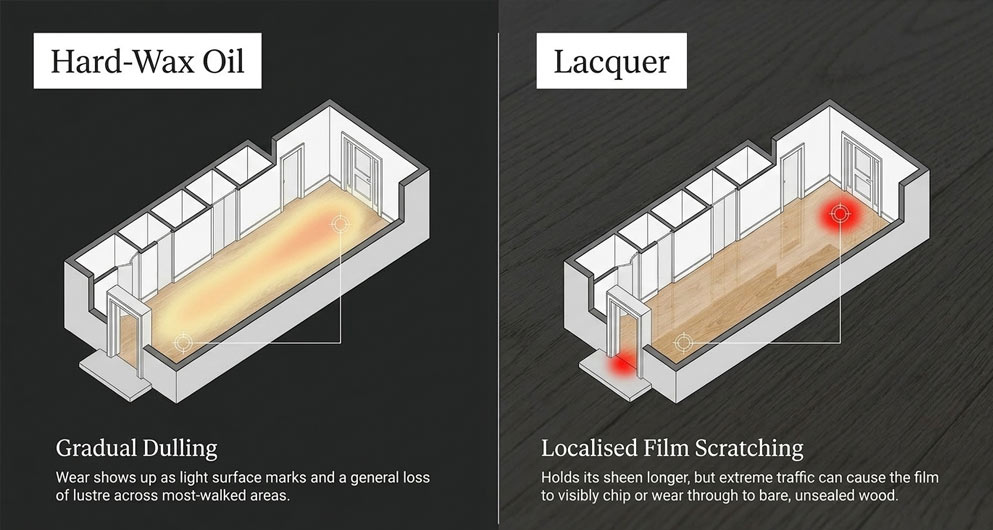
It's tempting to want an exact number of years for each option, but the honest answer is that wear timelines depend heavily on actual foot traffic, grit and debris exposure, footwear, and how consistently the floor is cleaned — a hallway in a family home with children, pets, and no doormat wears very differently to a quiet single-occupant flat. What can be said with confidence:
- Hard-wax oil tends to need attention sooner and more often, but each round of attention is smaller, localised, and less disruptive
- Lacquer tends to go longer between needing attention, but when it does need it, the job is typically bigger and affects a larger area of the floor
- High-durability lacquers (like Bona Traffic HD) are specifically built to extend that gap further in genuinely heavy-traffic settings, at the cost of the softer, more natural look hard-wax oil gives
- Neither finish is maintenance-free — the real difference is the shape maintenance takes, not whether it's needed at all
Which Should You Choose?

- Choose hard-wax oil if you value a natural matt finish, don't mind slightly more frequent light maintenance, and like the idea of being able to spot-treat worn patches yourself without a full professional recoat
- Choose lacquer if you want the longest possible stretch between maintenance jobs and don't mind that when a recoat is eventually needed, it typically covers the full room rather than a small patch
- Choose a high-durability lacquer specifically if the hallway sees genuinely heavy daily traffic — multiple children, pets, or a lot of footfall through the front door — and long-term resistance matters more than the softer look of an oiled floor
There's a reasonable case for either finish in a hallway. The honest answer is that it comes down to whether you'd rather do a bit of upkeep more often, or less upkeep that's more involved when it happens.
Getting the Right Finish for Your Hallway
Because the right choice depends on your specific traffic levels, flooring type, and how much upkeep you're realistically willing to do, it's worth talking through your hallway's actual usage before committing to either finish. We work with hard-wax oil and lacquer options from Osmo, Bona, Loba, and Junckers, and can talk you through which suits a high-traffic entrance best based on what we see on site — all sanding is carried out with dust-free sanding equipment capturing up to 99% of particles, so the process itself is clean regardless of which finish you choose. You can see examples of both finishes on real projects in our floor sanding gallery.
Get your free quote — call 020 8830 9782 to talk through the right finish for your hallway.