Project Overview
This Barnet project brought together several different trades under one visit: floorboard replacement for the most damaged sections of a hardwood floor, gap filling throughout, full sanding and staining of the floor, plus re-sanding and staining of the wooden staircase to match. When a client wants a complete renovation of both floor and stairs in one go, careful sequencing and clear communication between the team working on each area are important. The goal here was a consistent stain colour across both surfaces and a finished result that looked purposeful rather than patched. Sanding and staining projects of this scale in North London typically run from £30 to £45 per square metre.
The Challenge
The main challenge was achieving a consistent stain result across surfaces in different conditions. Some sections of the floor had very worn boards, some had new replacement boards, and the staircase had a different finish depth and grain profile to the floor. New boards absorb stain at a different rate to aged timber. Stair nosings and treads also take stain differently to flat boards. Getting a uniform colour result across all these different surfaces requires preparation work at each stage — pre-conditioning in some areas, test patches before committing — rather than simply applying stain and hoping for the best.
Our Approach
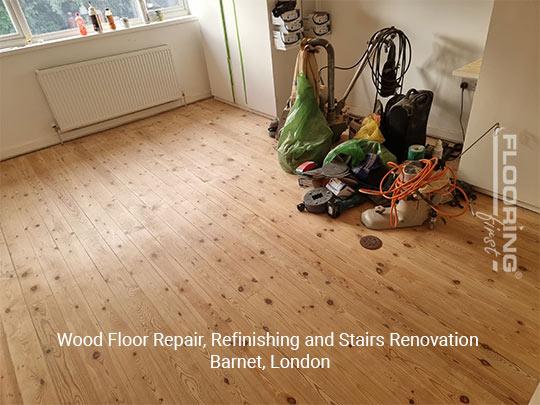
Board replacement: Boards too far gone for sanding to help were lifted and replaced with matching timber. We sourced boards close in species, width and thickness to the existing floor to minimise visible joins. Where small gaps remained at the joints with surrounding boards after fitting, these were addressed in the gap-filling stage.
Gap filling: All gaps across the floor — between original boards and around the replacements — were filled with a resin and sawdust mix appropriate to the gap width. Wider gaps received pine slivers first. The stairs were also checked for loose treads and any flexing was fixed before sanding began.
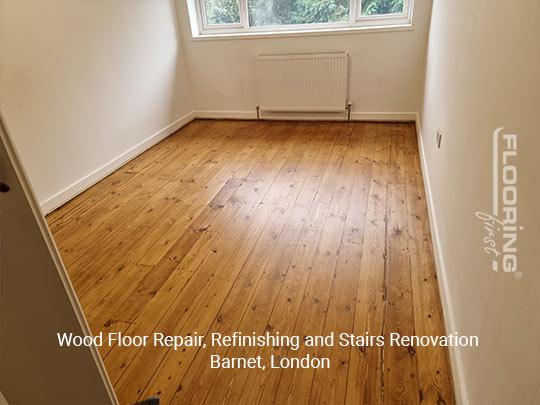
Sanding floor and stairs: The floor was sanded in three passes from coarse through to fine, following the grain throughout. The stairs were sanded on treads, risers and nosings, with hand tools used where machine access was limited around spindles and the stringer. A consistent fine-grit finish across both surfaces was achieved before any stain was applied.
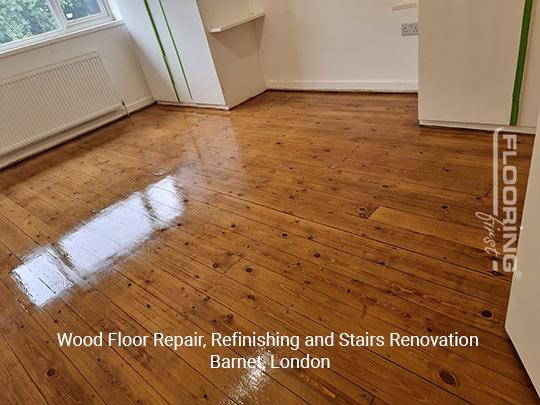
Staining and finishing: A mid-tone stain was applied to floor and stairs in careful sequence, allowing the stain to cure fully between coats. Two coats of lacquer were applied over the stained surfaces to protect the colour and give a durable finish in line with what a busy household needs.
The Result
The floor and stairs came out with a consistent colour and finish throughout. The new replacement boards are not distinguishable from the originals under the stain and lacquer. The client now has a cohesive look from the hallway floor up the staircase, achieved within a single project visit rather than spreading work across multiple contractor visits. This Barnet renovation shows what is achievable when floor and stair work is planned and executed as a single coordinated job.
FAQ
Is it better to do the floor and stairs in one visit or separately?
Doing both together is almost always better. You get a consistent finish across both surfaces because they are sanded and stained in the same session with the same materials. It also reduces the disruption to the household — one period of upheaval rather than two. The sequencing needs care (stairs typically after the floor for access reasons) but a well-organised team handles this without difficulty.
Can the stain colour be changed entirely from the original floor colour?
Yes. Sanding takes the floor back to bare wood, at which point any stain colour can be applied. Going significantly lighter than the original colour is more straightforward than going darker, but in both cases we do test patches to confirm the result before committing to the full floor.
How long will the stain and lacquer last on a busy staircase?
Staircases are high-traffic areas and lacquer on treads and nosings will wear faster than on a flat floor. In a busy household, expect the stair finish to need a refresh every five to seven years. The floor in normal domestic use will typically last ten to twelve years before needing re-sanding. We advise on a maintenance schedule when completing the job.