Project Overview
This Fulham project covered the repair, gap filling, sanding and refinishing of a hardwood floor and a wooden staircase in a residential property. The floor had developed gaps and some boards had suffered damage that needed addressing before any finishing work could begin. The staircase was due for a full refresh — treads were scuffed, the finish had peeled away on the nosings and the handrail area was worn. The client wanted the floor finished with a high-quality lacquer and the staircase treated to the same standard with a durable sealant suited to heavy daily traffic. Work of this scope in Fulham and the surrounding areas typically costs between £28 and £42 per square metre.
The Challenge
Combining floor and stair renovation in one project is logical and cost-effective but it requires careful planning. The staircase is the access route for the team, so the floor and stairs cannot simply be sanded and finished at the same time — the sequence must be managed so that the team can still move around the property without walking on wet finish. Boards with damage beyond repair also needed sourcing and replacing before sanding, and the range of finish conditions across the floor — some areas very worn, others in better shape — meant the coarse sanding pass needed care to avoid taking too much material from the better-preserved sections while still removing the damage in the worst areas.
Our Approach
Board repair and replacement: Boards that were structurally damaged or too worn for sanding to cure were replaced with closely matched hardwood. Loose boards elsewhere were refixed. All repair work was completed and inspected before sanding began.
Gap filling: Gaps across the floor were filled in two stages: pine slivers where gaps were wide, resin and sawdust mix for the finer ones. Once the filler had fully cured, it was taken back flush with the surrounding boards in the first sanding pass.
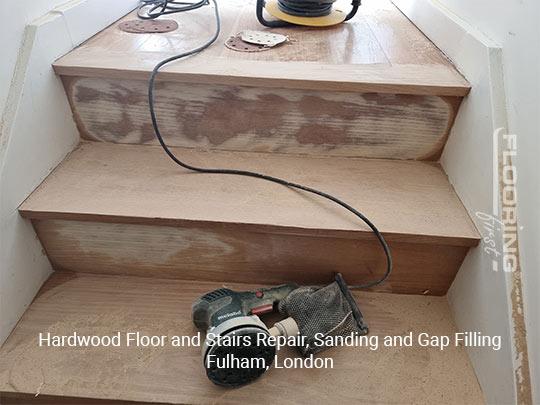
Sanding: The floor was sanded through three grits — coarse, medium, fine. Care was taken to follow the grain throughout and to blend the transitions between repaired and original sections. The staircase was sanded after the floor, with the team using a combination of portable machines and hand tools to cover treads, risers and nosings thoroughly.
Finishing: The floor received two coats of a hard-wearing water-based lacquer with a light abrasion between coats. The staircase was finished with a purpose-formulated sealant appropriate for high-traffic stair use. Both finishes were applied in a consistent satin sheen for a cohesive look from floor to staircase.
The Result
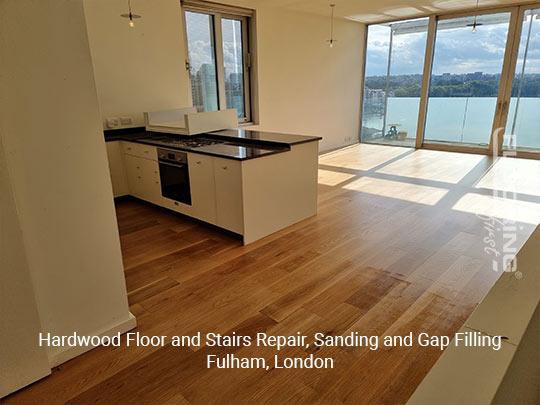
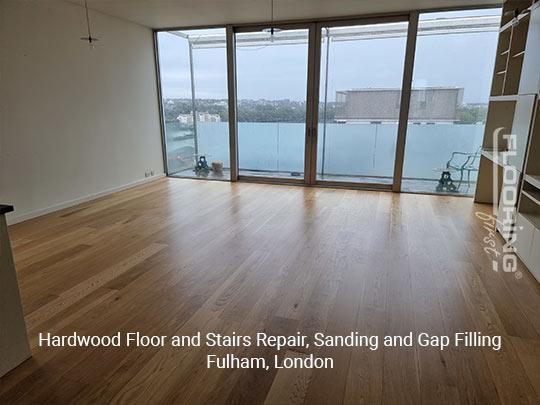
Both the floor and the staircase came out looking clean, repaired and well-protected. All gaps are filled, the surface is smooth and even, and the lacquer gives a durable finish that will hold up for years under normal household traffic. The stair sealant is appropriately hard-wearing for what is genuinely one of the most demanding surfaces in a domestic property. This Fulham job illustrates the value of tackling floor and stair renovation as a single coordinated project.
FAQ
What is the best finish for a wooden staircase?
A purpose-mixed floor lacquer or sealant with a high solids content is the best choice for stairs. The finish needs to be hard enough to withstand concentrated point loads from foot traffic without chipping or peeling. We advise against standard wall or furniture varnishes on stairs as they are not formulated for this level of use and tend to peel away at the nosings within months.
Can a staircase be sanded if it has spindles and a newel post in the way?
Yes. Machine access is limited around spindles, but this is standard on all staircase sanding jobs. Detail machines and hand tools are used in the areas where a larger machine cannot reach. The result is the same quality of surface — it simply takes longer per tread than a flat floor area does.
How long does the whole floor and staircase project take?
A project covering a mid-sized floor plus a full staircase, including board replacement, gap filling, sanding and two coats of finish, typically takes three to four days. The property needs to be accessible throughout and we ask that the floor and stairs are left clear for at least 24 hours after the final finish coat before normal use resumes.