Project Overview
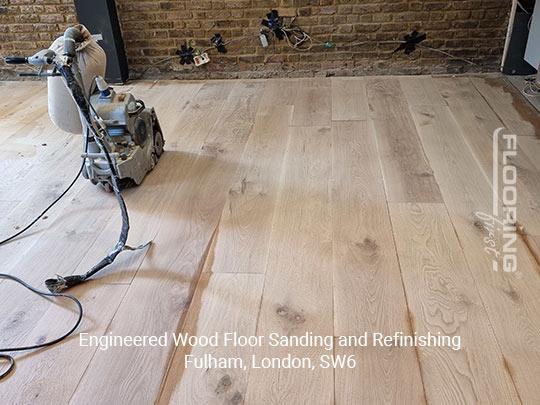
This Fulham SW6 property had engineered wood flooring that had been in place for several years and was showing significant surface wear. The boards had developed scratches, the original finish was dull and uneven, and some areas close to the kitchen had started to look noticeably worse than the rest. The client wanted the floor sanded back and refinished to restore its appearance without the cost of replacement.
The Challenge
Sanding engineered wood floors requires more care than sanding solid timber. The wear layer on an engineered board is thinner than on solid wood, so there is less margin for error. Taking off too much material can expose the core layers beneath the veneer, which cannot be finished to a satisfactory standard. We needed to determine the exact thickness of the veneer on this particular product before agreeing to sand it. The floor had a 4mm hardwood veneer, which was sufficient to allow a careful light sand and refinish. Any thinner and we would have advised a different approach.
Our Approach
Veneer Depth Assessment
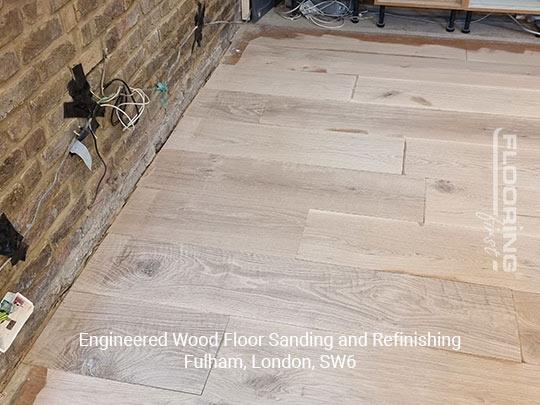
Before any sanding began, we checked the veneer thickness carefully at the edge of the floor where a board had been partially lifted for inspection. Confirming there was enough material to work with is the most important first step when sanding engineered floors.
Light Sanding Programme
We used a light sanding programme designed specifically for engineered boards, working with finer starting grits than we would typically use on solid wood. This removes the damaged surface layer without cutting deeply into the veneer. Multiple passes with increasing fineness brought the surface to a smooth, consistent condition ready for finishing.
Edge and Detail Work
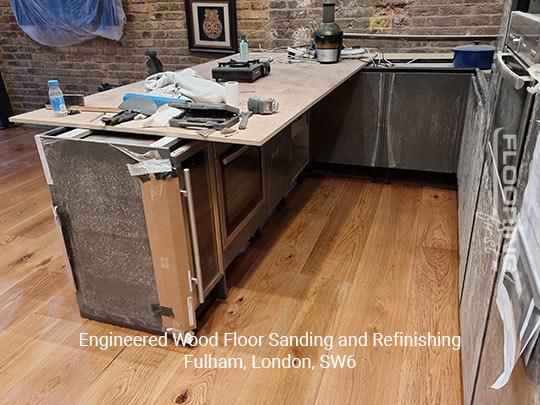
The edges of the floor close to the skirting and around the doorways were worked by hand using orbital sanders and scrapers to ensure a consistent result across the whole room. These areas are easy to miss or rush, and inconsistency here is immediately obvious on a finished floor.
Finish Application
A hard-wearing lacquer was applied in three coats to provide good protection for daily use. The product was chosen to complement the natural tone of the oak veneer without adding a heavy or artificial sheen to the surface.
The Result
The floor looked noticeably better once the old finish had been removed and the new lacquer applied. The scratches were gone, the colour was even, and the boards looked consistent across the whole room. The client was pleased to have saved the cost of replacement and noted that the floor looked better than it had for several years. Engineered floor sanding in London typically runs from £25 to £40 per square metre, depending on the condition and the veneer depth available.
Frequently Asked Questions
How many times can an engineered floor be sanded?
This depends entirely on the thickness of the veneer. A 2mm wear layer generally allows one careful sand. A 4mm or 6mm layer can be sanded two or possibly three times over the lifetime of the floor. We assess each floor individually before committing to a programme.
What are the signs that an engineered floor needs refinishing rather than replacing?
If the finish is dull, scratched, or worn through but the boards themselves are structurally sound and the veneer is undamaged, refinishing is almost always the better option. It costs significantly less than replacement and produces excellent results when done correctly.
Does sanding void the manufacturer warranty on engineered flooring?
This varies between manufacturers. Some specifically include sanding and refinishing within the product's expected lifecycle, while others have conditions attached. We advise checking the specific warranty terms before proceeding. In most cases, after the initial warranty period, the floor can be refinished without restriction.