Project Overview
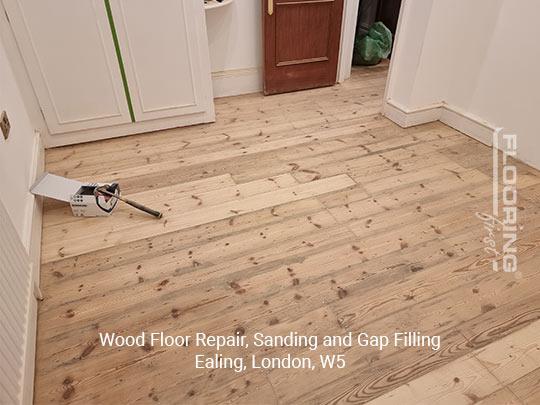
This Ealing project centred on a real hardwood floor that had developed several maintenance issues over the years. Floorboards had become loose, gaps had opened up between boards, and the surface finish had worn through in a number of places leaving bare wood exposed to everyday traffic. The client wanted the floor repaired, stabilised and refinished with a hard-wearing lacquer to see it through many more years of use. The job covered board refitting, gap filling, full sanding and two coats of lacquer finish.
The Challenge
Loose boards are a warning sign. Left unfixed, they flex underfoot, which stresses the fixings on neighbouring boards and gradually works them loose too. The main risk with this floor was that the movement had been going on long enough that some boards had started to develop hairline splits at the nail points. We needed to refix the loose boards properly — not just tap them back and hope — while checking the subfloor underneath for any softness or damp that might have contributed to the problem. Gaps between boards that form as a result of board movement also tend to be irregular in width, which makes gap filling a more involved job than on a floor where gaps have opened up through simple seasonal shrinkage.
Our Approach
Board refitting: Loose boards were carefully lifted where necessary, the subfloor checked and cleaned, and the boards refixed using appropriate fixings and adhesive. Where the subfloor showed any softness it was treated and allowed to dry before refitting.
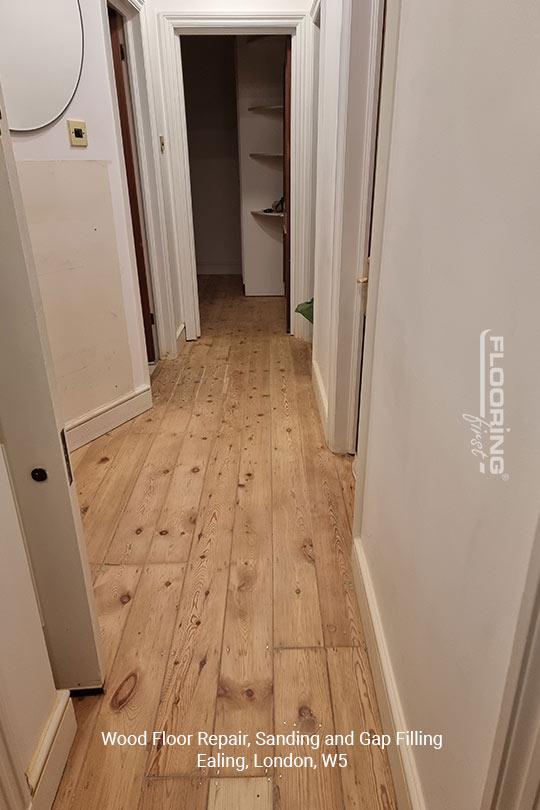
Gap filling: Fine gaps were packed with a resin and sawdust mix. Wider gaps got pine slivers tapped in and trimmed, then the whole lot was sanded flush in the first sanding pass. This step significantly improves the thermal insulation and structural integrity of the floor.
Sanding in stages: We started with a medium-coarse grit to level off the filler and remove the old worn finish, then moved to medium and fine grits for the finishing passes. Edging machines worked around the perimeter while the drum sander handled the main field. The result was a smooth, uniform surface with an open, clean grain.
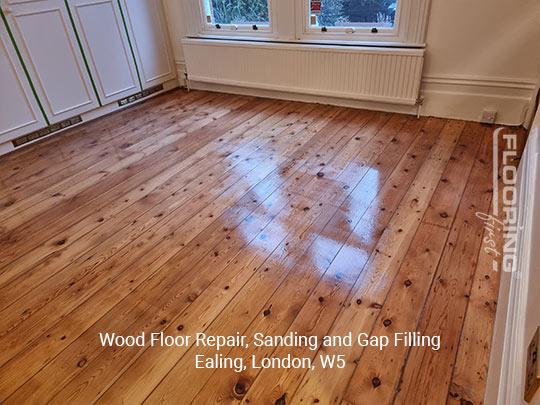
Lacquer finish: Two coats of hard-wearing water-based lacquer were applied with a light abrasion between coats. Lacquer is the right choice for high-traffic domestic floors — it holds up well against scuffing, is easy to clean and keeps the floor looking good between full renovation cycles.
The Result
All boards are solid and stable, the gaps are filled, and the surface is clean and evenly finished throughout. Lacquer refinishing after sanding and repairs typically costs £28 to £42 per square metre for a domestic floor of this type. This is a good investment given that a well-maintained real wood floor can last a century or more with periodic sanding and refinishing every eight to twelve years.
FAQ
What causes floorboards to become loose over time?
The most common causes are seasonal movement — wood expanding and contracting with changes in humidity — combined with the original fixings working loose over time. Damp from below can also cause boards to cup or lift. We always check the subfloor when refitting boards to rule out underlying moisture issues.
Is it worth filling gaps or should I just sand and lacquer over them?
Filling gaps before sanding is always worth doing. Unfilled gaps let cold draughts through from below, reduce insulation and collect dirt. They can also make the floor feel unstable underfoot. The gap-filling step is not expensive and makes a real difference to how the floor performs.
How often does a lacquered hardwood floor need resanding?
In a normal domestic setting, most hardwood floors benefit from a full sand and refinish every eight to twelve years. Light maintenance — cleaning the lacquer surface and applying a topcoat if it starts to look worn — can extend this considerably. We can advise on the right maintenance routine for your specific floor and finish.