Project Overview
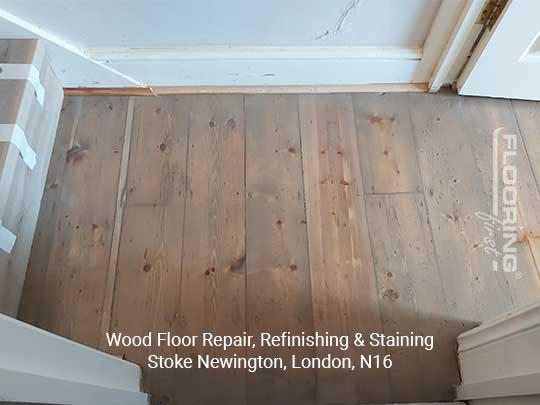
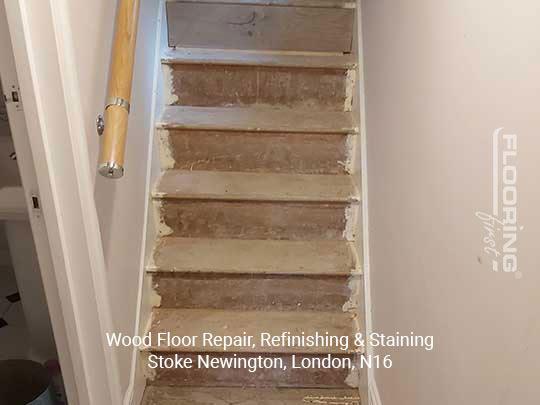
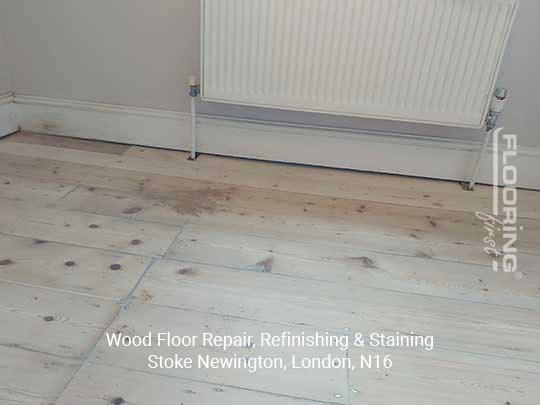
This was a challenging and rewarding wood floor renovation project in Stoke Newington. The floor was a wide-board solid wood installation that had seen years of heavy use and had received no professional maintenance in a long time. Several boards were damaged, there were open gaps throughout, and the surface finish had worn down to bare wood in places. The clients wanted the floor repaired, refinished and stained darker to match a recently updated interior. Our team handled the complete job from board replacement to final staining and lacquering.
The Challenge
Wide-board floors are more demanding to work with than narrow-board floors. The boards move more with seasonal humidity changes, which means gaps are often wider, and the boards themselves are heavier and can be harder to remove and replace without disturbing adjacent boards. Sanding wide boards also requires more attention to keeping the machine flat and level across the width of each board to avoid dishing. Getting the stain to penetrate evenly across both old and new boards required careful surface preparation, particularly on the replacement boards which were newer and had a tighter grain.
Our Approach
- Board replacement: Damaged boards were lifted individually and replaced with matching wide-board timber. New boards were secured with both adhesive and nailing for long-term stability.
- Gap filling: All significant gaps throughout the floor were filled with a sawdust-and-resin compound mixed to match the board colour as closely as possible.
- Sanding: A progressive sanding sequence from coarse to fine grit levelled the repaired areas and prepared the full surface for staining. Extra care was taken on the wide boards to avoid any dishing across the board width.
- Grain preparation on new boards: New replacement boards were lightly abraded by hand before staining to open the grain and encourage even pigment uptake.
- Staining: The agreed dark stain was applied and worked into the grain evenly. A second coat was applied to areas that needed more depth of colour.
- Lacquering: Two coats of hardwearing lacquer completed the job, protecting the stain and producing a consistent surface finish.
The Result
The transformation was considerable. What had been a tired, worn and gapped floor became a striking dark-stained wide-board floor that suited the updated interior perfectly. The repaired sections were not visible under the stain, and the gap filling had closed the most obvious gaps while leaving a natural look. The clients were extremely pleased with the result and described it as one of the best decisions they had made during their renovation. Sanding and refinishing a floor in this condition costs between £25 and £45 per square metre, with board replacement and gap filling costed based on the extent of work needed.
Frequently Asked Questions
Are wide-board floors harder to sand than narrow-board floors?
They require a bit more care, particularly around keeping the sanding machine flat across the board width, but they are not dramatically harder to work with. The main additional consideration is that wide boards move more with humidity changes, so gap filling needs to account for some residual seasonal movement.
How dark can you stain a wood floor?
You can go from a very light honey tone through to an almost black finish depending on the stain and the number of coats applied. We always do a test patch on an inconspicuous area or offcut before committing to the full floor so the client can see exactly what the finished colour will look like.
Do you cover Stoke Newington and north-east London?
Yes. We work regularly in Stoke Newington, Hackney, Islington, Dalston and the wider N and E postcode areas. Contact us to arrange a free survey and quote.