Project Overview
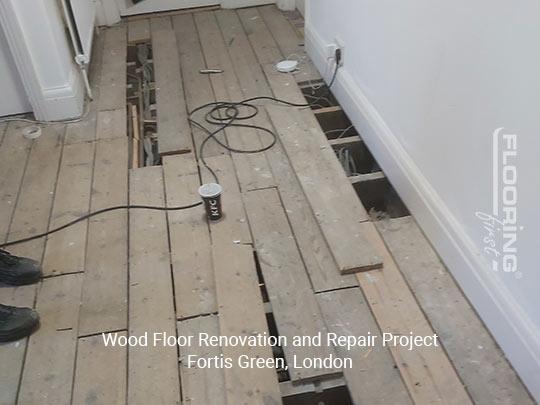
This Fortis Green property had original hardwood floorboards that had sustained a fair amount of damage over the years, including several boards that were beyond simple restoration and needed replacing, along with significant gaps throughout, surface wear, and loss of finish. The project involved a combination of board replacement, gap filling, full sanding, and refinishing to bring the floor back to a consistent, well-finished standard.
The Challenge
Renovation and repair work on older floors is always more complex than a straightforward sand and finish because you are dealing with the floor's history rather than starting from a blank canvas. Matching replacement boards to the existing timber is one of the more difficult parts, as the original floorboards in older properties are often a specific width, species, or grade that does not correspond directly to anything currently available off the shelf. Getting a close enough match that the repaired sections are not immediately obvious after sanding is a key part of the craftwork on projects like this.
Our Approach
Assessment and Board Replacement
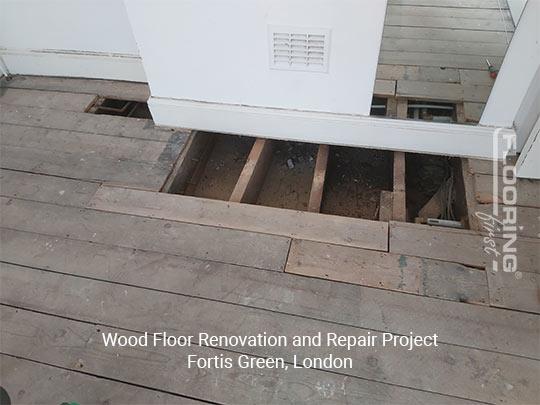
We started with a full inspection of every board to determine which ones could be restored through sanding and gap filling, and which were too damaged or structurally compromised to keep. The boards requiring replacement were carefully removed and new boards were sourced to match as closely as possible in species, width, and thickness. These were fitted and secured in place before any sanding began.
Gap Filling
Once all board replacements were complete, the gaps throughout the floor were filled with a resin and sawdust mixture. This was collected during the first sanding pass to ensure the colour of the fill matched the existing timber. All gaps were properly filled and left to cure before progressing to the finishing sanding stages.
Multi-Stage Sanding
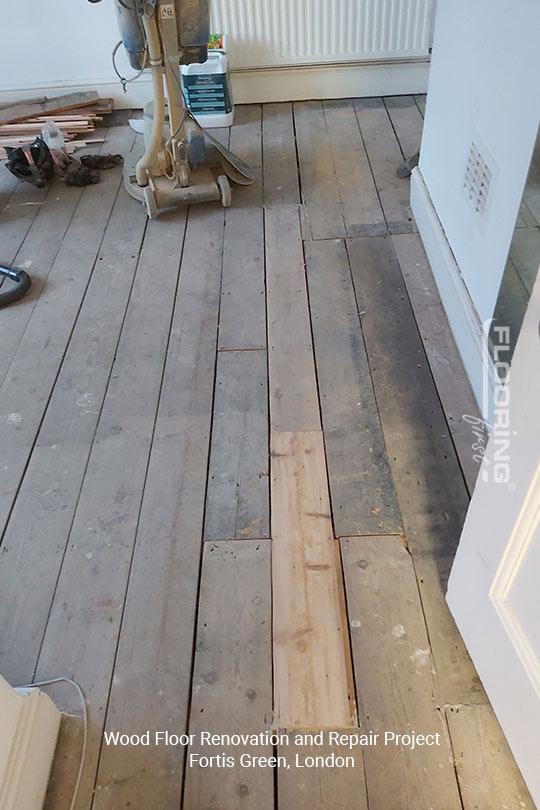
The full floor was sanded in stages, working from coarser grits to progressively finer ones. The replacement boards were blended into the existing floor surface during this process, and by the time the final fine-grit pass was complete, the new and old boards read as a consistent, unified floor surface.
Refinishing
Two coats of a hard-wearing lacquer were applied to protect the floor and provide a consistent finish across the whole area. The finish was chosen to complement the natural colour of the timber and give a clean, durable surface for everyday use.
The Result
The renovation was successful in bringing a worn and damaged floor back into good condition. The replaced boards blend well with the original ones, the gaps are gone, and the finished surface looks consistent and well-protected. The client was pleased with both the end result and the way potential problems had been identified and dealt with at the start. Renovation and repair work in London is typically priced alongside standard sanding rates of £25 to £45 per square metre, with additional costs depending on the extent of board replacement required.
Frequently Asked Questions
How do you match replacement boards to an older floor?
We source materials from specialist timber suppliers who stock reclaimed and period-matched flooring. The match is rarely perfect until the floor has been sanded, at which point the age difference in the timber becomes much less noticeable. The grain and colour tend to blend well under a consistent finish.
Is it worth repairing an old floor rather than replacing it entirely?
In most cases, yes, particularly with older properties where the original boards have character that modern replacements cannot replicate. Repair and renovation is also significantly cheaper than full replacement. We always provide an honest assessment of whether renovation will achieve the result the client wants before any work begins.
How long does a floor renovation like this take?
A project combining board replacement, gap filling, and full sanding and finishing typically takes two to three days for a standard room, depending on the extent of repairs needed. We always give a realistic timeline after the initial assessment.