Project Overview
This project in Romford involved a parquet floor that had accumulated years of wear and needed a full restoration through sanding, staining, and gap filling. Parquet floors respond well to this type of work — the solid wood blocks have enough depth to absorb a proper sand and come back looking significantly better. Parquet sanding and refinishing typically costs between £30 and £45 per square metre depending on condition and specification.
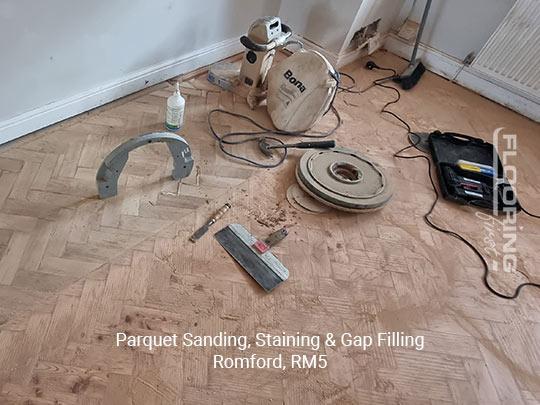
The Challenge
This project took us to a parquet floor in need of proper restoration. The floor had seen better days, with signs of wear and tear across the surface. A careful inspection confirmed that the blocks themselves were structurally sound — no significant lifting or loose sections — which meant sanding and refinishing was the right approach rather than a full strip-out and replacement. A good sanding and refinishing job can return a worn parquet floor to something close to its original condition, and that was the aim here.
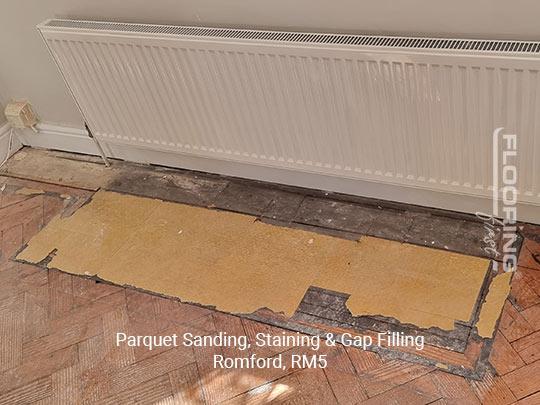
Our Approach
- Initial inspection: We checked the whole floor for loose, damaged, or missing blocks before starting. Any blocks that needed re-adhesion were glued and left to cure before sanding began.
- Gap filling: Gaps between blocks were filled prior to sanding. This creates a uniform surface and prevents filler from crumbling out after the finish is applied.
- Sanding: The floor was sanded with professional equipment, working through progressively finer grades. Parquet sanding requires care around the pattern joins where grain direction changes — rushing this stage shows in the finished result.
- Staining: A stain was applied to achieve the client's preferred colour tone. Staining parquet can transform the appearance considerably, and the colour chosen here worked well with the room's overall scheme.
- Finishing coat: A protective finish was applied over the stain to seal and protect the floor, giving it durability and making it straightforward to keep clean going forward.
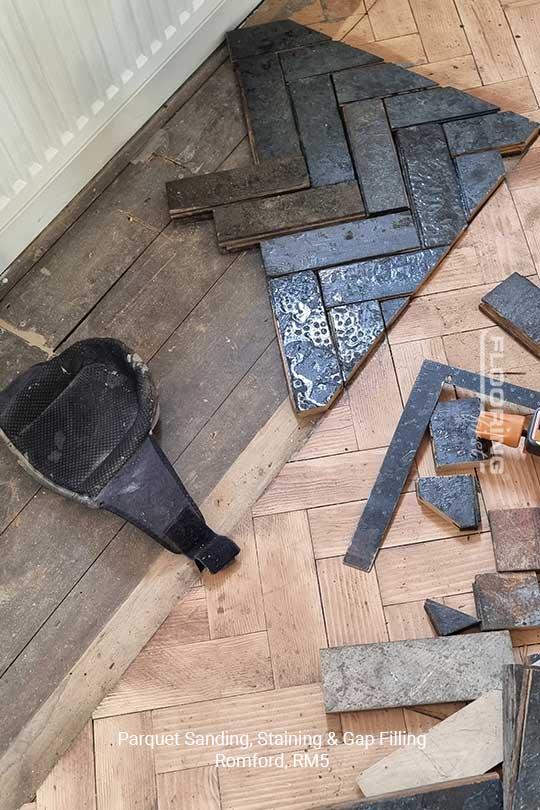
The Result
Floor restoration and refinishing services are recommended every several years, or once visible wear and deterioration becomes noticeable. This is the effect achieved for the Romford parquet floor — brought back to its initial condition. The staining gave the floor a fresh, considered look, and the finish coat means it is properly protected for the years ahead. The client was pleased with how the floor came out, and it is a good example of what proper restoration can achieve on a floor that might otherwise have seemed past its best.
Frequently Asked Questions
Q: When is it better to restore a parquet floor rather than replace it?
A: Restoration makes sense when the blocks are structurally sound, the pattern is largely intact, and there is sufficient thickness remaining in the wear layer for a sand. If more than 20 to 30 per cent of blocks are missing or beyond repair, replacement may be more practical. We assess this honestly during the initial visit and give a clear recommendation.
Q: Can you stain parquet to a dark colour?
A: Yes. Parquet takes stain well, and dark tones — such as dark walnut or ebony — are a popular choice. The key is applying the stain evenly and allowing adequate absorption time before applying the topcoat. We always do a test area first to confirm the colour result before committing to the full floor.
Q: How do I maintain a restored parquet floor?
A: Regular sweeping or vacuuming with a soft attachment, wiping up spills promptly, and avoiding wet mopping are the main requirements. For lacquered floors, a maintenance coat every few years keeps the surface in good condition. For oiled floors, periodic re-oiling is recommended. We advise on the correct maintenance products after completing each job.