Project Overview
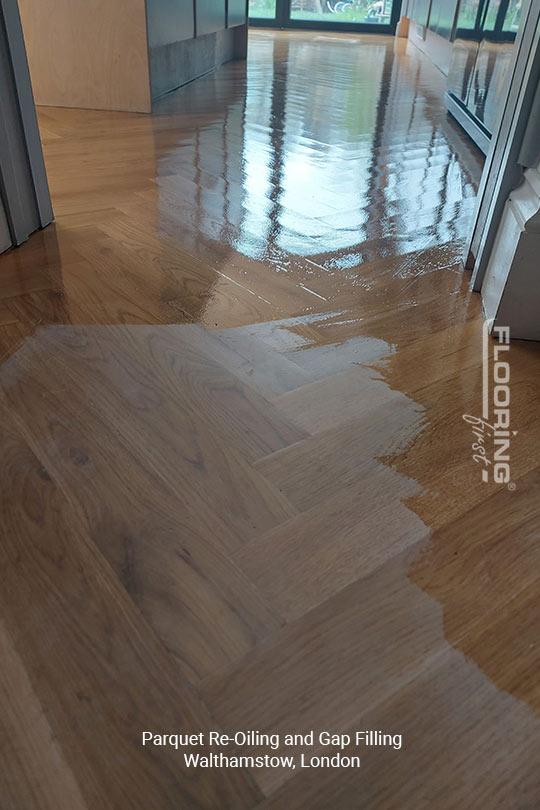
This parquet floor in Walthamstow had an oil finish that had not been maintained for several years and was showing the typical signs of a depleted oil coat: the surface had become dry and dull, the wood had lost its natural warmth, and minor gaps had opened between some of the blocks. Rather than a full sand, which would not have been necessary given the condition of the underlying wood, the right treatment was a targeted gap fill followed by a re-oil. This approach preserved the existing surface, required no heavy machinery, and was completed with far less disruption than a full sanding job. Re-oiling costs considerably less per visit than a full sanding cycle, making it a cost-effective part of any regular parquet maintenance programme.
The Challenge
The gaps in this parquet floor were relatively minor but distributed across a large area of the floor. Filling them required care because the gap fill had to sit flush with the surface of the blocks rather than proud of them, and the colour had to be a reasonable match for the existing wood. On an oiled floor where the surface is not being sanded down to bare wood, the filler cannot be matched by mixing it with fresh sanding dust, so the colour match relies entirely on selecting the right resin product. The re-oiling also needed to be done in stages rather than all at once, to allow each coat to be absorbed properly by the wood rather than pooling on the surface.
Our Approach
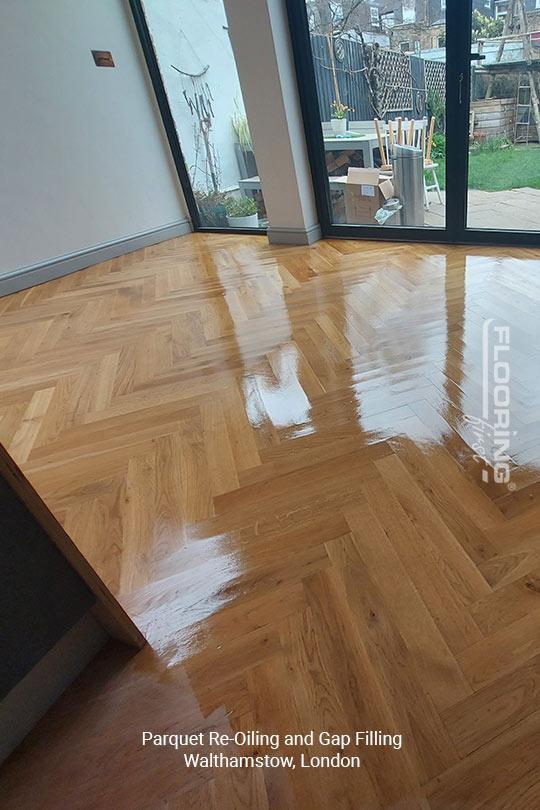
Initial inspection. We inspected the full floor to confirm that no blocks were loose and that the wood itself was in good condition beneath the depleted oil finish. No blocks required re-gluing, and no deeper sanding was needed.
Gap filling. The gaps between parquet blocks were filled with a natural resin compound selected for compatibility with an oiled finish. The filler was pressed into the gaps, allowed to cure, then lightly sanded flush with a fine abrasive pad to ensure a level surface before the oil was applied.
Surface preparation. The whole floor was lightly buffed with a fine pad to remove any surface contamination and open the wood's pores slightly, which helps the oil absorb evenly.
Oil application. Two coats of Osmo Polyx Hardwax Oil were applied, working in the direction of the block grain where possible. This product was selected for its combination of oil and wax, which gives a natural, lustrous finish and provides both penetrating protection from within the wood and a light surface hardness from the wax component.
The Result
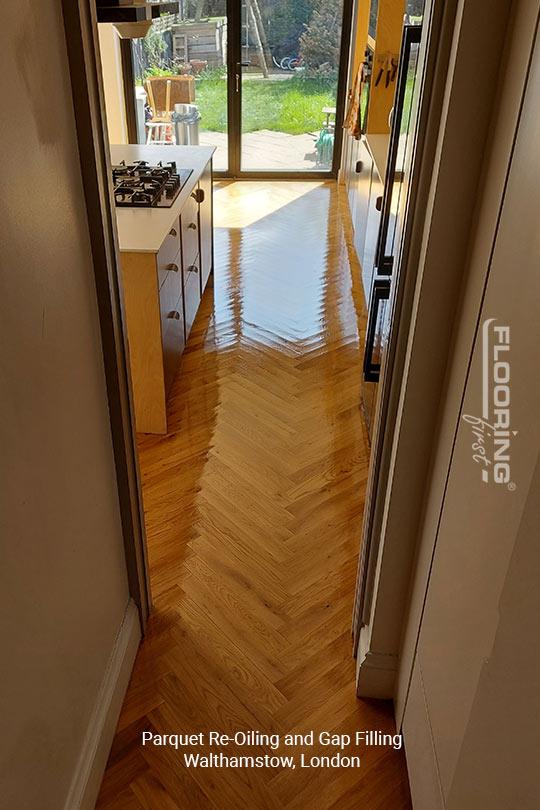
The floor came back to life after the re-oiling. The natural warmth and colour of the parquet wood returned fully once the Osmo oil was applied, the gaps were closed and invisible, and the surface had a consistent, healthy sheen throughout. The owners now have a parquet floor that is properly protected and will remain in good condition with a re-oil every year or two. On a well-maintained oiled parquet floor, the need for a full sand can be pushed back considerably by keeping up with regular re-oiling, making this a practical long-term maintenance strategy.
Frequently Asked Questions
How often does an oiled parquet floor need re-oiling?
In a busy household, re-oiling every one to two years is usually appropriate. Lightly used rooms may go three years between treatments. The floor itself gives clear signals when re-oiling is due: the surface looks dry, the colour becomes flat, and water no longer beads on the surface as it should on a well-oiled floor.
Does re-oiling require sanding the parquet first?
Not for a routine maintenance re-oil. A light buff with a fine pad to remove surface contamination and open the pores is usually all that is needed. Sanding is only necessary if the floor has scratches that have gone through the oil finish into the bare wood, or if the surface needs significant correction.
What is Osmo Polyx Hardwax Oil and why is it used on parquet floors?
Osmo Polyx is a combination of natural oils and hard waxes that penetrates the grain of the wood while leaving a light protective layer on the surface. It is popular for parquet floors because it gives a natural appearance that enhances the character of the wood pattern, it is hard-wearing for a penetrating oil, and it can be re-applied without stripping the old finish.