Project Overview
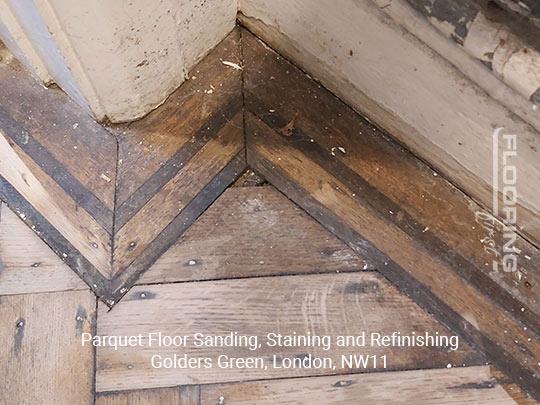
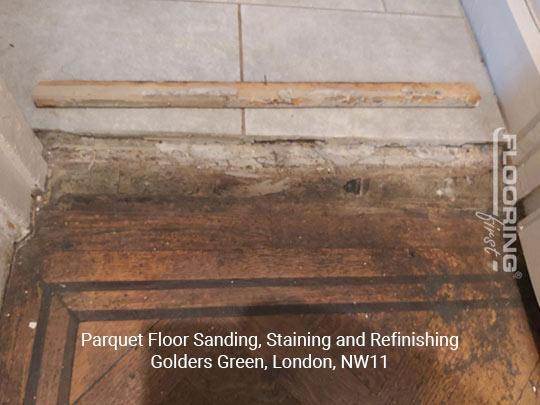
This Golders Green project centred on a traditional herringbone parquet floor in need of full restoration. The parquet had been laid years earlier and had become heavily scratched, stained in places and stripped of its protective finish in high-traffic areas. The clients wanted the floor stained to a richer tone than the original and refinished to a hard gloss. Our team approached this as a precision job from start to finish, given the complexity of the herringbone pattern and the need to sand across multiple angles without leaving visible sanding marks.
The Challenge
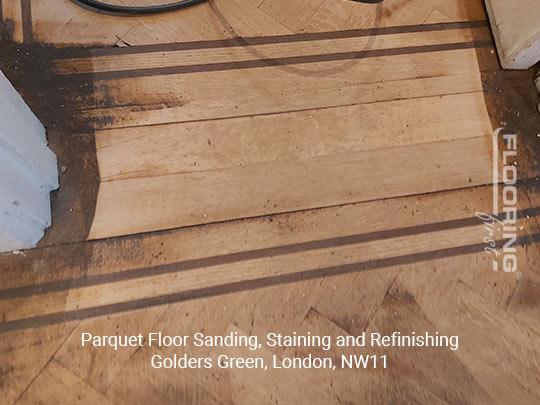
Parquet floors present a specific challenge for sanding because the blocks run in multiple directions. Sanding along the grain of one set of blocks puts you across the grain of the adjacent set. This means working at a diagonal to the pattern is often necessary, followed by careful fine-grit passes and buffing to remove any cross-grain marks. Any sanding marks left on a parquet floor become very visible once stain is applied, so the preparation has to be thorough. The staining also required even application across the whole floor to avoid blotching, particularly where some blocks were more porous than others.
Our Approach
- Assessment: We checked every block for stability before sanding began. Any loose blocks were re-adhered and allowed to bond fully before the machine sanding started.
- Diagonal sanding: The first machine pass ran diagonally across the herringbone pattern to cut through the old finish and surface damage without tearing along one grain direction only.
- Along-pattern passes: Progressive finer grits were then used in the direction of the pattern to remove any diagonal marks from the first pass.
- Hand sanding: Border blocks and corners were sanded by hand to ensure consistency with the main field.
- Staining: A dark wood stain was applied evenly and worked into the grain with a cloth before being allowed to penetrate fully. A second coat was applied to areas that required greater depth of colour.
- Lacquering: Three coats of lacquer were applied to build a hard, high-gloss finish appropriate for a parquet of this quality.
The Result
The restored parquet looked exceptional. The rich stain brought out the geometry of the herringbone pattern and the three-coat lacquer produced a deep, reflective finish. The clients were delighted with how dramatically the room had changed without any structural work at all. Parquet sanding and refinishing in London typically runs between £70 and £100 per square metre given the additional labour involved in working with the pattern. It is, however, significantly cheaper than relaying a new parquet floor and produces outstanding results on a well-laid original.
Frequently Asked Questions
Can you change the colour of a parquet floor with staining?
Yes. Staining allows you to go darker than the natural wood tone. Going lighter requires bleaching, which is a more involved process. We can provide stain samples on a small test area before committing to the full floor.
How many coats of lacquer does a parquet floor need?
For a high-traffic residential area, we recommend at least three coats. The first seals the wood and stain, the second builds the protective layer, and the third gives the final surface hardness and sheen.
Is my parquet floor worth restoring if some blocks are loose?
Usually yes, provided the majority of the floor is sound. Loose blocks can be re-glued as part of the preparation stage. We only recommend replacement where a significant proportion of blocks are damaged beyond saving.