Project Overview
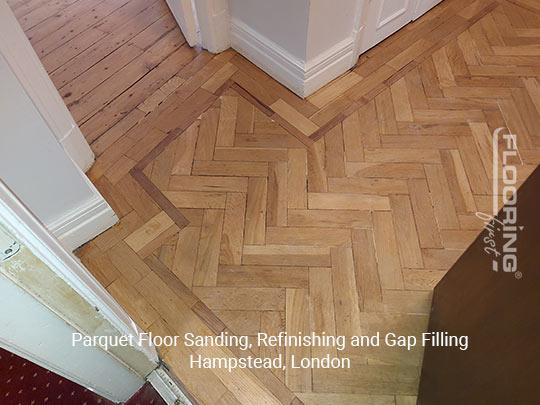
A beautiful parquet floor in Hampstead had developed a number of problems that needed addressing. The finish was heavily worn, gaps had appeared across the block pattern, and the overall surface looked dull and tired. The owners had owned the property for several years and wanted to restore the floor to its original standard before redecorating. Parquet floors in Hampstead properties are often original to the house and made from quality hardwood, so restoration is nearly always the right choice. Professional parquet sanding in London typically costs in the region of £70 to £100 per square metre due to the additional skill and time required compared to a standard plank floor.
The Challenge
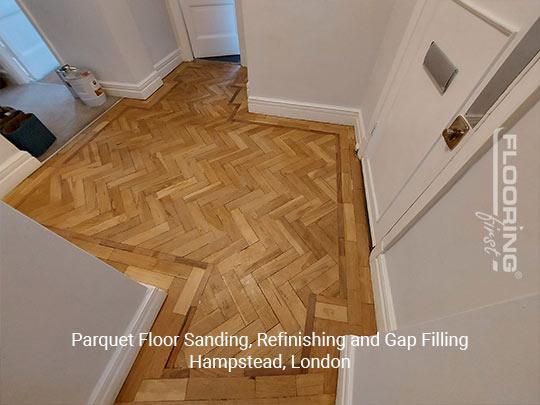
Parquet floors are sanded differently to straight-plank floors because the blocks run in multiple directions to form the pattern. Sanding always has to follow the grain; otherwise the cross-grain scratching left by the machine becomes visible under the finish. On a herringbone or basket-weave pattern, achieving a consistent, scratch-free surface requires diagonal sanding passes at specific angles, careful edging around the perimeter, and detailed hand scraping in tight spots. The gap filling on this floor also required more attention than usual because the gaps were not uniform, varying in width depending on where the floor had contracted most. Each section had to be filled to the right level without overfilling.
Our Approach
Full floor inspection. Before any sanding, we checked every block for looseness and the subfloor for any soft spots or movement. All loose blocks were re-glued and left to cure before we moved on.
Gap filling with resin mixture. We mixed natural resin with the fine dust generated during the first sanding pass to produce a filler that closely matched the floor colour. The filler was pressed firmly into each gap, allowed to cure fully, then lightly sanded flush with the surface.
Multi-stage sanding. The floor was sanded in three stages using progressively finer grits. The initial passes worked diagonally across the pattern to remove the old finish and any deeper surface imperfections. Subsequent passes followed closer to the grain direction to eliminate any cross-scratch marks. Edge sanding and hand scraping completed the perimeter.
Lacquer finish application. At the client's request, two coats of a high-quality lacquer were applied. Lacquer was chosen for its durability and the clean, clear finish it gives to a classic parquet pattern.
The Result
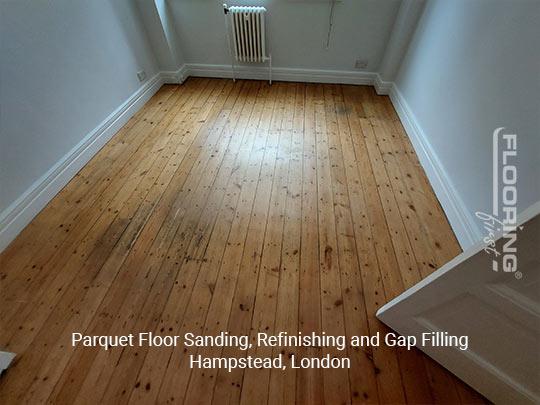
The restored floor was a significant improvement on what we arrived to. The old, dull finish was completely removed, the gaps were invisible, and the lacquer brought out the full depth of colour in the hardwood blocks. The pattern looked crisp and precise once the surface was flat and uniformly finished. The owners were very pleased with the result, and the floor now sits at the heart of a freshly redecorated room looking exactly as it should.
Frequently Asked Questions
Why does parquet sanding cost more than sanding a straight-plank floor?
Parquet requires multiple sanding angles rather than one straight pass, takes longer per square metre, and demands more experience to avoid visible cross-grain scratching. The additional time and skill involved accounts for the higher rate.
How many times can a parquet floor be sanded in its lifetime?
This depends on the thickness of the blocks. Solid parquet blocks are typically 22mm thick, and each full sand removes around 0.5 to 1mm of wood, so a well-maintained parquet floor can be sanded many times before the blocks become too thin.
Is lacquer or oil a better finish for parquet?
Both work well. Lacquer gives a harder, more durable surface film that is good for high-traffic rooms. Oil gives a more natural look and feel and is easier to spot-repair, but needs re-applying more regularly. The choice comes down to preference and how much maintenance the owner wants to carry out.