Project Overview
This project in Rickmansworth brought an ageing parquet floor back into good condition through sanding, buffing, gap filling, lacquering, threshold fitting, and installation of replacement oak parquet blocks. Parquet sanding typically costs between £30 and £45 per square metre, with the final price reflecting the amount of repair work and the number of finish coats specified.
The Challenge
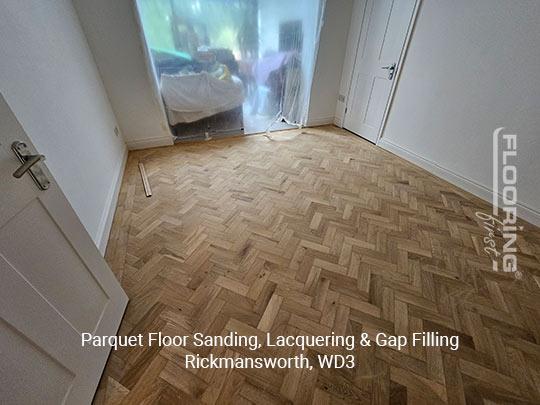
The project involved various tasks including sanding, buffing, lacquering, fitting thresholds, and material installations. The main focus was to bring the parquet flooring back to life and restore its natural character. Our team used the latest sanding equipment and techniques to remove blemishes, roughness, and scratches from the surface. Once the floor was smooth, it was buffed with care to ensure uniformity and to bring up its natural sheen before any finish was applied.
Our Approach
The job was broken down into clearly defined stages:
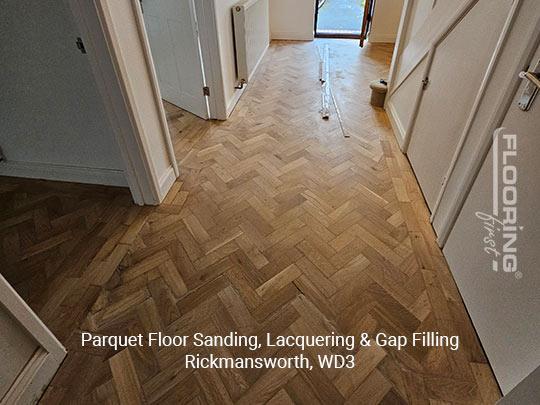
- Assessment and preparation: We inspected the full floor area to identify loose, damaged, or missing parquet blocks. Loose blocks were re-glued and any that could not be saved were replaced with matching oak parquet to maintain a consistent pattern.
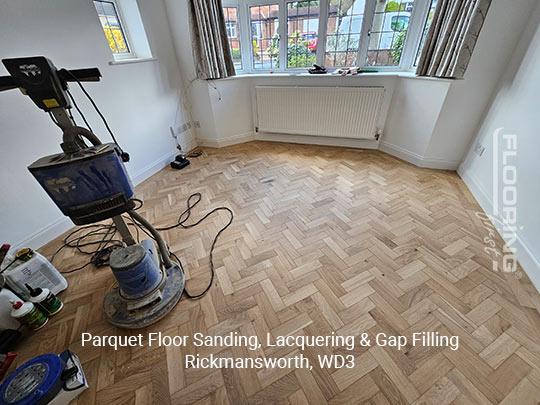
- Sanding: Using professional drum and edge sanders, we worked through the floor in multiple passes — starting with a coarser grade to level the surface and remove the old finish, then progressing to finer grades for a clean, smooth result.
- Buffing: After sanding, buffing machines were used to finish the surface and prepare it for lacquering.
- Gap filling: Any gaps between parquet blocks were filled to produce a consistent surface before the lacquer was applied.
- Lacquering: Multiple coats of lacquer were applied with adequate drying time between coats to build a durable, protective finish.
- Thresholds: New threshold strips were fitted to complete the edges and transitions across the floor.
The Result
Our team fitted new thresholds and installed quality oak parquet flooring blocks to replace any sections that could not be restored. The sanding, buffing, and lacquering process transformed what was a worn and tired parquet floor into something that looks properly looked after. The Rickmansworth client now has an elegant, classic floor that will continue to perform well with straightforward maintenance.
Frequently Asked Questions
Q: How many times can a parquet floor be sanded?
A: Traditional solid parquet blocks are typically 10mm to 16mm thick. Depending on how much material is removed each time, a solid parquet floor can usually be sanded four to six times over its lifetime. This makes it an excellent long-term investment compared to thinner engineered options.
Q: What happens when parquet blocks are missing or damaged?
A: We source matching replacement blocks as closely as possible in terms of species, size, and grain. Once sanded across the whole floor, the colour difference between old and new blocks tends to even out considerably, particularly after staining or lacquering.
Q: How long does a parquet sanding job take?
A: A typical room of around 20 to 30 square metres generally takes two to three days, including sanding, filling, and applying lacquer coats with drying time in between. Larger areas or heavier repairs will add to this.