Project Overview
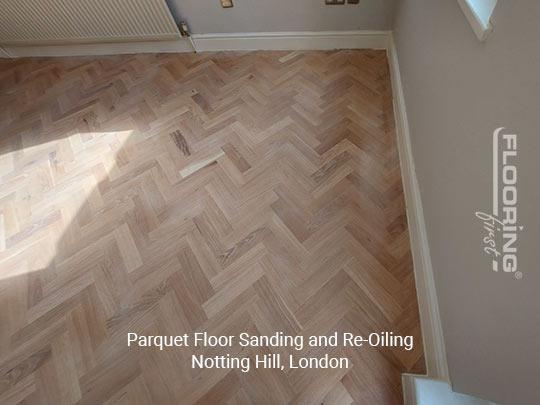
This Notting Hill property had a classic herringbone parquet floor that had been in the home for decades. The owners had been putting off a full sanding and re-oiling for a while, but the floor had reached the point where the old oil finish was worn through in the main walkways and the wood had lost its warmth and depth. They wanted the floor brought back to a natural, open-grained oil finish rather than a lacquered look, which suited the character of the property well.
The Challenge
Parquet floors require a different approach to sanding compared to standard strip boards. The blocks are laid at opposing angles in a herringbone pattern, which means that following a simple straight sanding line across the floor would mean working against the grain on half the blocks at any given point. Do that with a heavy drum sander and you risk tearing the fibres and leaving scratch marks that are very difficult to remove. The other challenge was the floor's existing oil finish, which had built up unevenly over the years and needed to be stripped back completely before a new application could be done correctly.
Our Approach
Initial Assessment
We started by walking the full floor to check for any loose or raised blocks, and to assess the depth of remaining timber above the tongue. This confirmed there was enough material to sand back without any risk to the structural integrity of the blocks.
Diagonal Sanding Passes
To sand a herringbone parquet correctly, you work at 45 degrees to the main pattern, which puts the machine at roughly the same angle to the grain of each alternating block. We worked through multiple grit stages, starting coarser to remove the old finish and level the surface, then finishing finer to prepare the wood for oiling. A belt edger and hand scrapers were used close to the skirting boards and in corners.
Dust Removal and Preparation
Before oiling, the floor was thoroughly vacuumed and tack-cloth wiped to remove all residual dust. Even small amounts of dust trapped under an oil finish will affect the final appearance and durability.
Oil Application
We applied a hardwearing natural wood oil in two coats, buffing the first coat into the wood and allowing it to cure before the second application. Oil finishes suit parquet particularly well because they penetrate the wood rather than sitting on top, giving the floor a more natural feel underfoot and making localised touch-ups easier in the future.
The Result
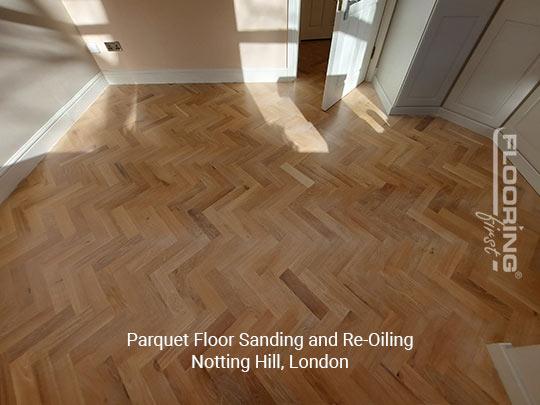
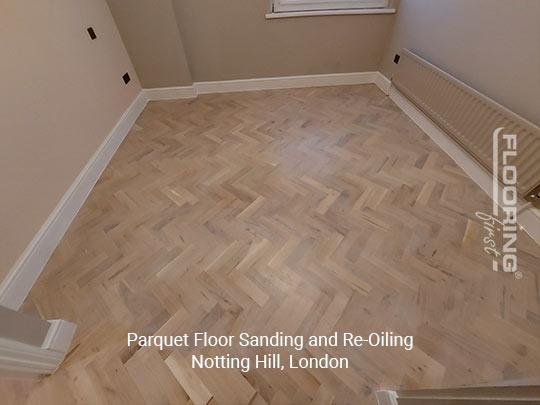
The finished floor looks genuinely transformed. The herringbone pattern shows clearly, the wood grain is visible, and the oil finish gives the blocks a warm, natural tone that suits the property. The owners were particularly pleased with how consistent the result was across the whole room. Floor sanding projects in London typically cost between £25 and £45 per square metre, with parquet at the upper end of that range due to the additional care required during sanding.
Frequently Asked Questions
How often does an oiled parquet floor need re-oiling?
In a domestic setting with normal use, a fully sanded and re-oiled parquet floor typically needs a maintenance coat every one to two years. This is a much quicker process than a full sand and does not require furniture removal or extended drying times.
Is oil or lacquer better for a herringbone parquet floor?
Both are suitable, and the choice comes down to the look and feel you want. Lacquer gives a more protective hard surface and is easier to keep clean in busy households. Oil gives a more natural, matte appearance and can be touched up in small areas without resanding. Parquet in older properties often suits oil better aesthetically.
Can a parquet floor be repaired if some blocks are damaged or missing?
Yes, individual blocks can be replaced. We source matching timber where possible, and after sanding the full floor the repaired sections blend in well. If the original wood species is unusual, sourcing a close match takes longer, but it is rarely impossible.