Project Overview
This project involved the full repair and restoration of an original parquet floor inside a listed Old Town House in Woolwich. Carried out as part of an English Heritage project, the brief required us to retain as much of the original material as possible and use seasoned reclaimed timber to replace only what could not be saved. The floor had been in place for many decades and while sections were in reasonable order, other areas had suffered lifting, cracking and loss of individual blocks. The entire floor was also heavily worn and dull, with old wax and grime built up in the joints.
The Challenge
Heritage projects present specific constraints. We could not simply pull up damaged areas and replace with new timber — the character and age of the reclaimed blocks had to be matched. Modern parquet is machine-cut to consistent dimensions, but original parquet from older buildings tends to vary slightly in thickness and size. Finding seasoned reclaimed blocks that matched both the dimensions and the species of the existing floor took time and care. Beyond the sourcing challenge, parquet sanding always requires skill because the blocks run in multiple directions. Sanding against the grain on any run of blocks will leave scratches that are very difficult to remove.
Our Approach
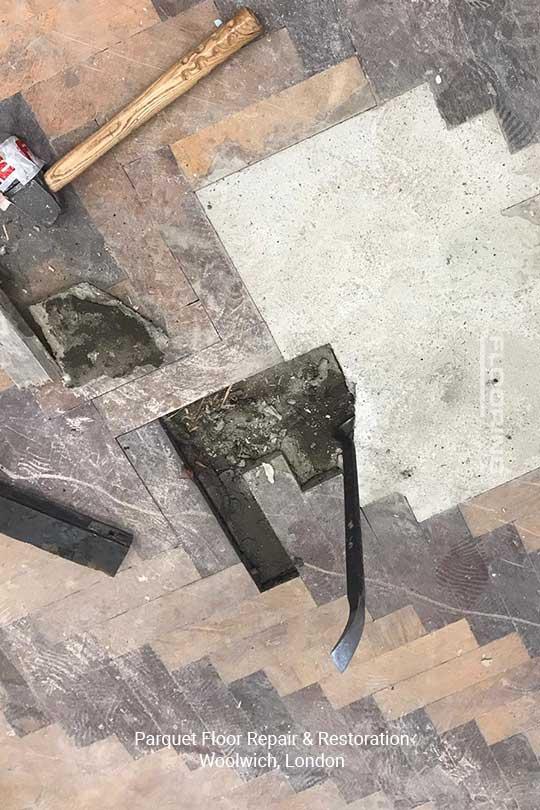
Block repair and reinstatement: We started by going over the entire floor block by block, testing for movement, hollowness and structural failure. Loose blocks were carefully lifted, the adhesive bed cleaned down to bare subfloor, and the blocks reset with an appropriate adhesive. Where blocks were too damaged or missing entirely, seasoned reclaimed timber was cut to fit and bedded in to match the surrounding pattern as closely as possible.
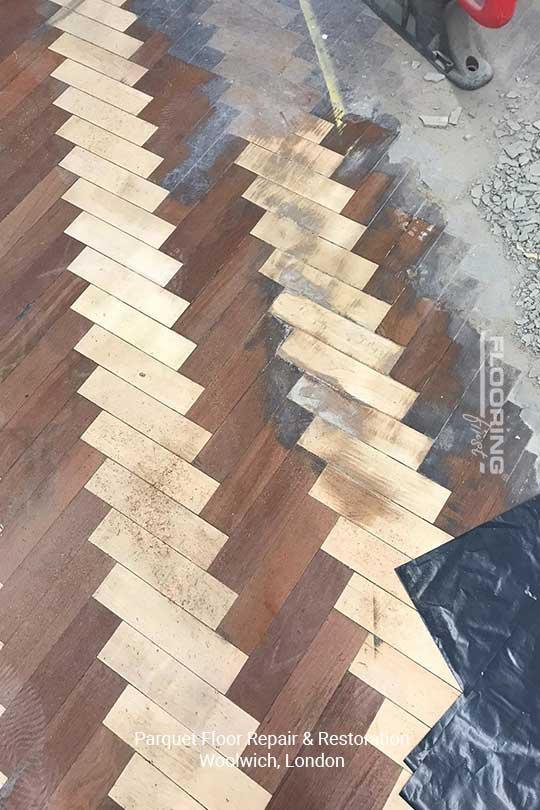
Gap filling and joint cleaning: Original parquet often accumulates old wax, polish residue and grime in the joints over time. We cleaned the joints out before filling where needed with a resin and sawdust mix compatible with the period finish we planned to apply.
Multi-directional sanding: We used a combination of belt sanders and rotary machines suited to parquet work, adjusting direction carefully across each section of the pattern. The floor was taken through several grits from coarse to fine until the surface was consistent and smooth throughout.
Finishing: Given the heritage context, the finish was selected to suit the original character of the floor — a hard wax oil that gives a natural low-sheen appearance without the plastic look of lacquer. This approach also makes future maintenance easier: small areas can be re-oiled without the need to sand back the whole floor.
The Result
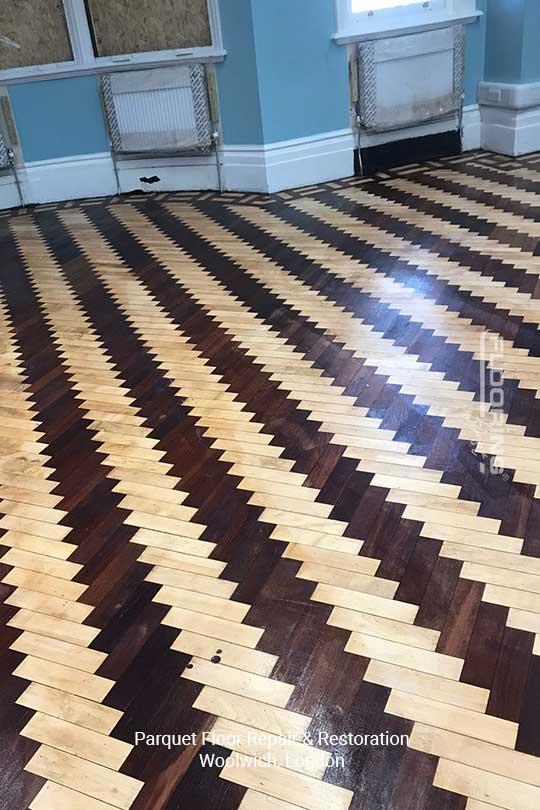
The restored floor now reads as a complete and consistent piece of work. The repaired sections blend with the original, the surface is clean and even, and the oil finish gives the blocks a warm, natural tone in keeping with the character of the building. Parquet restoration of this type typically falls in the £70 to £100 per square metre bracket depending on the extent of block repair required. This project stands as a good example of the level of care and patience the work demands.
FAQ
Can any parquet floor be restored, or are there cases where replacement is better?
Most parquet floors can be restored provided the subfloor is structurally sound and a reasonable proportion of the original blocks are intact. Where more than 30 to 40 per cent of blocks are damaged, replacement sometimes makes better sense economically. We always carry out an honest assessment before recommending either route.
Do reclaimed replacement blocks ever stand out after sanding?
With well-matched reclaimed timber, the difference is minimal once sanding and finishing is complete. The age and slight tonal variation in reclaimed blocks can actually help them blend with an original floor better than new timber would.
Is hard wax oil suitable for a high-traffic area in a public building?
Modern hard wax oils are very durable and well suited to heavy use. They penetrate into the wood rather than sitting on top as a film, which means they resist scuffing differently to lacquer. Spot repairs and re-oiling can be done locally if a section becomes worn, without disrupting the whole floor.