Project Overview
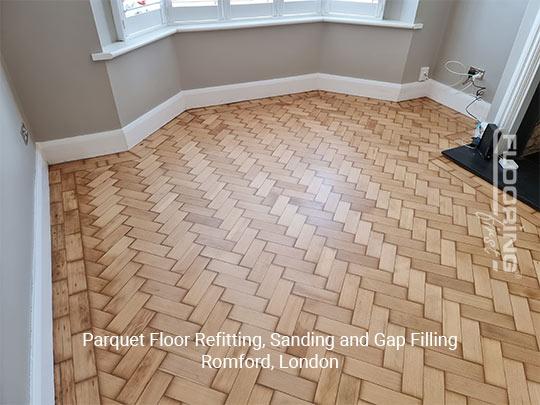
This Romford property had a traditional pine parquet floor that had seen many decades of use. The overall pattern was intact and the wood itself was in reasonable condition, but closer inspection showed loose blocks, gaps between sections and a tired, heavily worn finish. Rather than ripping it out, the owners sensibly opted for a full restoration: re-gluing the loose blocks, filling the gaps and sanding and refinishing the surface. Parquet restoration typically falls in the higher end of the sanding price range at around £70-100 per square metre, but it is almost always better value than replacement given the character of original parquet floors.
The Challenge
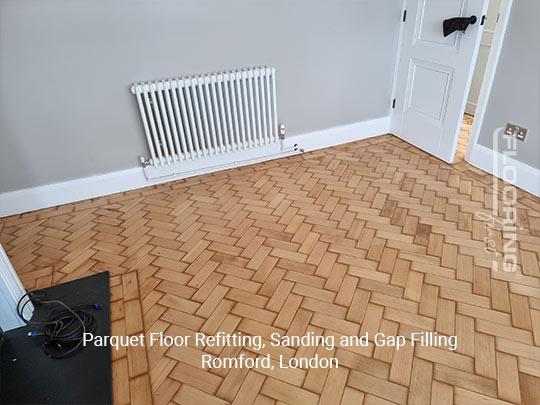
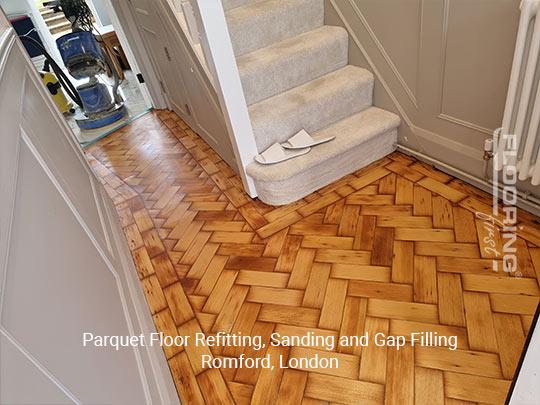
Parquet floors present several challenges that solid plank floors do not. First, the blocks are laid in directional patterns, which means you cannot sand straight down the room in one direction. Sanding across the grain damages the surface, so parquet requires multiple diagonal and cross-grain passes with careful feathering at each stage. Second, loose blocks have to be identified and re-glued before any sanding takes place, because a block that lifts mid-sand can cause serious damage to the machine and uneven results. Third, the gaps in this floor were at different stages, some small and tight, others wide enough to trap debris. A uniform fill was needed that would blend with the rest of the surface after sanding.
Our Approach
Block inspection and re-gluing. We worked across the entire floor systematically, pressing each block to identify loose ones. Loose blocks were carefully lifted where necessary, the old adhesive was cleaned from the subfloor, and fresh flooring adhesive was used to refix them. Any blocks that were split or beyond saving were replaced with matching pine stock.
Gap filling. Once all blocks were secure and the adhesive had cured, we mixed a filler of natural resin and wood dust. This mixture remains slightly flexible when dry, which means it contracts and expands with the wood rather than cracking away from the edges. Using the sanding dust from the floor itself ensures the colour match is as close as possible.
Multi-pass sanding. The floor was sanded in several stages, starting with a coarser grit to remove the old finish and surface imperfections, then progressing to medium and fine grits to achieve a smooth, uniform surface. We worked diagonally across the herringbone pattern and used edging machines and corners scrapers to reach the areas the drum sander cannot access.
Refinishing. Two coats of a durable finish were applied to seal the floor and protect it from further wear.
The Result
The finished floor looked completely different to the one we started with. Every trace of the old worn finish was gone, the blocks sat level and tight with no movement, and the gaps had been filled to an almost invisible finish. The natural warmth and pattern of the pine parquet came back fully once the new finish was applied. This floor will now last many more decades with normal maintenance.
Frequently Asked Questions
How long does parquet floor restoration take?
A typical residential parquet floor of around 20-40 square metres takes two to three days, allowing for drying time between the gap fill and the final finish coats.
What is used to fill the gaps in parquet floors?
We mix a paste of natural wood resin and sawdust collected during sanding. This gives a colour-matched, flexible filler that does not shrink or crack when the floor moves seasonally.
Is it worth restoring old parquet rather than replacing it?
Almost always yes. Original parquet, particularly in older London homes, is often made from better-quality wood than modern equivalents and has a character that is hard to replicate. Restoration costs a fraction of replacement and the results can be remarkable.