Project Overview
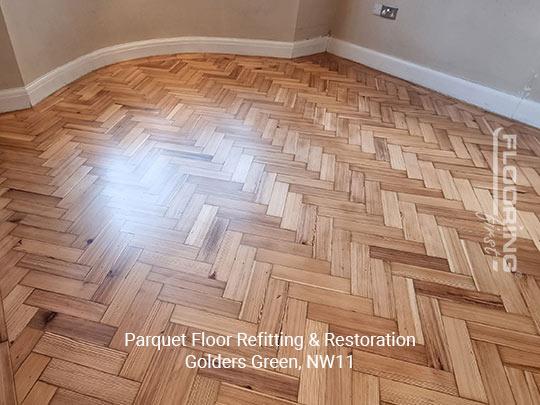
This Golders Green project involved a full parquet floor restoration — inspecting the condition of each block, addressing repairs and loose sections, sanding the entire surface back to bare wood, and applying a lacquer finish to protect and seal it. Parquet restoration costs typically sit between £30 and £45 per square metre, depending on the extent of repairs and the finish specified.
The Challenge
Parquet floor restoration is a process that requires care and attention to detail. The first step is a thorough inspection of the floor to assess the extent of any damage or deterioration. Once this is completed, the next stage is sanding the floor to even out the surface. This is a critical step — the quality of the sanding determines the quality of the final finish. Sanding a parquet floor requires patience and the right equipment, particularly around the edges and in the corners of the pattern where a drum sander cannot reach.
Our Approach
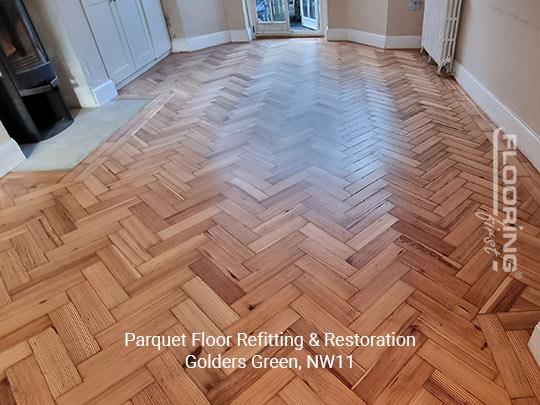
- Full floor inspection: Each section of the parquet was checked for loose, lifting, or damaged blocks. Areas where the adhesive had failed were identified, blocks were re-glued and clamped, and any blocks beyond repair were sourced and replaced.
- Surface preparation: Once all blocks were secure and any repairs had cured, the floor was ready for sanding. Sanding a parquet floor requires careful attention to the direction of the grain — different sections of a herringbone pattern run at angles to each other, so the sanding approach needs to account for this to avoid cross-grain scratching.
- Sanding: We worked through the floor with a drum sander for the main field and an edge sander for the borders, progressing through grades of abrasive to produce a clean, even surface.
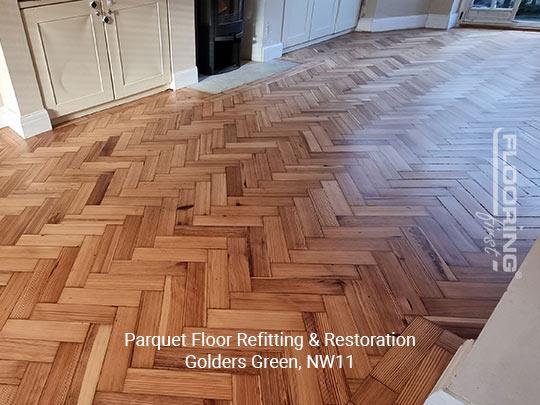
- Lacquering: Multiple coats of lacquer were applied to protect the restored surface and bring out the natural character of the wood. Each coat was allowed to cure fully before the next was applied.
The Result
Finally, the lacquer was applied to protect the floor from future damage. The process of inspecting, repairing, sanding, and lacquering has restored this Golders Green parquet floor to a condition it has not been in for many years. A properly lacquered parquet floor is straightforward to maintain and will continue to look well for a long time with basic care. This type of restoration is exactly what makes parquet such a worthwhile flooring investment — it can be renewed rather than replaced.
Frequently Asked Questions
Q: Can old parquet floors be fully restored regardless of their age?
A: In most cases, yes — provided the blocks themselves are structurally sound and the overall pattern is largely intact. Parquet floors in London properties are often 50 to 80 years old and can still be brought back to excellent condition. The key variables are the thickness of the remaining wear layer and how many times the floor has previously been sanded.
Q: What causes parquet blocks to lift or come loose?
A: The most common cause is moisture, either from damp rising through the subfloor or from water spills that have not been cleaned up promptly. Adhesive failure over time is also a factor in older floors where the original bitumen-based adhesive has dried out. Re-gluing loose blocks is a standard part of any parquet restoration.
Q: Is lacquer or oil better for parquet?
A: Both work well, and the choice comes down to preference. Lacquer gives a harder surface that is more resistant to water and abrasion. Oil gives a more natural, open look and can be spot-repaired without re-sanding the whole floor. For high-traffic areas, lacquer is generally the more practical choice.