Project Overview
This Hampstead job was a large-scale project running two workstreams in parallel: the installation of a new parquet floor in one section of the property, and the full renovation and refinishing of an existing parquet floor in another. Jobs of this size require careful coordination — both teams need clear ownership of their area, the right materials on site and a shared schedule so that neither workstream holds the other up. The new installation covered subfloor preparation and parquet fitting, while the renovation side included gap filling, sanding and oil finishing. Parquet fitting in Hampstead typically sits at £70 to £100 per square metre all-in.
The Challenge
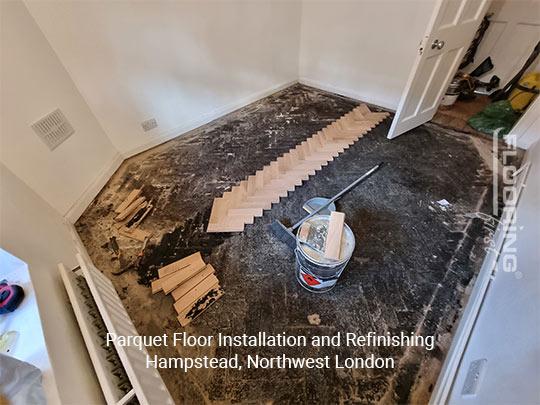
For the new installation, the subfloor moisture reading came back higher than acceptable for direct parquet fitting. Excess moisture trapped beneath wooden blocks causes them to expand, leading to lifting, creaking and eventual structural failure. This had to be addressed properly before any blocks were laid. On the renovation side, the existing parquet had significant gaps, a worn finish and some areas of localised damage that needed repair before sanding could begin. Working on both simultaneously under one roof meant dust management and scheduling required thought — sanding produces dust that settles on freshly laid floors if the two operations are not properly sequenced.
Our Approach
Subfloor preparation (new installation): A damp-proof membrane was installed across the full area to be covered with new parquet. This acts as a barrier between the subfloor and the timber, preventing moisture migration. Once the membrane was in place and moisture readings confirmed acceptable, we laid a plywood substrate over the top to provide a firm, level, clean base.
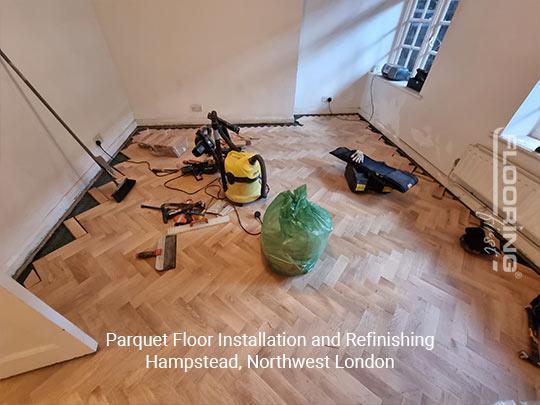
Parquet fitting: Blocks were laid in the agreed herringbone pattern, working out from the centre line of each room. Each block was checked for level as it went down and tapped in tight before fixing. Parquet installation is methodical, time-consuming work — the precision of the layout at the start determines the quality of the finished pattern. Flooring accessories were fitted once the main field was complete.
Renovation of existing parquet: The second team tackled gap filling first — wide gaps received pine slivers, fine gaps a resin mix — followed by a full sanding programme using equipment suited to multi-directional parquet work. The floor was then oil finished, giving a natural, low-sheen result that suits older parquet well and is straightforward to maintain.
The Result
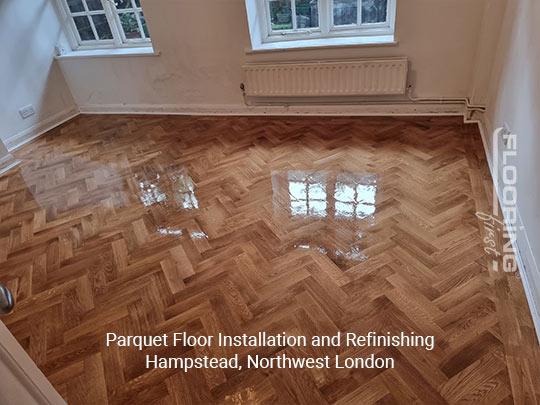
Both areas of the project were completed on schedule. The new parquet floor has a clean, precise pattern and a durable lacquer finish. The renovated parquet looks and feels in excellent condition, with the oil finish bringing out the natural warmth of the original timber. Running two workstreams on a job of this size requires experience and clear team organisation — it is not the kind of project to hand to a single operator working alone.
FAQ
Why does parquet installation cost more than laying standard strip flooring?
Parquet requires significantly more time per square metre because each block is individually placed and aligned to create the pattern. There is very little room for error — a block out of square affects the whole run. The material costs are also higher. As a rough guide, parquet fitting in London typically starts at £70 per square metre and can reach £100 or more for complex patterns or difficult subfloor conditions.
How long does a parquet floor take to install?
A room of around 30 to 40 square metres with straightforward subfloor conditions will take a skilled team two to three days to prepare, lay and finish. Larger or more complex projects take longer. We give realistic timelines when quoting and stick to them.
Can oil and lacquer finishes both be used on parquet?
Yes. Lacquer forms a hard surface film and is very durable, making it a good choice for areas with heavy foot traffic. Oil penetrates into the wood and gives a more natural look. Both are suitable for parquet. The trade-off is that lacquer is harder to spot-repair if it gets scuffed, while oil can usually be touched up locally without needing to re-sand the full floor.