Project Overview
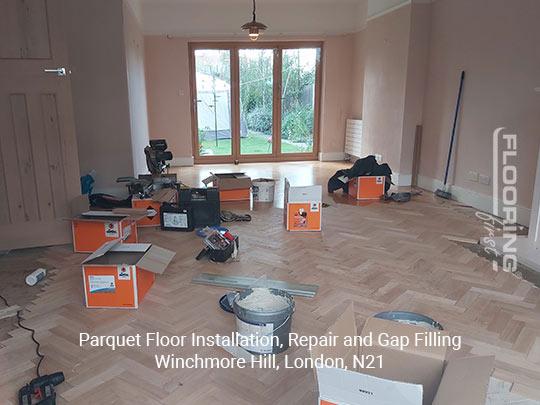
This project in Winchmore Hill, North London, combined parquet floor repair, gap filling, sanding, and lacquering to bring an ageing floor back to a high standard. The property was a traditional semi-detached house with a herringbone parquet floor covering the hallway and reception room. Over the years, moisture fluctuations had caused a number of blocks to lift and some to develop splits, while gaps between blocks had grown wide enough to trap dirt. Rather than replacing the floor entirely, the client chose a full restoration, which is considerably more cost-effective and preserves the original character of the floor.
The Challenge
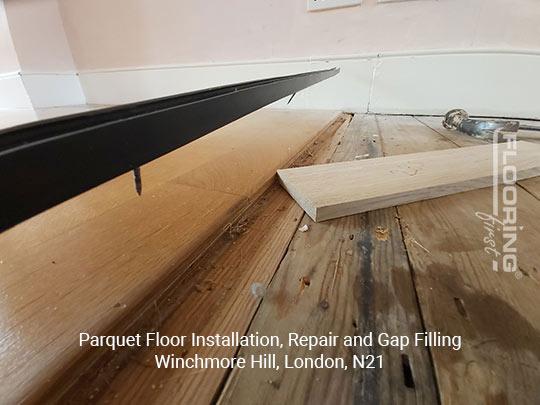
The main complication here was the extent of the block damage. Several blocks were not just loose but had split along the grain, meaning they needed to be removed and replaced rather than simply re-glued. Finding matching replacement stock that would blend with the original aged oak was important, as poorly matched replacements can make a repaired floor look patchy. The floor also had a wide variation in gap size, with some sections being tight and others having gaps of two or three millimetres, requiring careful filler work to achieve a consistent result across the whole surface.
Our Approach
- Damage assessment: We mapped the floor systematically, marking every loose, cracked, or damaged block for attention before any sanding equipment was brought in.
- Block replacement: Damaged blocks were carefully removed to avoid disturbing the surrounding ones. Replacement blocks in matching oak were glued and clamped in position, allowed to cure fully overnight.
- Re-gluing loose blocks: Undamaged blocks that had lifted were cleaned of old adhesive residue, re-glued with a flexible wood adhesive, and weighted down until set.
- Gap filling: We mixed a two-part resin with sanding dust to produce a filler matching the floor's natural colour, packed this into every gap, and allowed it to fully harden before sanding commenced.
- Sanding: The surface was sanded in the correct diagonal sequence for herringbone parquet, moving through coarse, medium, and fine grits to achieve a flat, smooth result. Edge sanding was completed by hand in tight corners.
- Lacquering: Two base coats followed by a top coat of hard-wearing gloss lacquer finished the job. Each coat was lightly abraded between applications for good adhesion.
The Result
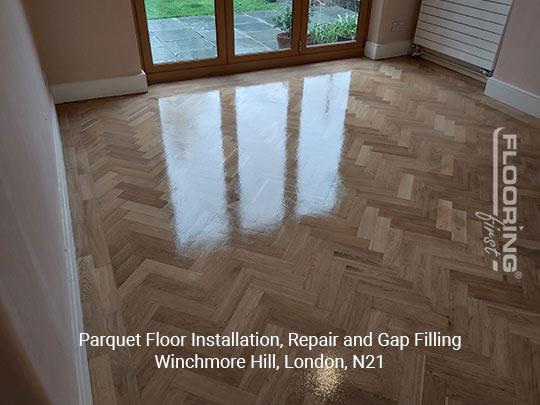
The finished floor looked consistent and clean, with no visible trace of the repaired sections. The gaps were gone, the surface was smooth, and the lacquer brought a warm sheen to the oak that the client had not seen since the floor was first installed. At around £70 to £100 per square metre for a full parquet restoration of this scope, the cost is significantly below that of a replacement floor, and the result is arguably better because the original wood carries character that new boards simply cannot replicate.
Frequently Asked Questions
How do you match replacement parquet blocks to the existing floor?
We source replacement blocks in the same species and, where possible, the same cut as the original. Once sanded and finished together, the natural wood tones blend well. In very old floors with heavily aged wood, a slight variation in tone can remain, but this is generally barely noticeable once the finish is applied across the whole surface.
Is gap filling in parquet floors a permanent fix?
A resin and dust filler in well-maintained conditions will last many years. Wood does expand and contract with seasonal humidity changes, so some hairline movement at the filler edges is normal. Keeping indoor humidity reasonably stable, ideally between 45 and 65 per cent, reduces this movement and extends the life of the fill.
Can all parquet floors be repaired rather than replaced?
Most can, provided the subfloor is sound and the boards have enough thickness remaining for sanding. Very thin parquet tiles or floors that have been sanded down close to their limit may not be suitable for further sanding. We assess this during a free pre-visit inspection before quoting.