Project Overview
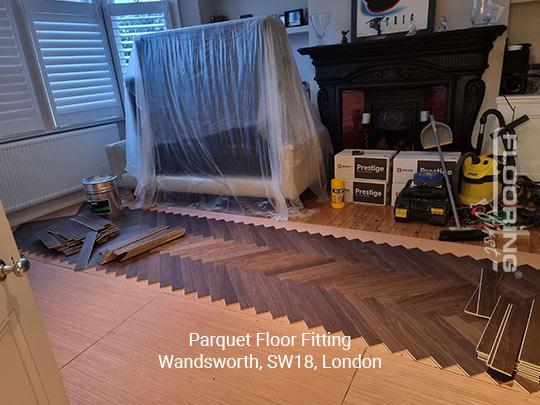
This Wandsworth job involved fitting a new parquet floor from scratch, including full subfloor preparation and the installation of finishing accessories. The client had selected a traditional herringbone parquet pattern in solid hardwood and wanted a result that would add genuine character to the room without looking like it had been rushed in. Parquet is one of the most time-intensive floor coverings to install correctly, and this project gave us the opportunity to demonstrate what a well-planned and carefully executed installation looks like. Parquet fitting in south-west London typically runs between £70 and £100 per square metre depending on pattern complexity and subfloor condition.
The Challenge
Achieving a truly symmetrical parquet pattern in a room that is not perfectly square requires careful planning before the first block is laid. The eye picks up asymmetry quickly — cut blocks at one end noticeably larger or smaller than those at the other end, or a pattern that runs visibly off-plumb. Setting out takes time but it is time well spent. The subfloor also required preparation. Parquet blocks need a solid, dry, flat base. Any movement or flexing in the subfloor will eventually work blocks loose or cause them to click when walked on.
Our Approach
Subfloor preparation: Moisture readings were taken across the subfloor and confirmed as satisfactory. The surface was swept clean and checked for level. Minor variations were addressed before any blocks were laid.
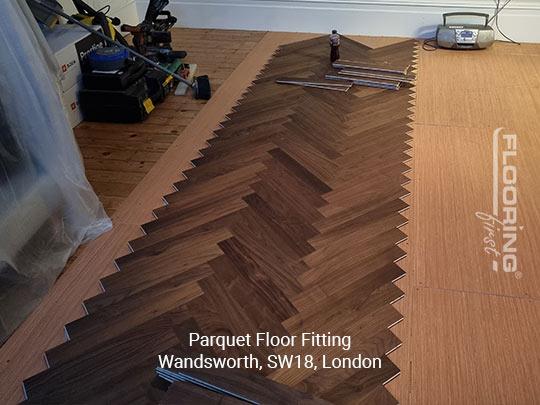
Setting out: We established a centre line across the room and dry-laid a run of blocks to check the cut sizes at each end before any adhesive was used. Adjustments were made to the starting position until the layout was balanced. This step is often skipped by inexperienced fitters and is one of the key differences between a professional installation and one that looks off.
Block fitting: Blocks were laid in the herringbone pattern working out from the centre line. Each block was pressed firmly into the adhesive, tapped tight with a rubber mallet and checked for level. We worked in sections to maintain a manageable open time for the adhesive.
Accessories and finishing: Once the main field was complete and the adhesive had cured, threshold strips and matching beading were fitted around the perimeter to complete the installation. These details finish the job properly and protect the expansion gap at the edges.
The Result
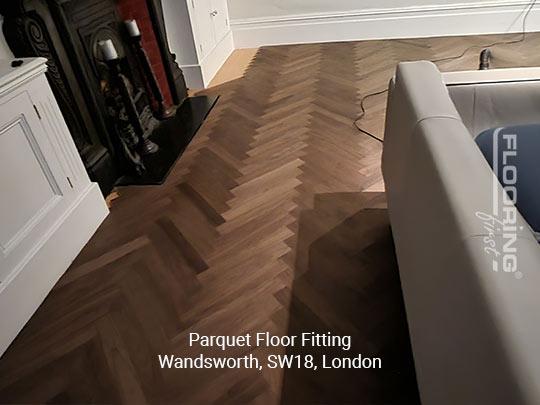
The finished parquet floor in this Wandsworth home has a clean, balanced pattern that sits evenly from wall to wall. The blocks are tight, the adhesion is solid and the accessories are fitted neatly. A well-installed parquet floor is a long-term asset — maintained properly it will outlast most other floor coverings by decades. This project illustrates why experience and setting out care matter so much with parquet work.
FAQ
What is the difference between engineered and solid parquet?
Solid parquet blocks are made from a single piece of hardwood and can be sanded multiple times over their lifetime. Engineered parquet has a real hardwood top layer bonded to a plywood core, making it more stable in rooms with variable humidity. Both are available in a wide range of species and patterns. We advise on the most suitable option based on your subfloor type and room conditions.
How long after fitting can we walk on the parquet?
We recommend staying off the newly laid floor for at least 24 hours to allow the adhesive to cure fully. Light foot traffic is fine after that, but we suggest keeping furniture off for 48 to 72 hours. Where the floor is also being sanded and lacquered after fitting, normal use can resume 24 hours after the final coat.
Is parquet suitable for underfloor heating?
Yes, engineered parquet works well with underfloor heating. Solid parquet can also be compatible but requires more careful acclimatisation and system management to keep the temperature variation within limits. We can advise on suitable timber species and adhesive types for heated subfloors when quoting.