Project Overview
This project in West Ealing involved the supply, fitting, sanding, and lacquering of modern mosaic oak parquet flooring in a ground-floor reception room. The client wanted the classic look of a traditional herringbone parquet floor but had a budget that made individual block laying impractical. Mosaic oak finger panels offered the perfect answer. These panels come with a pre-arranged parquet pattern already assembled on a backing, which cuts the installation time significantly compared to laying individual blocks. The result is visually indistinguishable from a traditionally laid parquet floor once sanded and finished. Mosaic parquet installation with finishing typically falls in the £70 to £100 per square metre range.
The Challenge
The main challenge with mosaic parquet panels is that the backing material needs to be completely removed before sanding can begin. The panels arrive glued to a hessian or paper backing for ease of installation, but this backing must be fully stripped and the adhesive residue removed to get a true, consistent sand across the surface. Any residue left on the surface will clog sanding belts and prevent the finish from bonding properly. In addition, the panels had to be laid so that the finger pattern aligned correctly across the full width of the room. Getting this layout right at the start is critical because any misalignment is very obvious once the floor is finished.
Our Approach
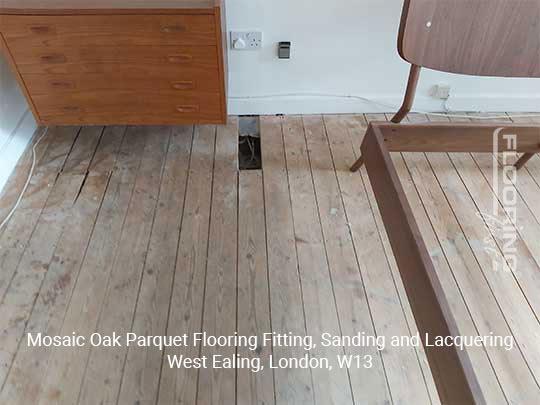
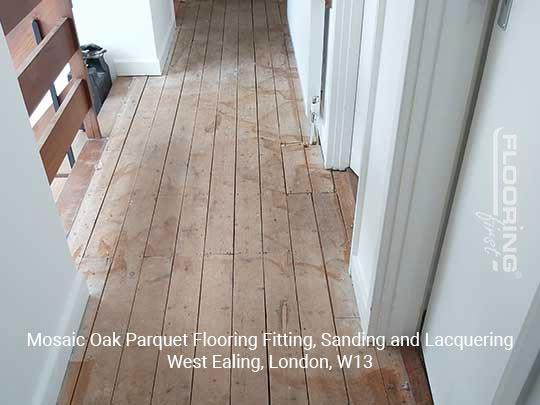
- Subfloor preparation: We removed the existing floor covering and prepared the subfloor, ensuring it was clean, flat, and dry. Any high spots were sanded back and low areas were filled with a levelling compound.
- Layout planning: We dry-laid the first few rows across the room to establish the correct alignment and confirm the panel orientation before any adhesive was applied.
- Panel fitting: The panels were glued down using a flexible floor adhesive, working from the centre of the room out to the walls. The backing was pressed firmly into the adhesive and any air pockets worked out before the adhesive set.
- Backing removal: Once the adhesive had cured, we dampened the backing with water and carefully peeled it away. Any remaining adhesive residue was scraped and sanded off before the main sanding run began.
- Sanding: The surface was sanded diagonally in two directions, as with traditional herringbone parquet, progressing through coarse, medium, and fine grits to achieve a flat, smooth result. Edge work was completed with a detail sander and hand tools in tight corners.
- Lacquering: Three coats of a hard gloss lacquer were applied, with light sanding between coats. A stain was applied before the final coat to give the oak a richer, warmer tone that the client preferred over the natural pale colour of the raw wood.
The Result
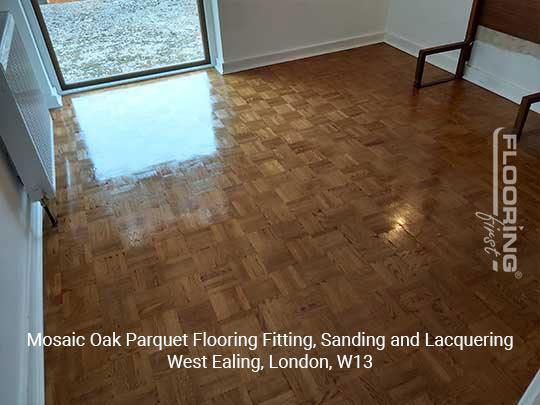
The finished floor looked exactly like a traditional parquet installation. The pattern was sharp, the surface smooth, and the stained lacquer gave the oak a warm, amber depth that complemented the period feel of the room. The client was genuinely surprised at how authentic it looked compared to the raw panels they had seen before fitting. This is a floor that will hold up well in a family home and, being solid oak at the surface, can be re-sanded and refinished in the future should it ever need attention.
Frequently Asked Questions
What is mosaic oak parquet and how does it differ from traditional parquet?
Mosaic parquet uses small oak finger blocks pre-assembled on a backing panel. Traditional parquet involves each block being laid individually. The visual result is essentially the same. Mosaic panels install faster and at lower labour cost, making the classic parquet look accessible at a more reasonable price point.
Can mosaic oak parquet be sanded and refinished like a standard parquet floor?
Yes. Once the backing has been removed and the floor is sanded and finished, it behaves exactly like any other solid wood parquet floor. It can be re-sanded and refinished multiple times over its lifespan.
What finish works best on mosaic oak parquet?
Lacquer is the most popular choice because it is hard-wearing and easy to clean. If you prefer a more natural look, a hardwax oil is a good alternative, though it requires more frequent maintenance. Staining before the final coat allows the colour of the floor to be adjusted to suit your interior.