Project Overview
This laminate floor fitting project was completed at a flat in Fulham, West London. The client was renovating their living room and kitchen area and wanted a floor that would look great, stand up to daily use, and not cost a fortune. Laminate flooring was the natural choice. Modern laminate has come an enormous distance from the flimsy products sold in the 1990s. Today's boards are thick, stable, and convincingly replicate the look and texture of real wood, including brushed finishes, hand-scraped effects, and natural grain variation. For a professional supply and fit, clients in London should expect to pay in the region of £35 to £60 per square metre, depending on the grade of laminate selected.
The Challenge
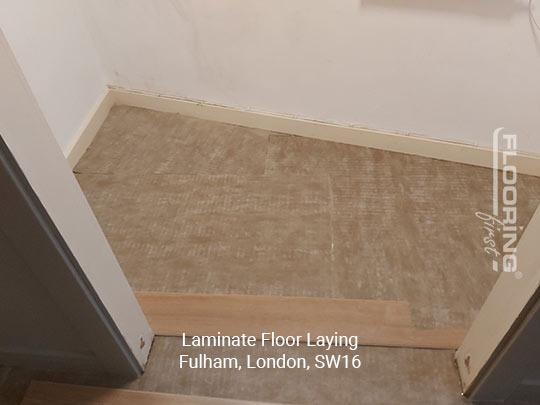
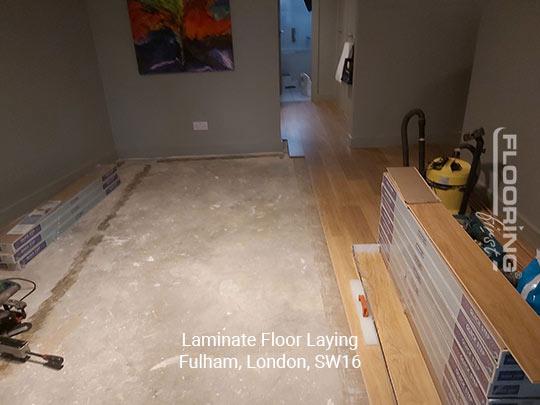
The room had an old carpet and underlay over a concrete subfloor that needed to be lifted before any fitting could begin. Concrete subfloors are unforgiving: any high spots or hollow areas will cause laminate boards to flex, click, and potentially crack at the joints over time. The concrete in this property had a few raised areas near a previous plumbing repair and some uneven dips near the wall. Getting this flat enough for floating laminate installation required careful grinding and levelling before the boards went down. Door frame clearances also needed to be checked, as the new floor raised the finished height by about twelve millimetres.
Our Approach
- Strip-out: We lifted and disposed of the existing carpet, gripper rods, and underlay, clearing the subfloor completely before starting any prep work.
- Subfloor preparation: The concrete was swept, vacuumed, and inspected for high spots. Raised areas were ground back with a belt sander and a self-levelling compound was poured over the low areas and feathered out to create a flat, smooth base.
- Damp-proof membrane: A polyethylene damp-proof membrane was laid over the concrete to prevent any residual moisture from migrating into the laminate boards and causing swelling or joint lift.
- Underlay installation: A quality foam underlay with a built-in moisture barrier was rolled out over the membrane. A good underlay is critical for reducing the hollow sound laminate can produce underfoot and for improving thermal insulation at floor level.
- Laminate fitting: The boards were fitted in a staggered brick-bond pattern, leaving the manufacturer-recommended expansion gap around the perimeter. Door frames were undercut to allow the boards to slide beneath, giving a clean finish without the need for ugly architrave trims.
- Finishing details: Scotia beading was fitted around the perimeter and colour-matched threshold strips were installed at every doorway to complete the job neatly.

The Result
The finished room looked clean, modern, and well-put-together. The laminate chosen had a natural oak tone with a lightly textured surface that worked well with the existing decor. The client commented that it looked far more like real wood than they had expected. The floor is now warm underfoot, quiet to walk on, and straightforward to keep clean. With normal care, a good quality laminate floor installed over a properly prepared subfloor will last fifteen to twenty-five years before replacement becomes necessary.
Frequently Asked Questions
Do I need underlay under laminate flooring?
Yes, always. Underlay cushions the boards, reduces the hollow sound laminate can make underfoot, and helps with thermal insulation. Over a concrete subfloor, an underlay with an integrated damp-proof membrane is particularly important. Some laminate boards come with underlay pre-attached, but a separate, higher-quality underlay generally gives better results.
Can laminate be fitted over underfloor heating?
Many modern laminate products are compatible with underfloor heating, but the system temperature must not exceed 27 degrees Celsius at the surface and the floor should be allowed to acclimatise to the room for at least 48 hours before fitting. Always check the manufacturer's specifications for the laminate you are using.
How do I deal with gaps between laminate and skirting boards?
The expansion gap between the laminate and the wall is deliberate and necessary. It is covered by the skirting board or by a separate Scotia bead fitted over it. Never fill this gap with sealant or fix anything into it, as this prevents the floor from expanding and can cause buckling.