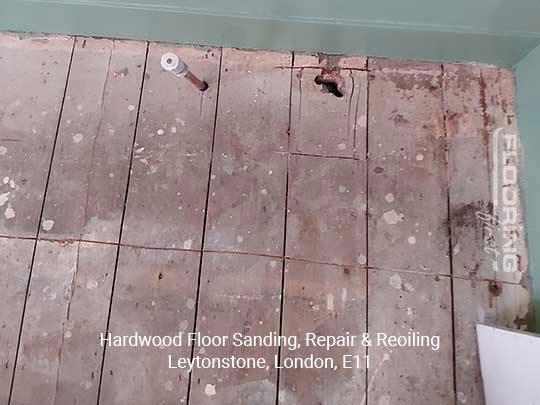
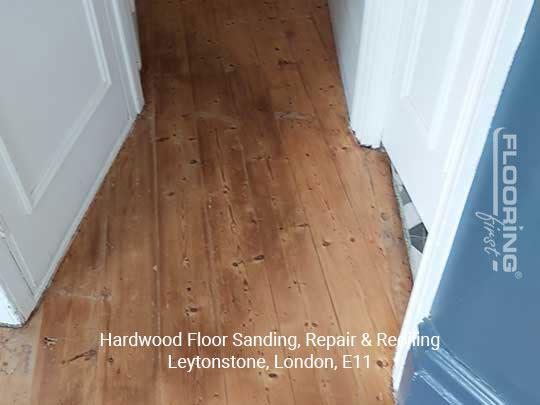
Project Overview
This hardwood floor sanding, repair, and re-oiling project was completed at a terraced property in Leytonstone, East London. The client had lived in the house for several years and the floor, a solid oak strip floor, had accumulated damage in several areas: a few boards had split along the grain, one had a deep gouge from furniture removal, and the oil finish throughout had become dry and patchy. Rather than replacing the entire floor, we carried out targeted board replacement in the worst-affected areas and then sanded and re-oiled the whole floor to bring everything back to a consistent, good condition. Spot repair plus sanding on a hardwood floor of this type typically costs in the range of £25 to £45 per square metre for the sanding element, with board replacement priced per board.
The Challenge
The key challenge in any spot repair project is making the new boards blend with the old ones. Fresh oak boards will always be paler and brighter than boards that have aged over years in a finished room. The fit-and-forget approach of simply swapping damaged boards and sanding straight over them often leaves the repair area looking obvious for some time. Getting a good colour match requires careful selection of replacement stock, appropriate staining or tinting of the oil finish, and thorough sanding across the whole floor rather than just the repaired patches. The client also wanted the floor to look as natural as possible after the work was done, which meant avoiding a heavy lacquer finish in favour of an oil that would blend the old and new wood tones naturally.
Our Approach
- Board assessment: We walked the floor and identified each board that needed replacing. In total, five boards were beyond economical repair and were marked for removal.
- Board removal: The damaged boards were carefully cut out using a circular saw set to the exact board thickness, then removed without disturbing the neighbouring boards.
- New board fitting: Replacement oak boards selected to match the existing profile were glued and secret-nailed into place, then left to cure before sanding began.
- Full floor sanding: The entire floor was sanded in sequence: coarse pass to strip the old finish and flatten the surface, medium pass to remove the scratch marks, fine pass to prepare for the oil finish. Sanding all the old and new boards together at this stage is what allows the final finish to read as one uniform surface.
- Oil application: We applied a hardwax oil tinted slightly amber to help the new boards blend with the aged tone of the original floor. Two coats were applied with a buffing pass between them.
- Final buff: A final light buff brought the oil to an even sheen across the whole floor.
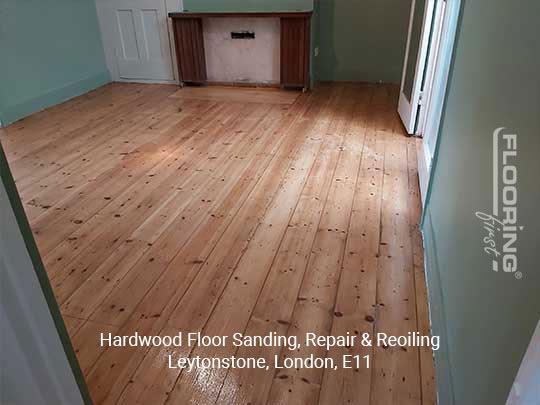
The Result
The repaired sections blended well with the rest of the floor. The slight tint in the oil helped to even out the colour difference between old and new boards, and within a few months of normal use the whole floor looked consistent. The client was pleased not just with the visual result but also with the cost saving compared to a full replacement, which would have been three to four times the price. The oil finish gives the floor a natural, matt look that suits the character of the house and is easy to maintain with occasional re-oiling of any areas that start to look dry.
Frequently Asked Questions
How do you match replacement floorboards to the existing ones?
We try to source replacement boards in the same wood species, width, and thickness as the originals. Exact matches are not always possible, particularly for older or non-standard boards, but working with the same species and then finishing old and new together minimises the visible difference. Tinted oils or stains can further close the gap in colour.
Is an oil finish as hardwearing as lacquer?
Oil finishes are less resistant to surface scratching than lacquer, but they are much easier to maintain. Scratches in an oiled floor tend to blend in naturally, whereas lacquer scratches show clearly as white marks. Worn areas in an oiled floor can be re-oiled without sanding the whole floor, which makes maintenance straightforward and low-cost.
How often does an oiled hardwood floor need maintenance?
In a normal domestic setting, a full re-oiling is typically needed every three to five years. Between re-oiling, using a suitable wood floor cleaner and a maintenance oil product on heavy-wear areas every few months will extend the time between full treatments considerably.