Project Overview
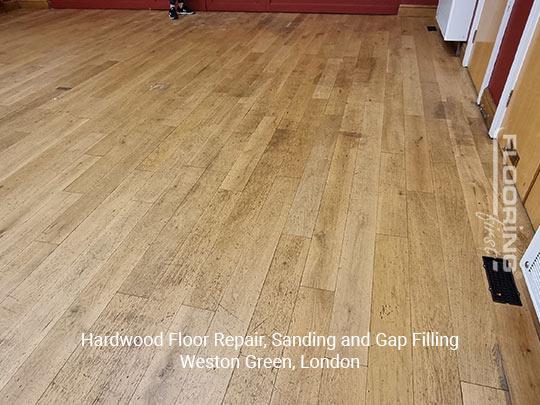
This job in Weston Green covered a hardwood floor in need of repair, gap filling, sanding and refinishing. The floor had been in the property for many years and while the bones of it were good — solid hardwood boards in a sound structural state — it had picked up the typical catalogue of issues that come with age and heavy use. The finish had worn through, gaps had opened up between boards, and a small number of boards had localised damage. The client wanted the floor brought back to a good functional condition and re-finished to protect it for years ahead. Sanding and refinishing of this type typically costs £25 to £42 per square metre depending on the repairs needed.
The Challenge
Hardwood floors that have been in place for many years often have a mix of issues that need addressing in the correct order. You cannot sand first and repair afterwards — filler applied to a sanded surface will not bond as well, and any board replacement done after sanding may leave the new board slightly higher than its neighbours, causing a visible ridge. The discipline of the job is in sequencing the work correctly: repairs first, then gap fill, then sand, then finish. Rushing any of these steps or doing them out of order affects the final result. The gaps in this floor also varied in width, which meant selecting the right filling method for each section rather than using one approach throughout.
Our Approach
Initial inspection and repairs: We went over the floor systematically, testing for loose boards, soft spots and structural damage. Boards with localised damage that was too deep for sanding to cure were replaced with matching timber. Any soft spots or movement in the subfloor were addressed before the replacement boards went in.
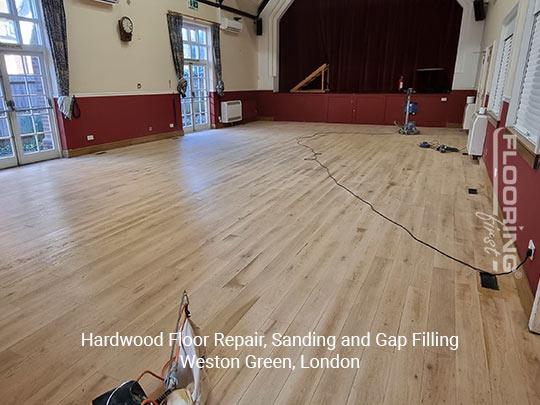
Gap filling: Narrow gaps between boards were packed with a natural resin and sawdust mix that dries hard and takes the final finish evenly. Wider gaps received pine slivers tapped in tight before the resin mix was applied over the top. Once the filler had cured fully it was sanded flush with the surrounding boards.
Sanding programme: The full floor was sanded in three passes — coarse to remove the old finish and level the repaired areas, medium to refine the surface, fine for the finishing pass. We worked with the grain throughout. The edges and corners were done with detail equipment to match the flatness of the main field.
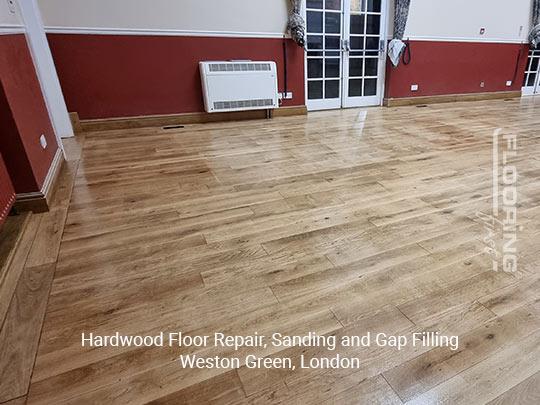
Finishing: The client opted for a hard-wearing oil finish rather than lacquer, giving the floor a natural, close-to-the-wood appearance. Oil finishes nourish the timber and are easier to maintain locally if small areas become worn — a spot re-oil can be done without sanding back the whole floor.
The Result
The floor came out clean, stable and evenly finished from wall to wall. The oil gave the hardwood a warm, natural tone and the surface is now properly protected against everyday traffic and spills. This Weston Green project is a good example of what professional maintenance can do for a hardwood floor that has been left without professional attention for too long — the same floor could have needed full replacement in another few years without intervention.
FAQ
What is the difference between an oil finish and a lacquer finish?
Lacquer forms a hard protective film on top of the wood. It is very durable but when it gets scratched or worn it shows clearly and typically needs a full sand to repair. Oil penetrates into the wood fibres and does not sit as a surface film. It gives a more natural look and small worn or scratched areas can often be spot-treated with additional oil without any sanding required. Both options are suitable for hardwood floors — choice depends on the level of traffic and how you want the floor to look and feel.
How long does oil take to dry before we can use the room?
Most hard wax oils are touch-dry within four to six hours and ready for light foot traffic after 24 hours. The floor continues to cure for several days. We recommend keeping rugs and furniture off for at least 48 to 72 hours and avoiding heavy loads for a week.
How do I maintain an oiled hardwood floor?
Regular sweeping and occasional mopping with a wood-safe, pH-neutral cleaner is sufficient for day-to-day care. Every year or two, a maintenance oil can be applied to refresh the protection — this is a simple process that does not require any sanding and can be done yourself with the right product. We advise on suitable maintenance products when we complete the job.