Project Overview
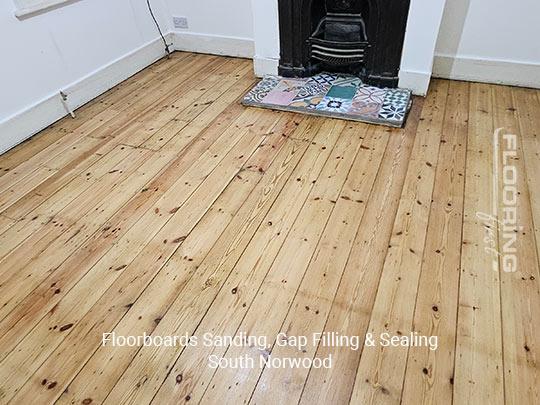
This South Norwood project covered a full floorboard restoration in a residential property. The scope included replacing damaged boards, gap filling throughout, sanding, and applying a lacquer finish. New thresholds were fitted at doorways, and the boards were staggered during installation to improve both the look and the structural performance of the floor.
The Challenge
The client's floor was showing significant signs of damage, with several floorboards cracked or warped. Gaps were evident, and the overall appearance was dull. The flooring did not have the cohesive look the client was after, and it required a comprehensive restoration to address both function and appearance.
South Norwood properties of this age often have Victorian-era softwood floorboards that have moved and dried out considerably over the decades. Gaps between boards are common and can be considerable. A floor in this condition is draughty, collects dirt easily, and does not look good once a finish is applied because the gaps read as dark lines across the surface.
Our Approach
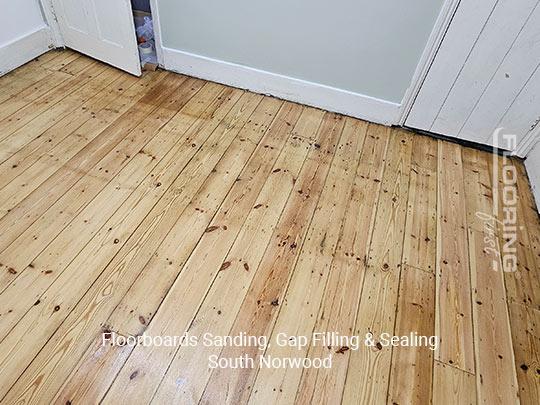
The first step was a thorough assessment of which boards could be saved and which needed replacing. Cracked and warped boards were lifted and set aside. Replacement boards were sourced to match the existing dimensions and were fitted with the boards staggered, which distributes any movement more evenly across the floor and looks better once finished.
Once the new boards were in, the entire floor was sanded using a drum sander, working along the grain from one end of the room to the other. This process removed the surface layer of old finish, grime, and minor imperfections, leaving a clean and even timber surface throughout.
Gap filling came next. We used a mixed-wood filler, which is made by combining fine sanding dust from the floor with a flexible filler compound. This produces a colour-matched fill that moves slightly with the boards through seasonal changes. Rigid fillers tend to crack in gaps over time. The mixed approach is more durable and blends into the floor more naturally.
After the filler dried, we buffed the surface smooth and applied a hard-wearing lacquer in three coats. Each coat was allowed to dry and then lightly abraded before the next was applied. New thresholds were fitted at all doorways to complete the work.
The Result
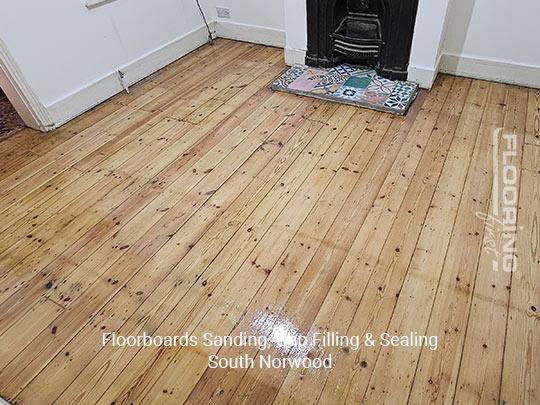
The transformation was substantial. The newly installed and lacquered floorboards exude warmth and character, with a consistent finish throughout. The gaps are filled, creating a much more cohesive surface, while the new thresholds add a neat finish at doorways. Staggering the replacement boards improved the visual balance of the floor and reinforced its durability. The client now has a floor that looks well-kept and will be easier to maintain going forward.
Frequently Asked Questions
What is the best gap filling method for old floorboards?
The most durable approach is a flexible, mixed filler made using fine sanding dust from the actual floor. This creates a colour-matched fill that can flex slightly as the boards move with changes in humidity. Rigid fillers, including some off-the-shelf products, tend to crack and fall out over time, particularly in older floors where movement is greater.
Do all damaged floorboards need replacing, or can they be repaired?
Many can be salvaged. Light cracks, cupping, and surface damage can usually be addressed through sanding. Boards with deep splits, severe warping, or structural damage are better replaced. We assess each board individually rather than assuming replacement is needed, because matching old timber is not always straightforward and avoiding unnecessary work keeps costs down.
What does floorboard sanding and restoration cost in South Norwood?
A full restoration covering sanding, gap filling, and two or three coats of lacquer typically runs between £25 and £40 per square metre in South Norwood and the wider South London area. Board replacement is charged separately based on the number of boards and sourcing difficulty.