Project Overview
This Walthamstow project was one of the more involved jobs on our books for the period. It covered floorboard replacement in multiple rooms, gap filling and sanding throughout the property, stair sanding and sealing, and the installation of Rockwool underfloor insulation in the living room. The piano also needed moving, which required careful planning to avoid damaging the newly prepared subfloor. The full scope from start to finish took several days.
The Challenge
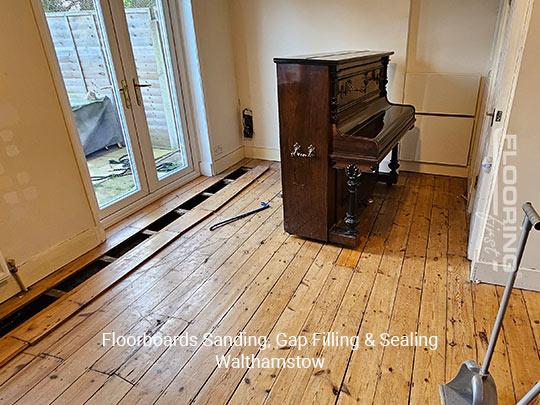
The floorboards in this space were showing clear signs of wear and tear, with some boards beyond repair and in need of replacement. The stairs had also lost their lustre and required sanding and sealing to revitalise them. Additionally, the living room floorboards needed lifting for insulation installation, adding another layer of complexity to the project.
Victorian terraces in Walthamstow regularly have suspended timber ground floors with little or no insulation beneath. Heat escapes through the floor, and draughts come up through gaps in the boards. The client was aware of this and wanted to address it properly at the same time as the cosmetic restoration, which meant lifting and relaying the living room boards in addition to all the sanding and finishing work.
Our Approach
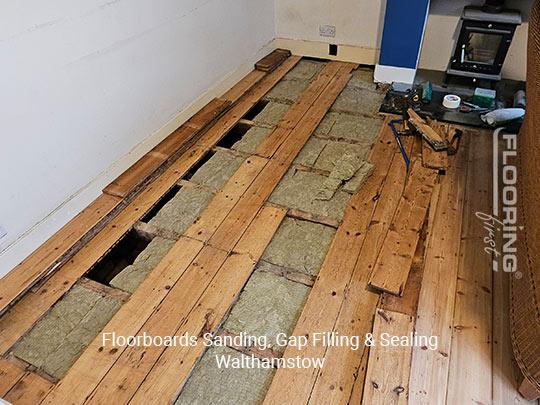
We started in the living room, lifting the floorboards carefully so they could be relaid afterwards. Boards were numbered as they came up to make relaying in the correct position straightforward. Rockwool insulation slabs were cut to fit between the joists and pressed into place, then covered with a breathable membrane before the boards were refitted. The boards went back down in sequence, and any that were damaged beyond reuse were replaced with matching timber.
Damaged boards in other rooms were identified and replaced before sanding began. The replacement boards were fitted flush, and any nail heads were punched below the surface to avoid damaging sanding belts. The entire floor area, including all rooms, was then sanded in sequence using a drum sander along the grain.
Gap filling came after the first sanding pass. We used a mixed-dust filler to match the floor tone and applied it across the whole surface, working it into the gaps with a float. Once dry, a second fine sanding pass was run to remove any filler that had dried on the surface and leave a clean result.
The stairs were sanded separately using a detail sander on the treads and a belt sander where access allowed. Nosings were treated with particular care — they take the most foot traffic and the most wear, so the finish needed to be consistent and durable. All surfaces were lacquered with two to three coats.
The Result
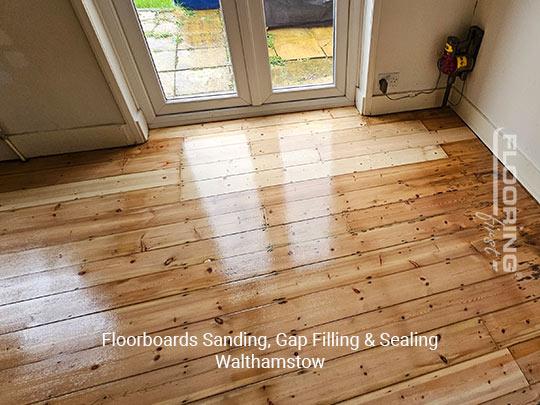
The floorboards across the property were completely transformed. The replacement of damaged boards restored structural integrity, and gap filling produced a smooth, even surface throughout. The stairs now have a clean, renewed finish, with the lacquer bringing out the natural grain of the wood. In the living room, the Rockwool insulation has made a noticeable difference to the warmth of the room. The boards were refitted and finished to match the rest of the property, so the work is not visible but the improvement in comfort is immediate. The piano was managed without incident.
Frequently Asked Questions
Is it worth adding underfloor insulation when restoring floorboards?
For suspended timber ground floors, yes, it usually is. Lifting and relaying the boards adds cost, but if the floor is already being restored, the additional disruption is relatively minor. Rockwool or rigid insulation between the joists can reduce heat loss significantly in older properties, and it helps with draughts too.
How do you sand stairs professionally?
Stairs are sanded using a combination of tools: a belt or orbital sander on the treads, a detail sander for the corners, and hand-sanding for the spindle bases and any tight spots. It is slow, methodical work compared to open floor sanding, and it takes longer per square metre. Nosings and edges need particular attention because they wear faster and need a solid finish coat.
What does floorboard restoration cost in Walthamstow?
For a typical Victorian terrace in Walthamstow, floor sanding and lacquering runs around £25 to £40 per square metre. Stair sanding is usually priced per staircase or per tread. Insulation installation is an additional cost based on the area and access involved. We quote each project individually once we have seen the conditions.