Project Overview
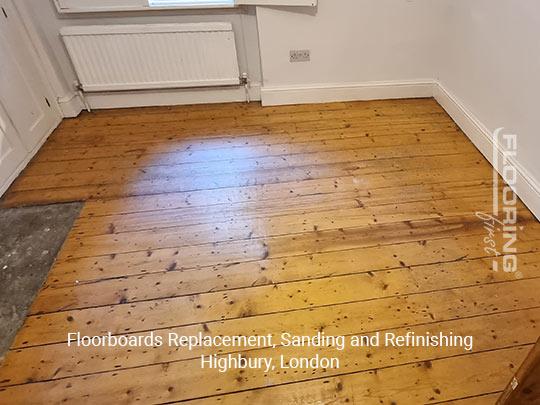
This job in Highbury involved a full wood floor renovation covering floorboard replacement, dust-free sanding and lacquer refinishing. The floor had suffered years of hard use — boards were cracked or split beyond repair, the existing finish had worn away in heavy traffic areas, and the surface was dull and scratched throughout. The client wanted a floor that looked consistent again and would hold up for years without constant attention. Our sanding and renovation team carried out a thorough assessment before a single machine was switched on.
The Challenge
Several boards were too far gone to save by sanding alone. When boards are deeply split, cupped or structurally weakened, sanding just thins them down further without removing the underlying issue. The challenge was sourcing replacement boards that matched the existing floor closely enough in width, thickness and species to sit flush and look right once refinished. Colour variation between old and new timber is normal — sanding and staining brings everything together — but getting the physical fit right from the start matters for both stability and appearance. The existing gaps between boards also needed treating before any finishing could begin.
Our Approach
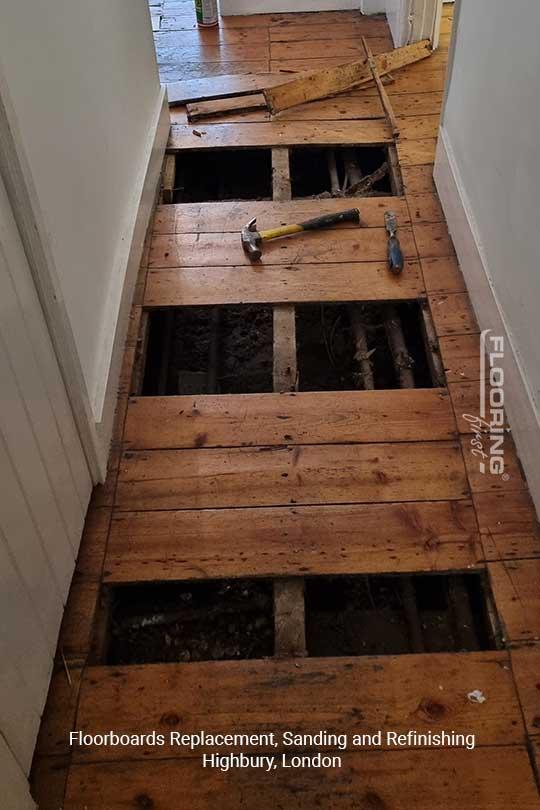
Board replacement: We lifted the damaged boards carefully, numbered them and removed any old adhesive or fixings from the subfloor underneath. New boards sourced from our regular suppliers were cut to length and fitted tight, nailed and glued where required to match the construction of the original floor.
Gap filling: With replacement boards in place, we addressed the gaps elsewhere across the floor. Fine gaps were packed with a mix of natural resin and sawdust collected from the first sanding pass. This mixture dries hard, takes the finish evenly and is barely visible once sanded flush.
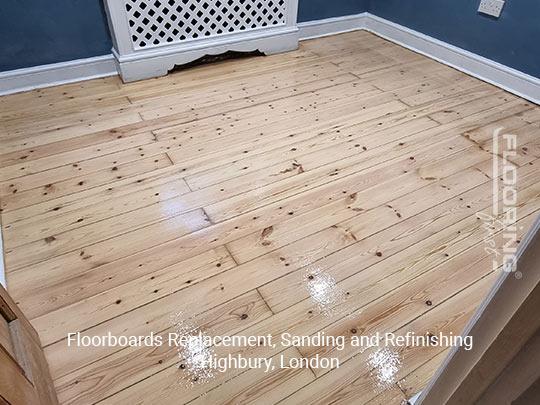
Multi-pass sanding: We used a drum sander for the main field, following the grain at all times, with edging machines working the perimeter. Each pass moved to a finer grit, working down from coarse through medium to fine. The result after sanding was a uniformly smooth, open-grained surface ready for finishing.
Lacquer application: Two coats of commercial-grade water-based lacquer were applied with a light abrasion between coats. Lacquer forms a hard film on top of the wood that resists scuffing and moisture, and it enhances the natural colour of the boards without going too orange or yellow. The client chose a satin sheen which suits the character of the room.
The Result
The finished floor looks consistent from end to end. The replaced boards are indistinguishable from the original once the lacquer was down. All gaps are filled, the surface is smooth and the colour is even throughout. Sanding and refinishing typically costs £25 to £45 per square metre depending on the condition of the floor and the number of repairs needed, making it far more economical than replacing the floor altogether. This Highbury project is a good example of what professional renovation can achieve on a floor that most people would write off.
FAQ
How long does a floor like this take from start to finish?
A job of this size — board replacement, gap filling, full sanding and two coats of lacquer — typically takes two to three days. The floor needs to be clear of furniture throughout and we ask that it is left for at least 24 hours after the final coat before heavy use resumes.
Can you always find matching replacement boards?
We stock a range of species and profiles and work with suppliers who carry reclaimed timber. In most cases we get close enough that the difference disappears once the finish is applied. Where an exact match is not possible, selective staining can help bring boards together in colour.
How many times can a hardwood floor be sanded?
Solid hardwood boards can typically be sanded four to eight times over their lifetime, depending on board thickness. Each sanding removes around 1 to 2 mm of timber. Engineered boards have a thinner wear layer, usually 3 to 6 mm, which limits them to two or three sandings. We check board thickness before quoting to confirm whether sanding is viable.