Project Overview
This Buckhurst Hill property needed new flooring installed across the main living areas. The client had opted for engineered wood as their preferred choice, primarily because the house had some areas with potential for moisture variation, including a room over an unventilated crawl space. Engineered wood's layered construction makes it considerably more stable in these conditions than solid hardwood, which was the right call for this particular property. The installation covered the living room, dining area, and hallway.
The Challenge
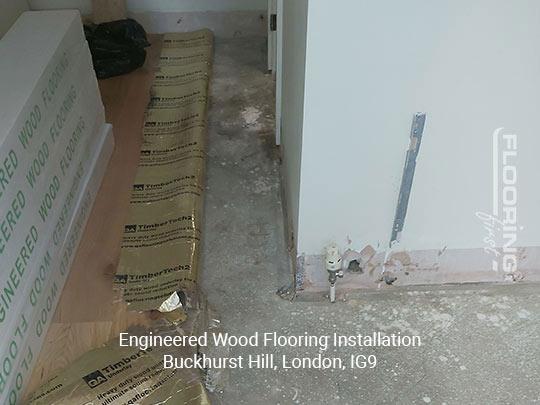
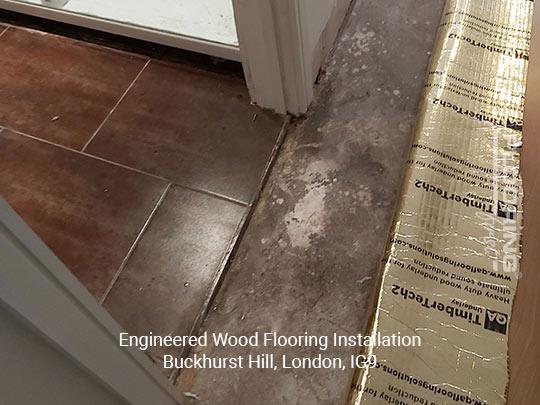
The room over the crawl space had shown slightly higher moisture readings in the past, and the subfloor in that area needed careful assessment before any flooring went down. Fitting engineered boards over a subfloor with unresolved moisture issues can lead to cupping, where the boards bow upward at their edges as they absorb moisture, or to the adhesive failing if the boards are glued down. The hallway subfloor also had an old adhesive residue from a previous floor covering that needed removing before a clean installation base was available.
Our Approach
Subfloor Assessment and Preparation
We carried out moisture testing across all subfloor areas. The room over the crawl space had a slightly elevated reading, which we addressed with a moisture barrier membrane before installation began. The adhesive residue in the hallway was mechanically removed and the surface levelled and cleaned.
Acclimatisation
The engineered boards were delivered to the property and left to acclimatise for the manufacturer's recommended period before fitting. This allowed the boards to reach equilibrium with the temperature and humidity of the space, reducing the risk of movement after installation.
Installation
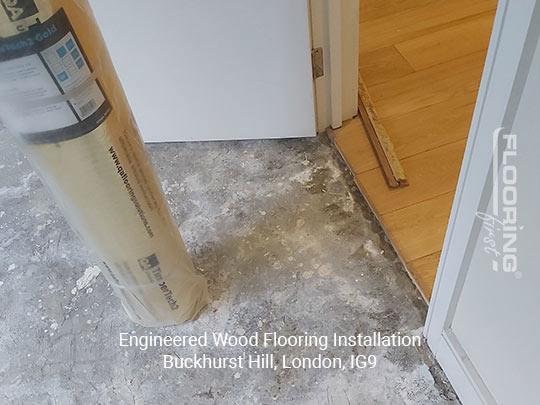
The boards were fitted using a combination of floating and glued methods, chosen according to the subfloor type in each area. The floating method was used in the main rooms for ease of future access, and a direct glue-down method was used in the hallway where there was less room for expansion and a firmer fix was preferable. All expansion gaps at perimeters were correctly maintained throughout.
Accessories and Finishing
Matching beading, threshold strips, and reducer bars were fitted at all walls and transitions. The product specifications were matched to the board profile to give a neat, factory-finished appearance at all edges.
The Result
The finished floor runs consistently throughout the property, with clean transitions between areas and all accessories properly fitted. The engineered boards have held their position well since installation with no movement or cupping, which confirms the subfloor preparation work was effective. Engineered floor fitting in Essex and the surrounding areas typically costs from £35 to £60 per square metre for supply and fit, depending on the board specification and subfloor preparation required.
Frequently Asked Questions
Why is engineered wood better than solid wood in a property with moisture concerns?
Engineered wood is constructed from multiple layers of timber bonded together at different grain directions, which gives it much greater dimensional stability than a solid plank. Where solid wood can expand, contract, cup, or bow significantly in response to moisture changes, engineered boards move far less and are far less likely to develop problems in areas where moisture control is not perfect.
What is the best installation method for engineered wood - floating or glue-down?
Both methods work well, and the best choice depends on the subfloor type and the property layout. Floating is quicker to install and easier to replace in sections if needed. Glue-down gives a more solid underfoot feel and is better in narrower spaces or areas with limited room for expansion. Many installations use both methods in different areas of the same property.
How thick should an engineered board be for a standard domestic installation?
Most domestic engineered floor installations use boards between 12mm and 20mm total thickness. The total thickness affects the underfoot feel and the height change at doorway transitions. The veneer thickness is also important as it determines how many times the floor can be sanded in the future. A 3mm or 4mm veneer is generally recommended for a floor you want to be able to refinish.