Project Overview
This engineered wood flooring installation was completed at a flat in Greenwich, South East London. The client had recently purchased the property and wanted to replace the existing old carpet throughout the open-plan living and kitchen area with a real wood floor. Engineered wood was chosen for several practical reasons: the flat was on the ground floor with a concrete subfloor, some areas were below the damp-proof course level, and the client had underfloor heating in the kitchen zone. Engineered wood handles all of these conditions better than solid wood. For a professional supply and fit, clients typically pay between £35 and £60 per square metre.
The Challenge
The concrete subfloor had two complications. First, moisture readings taken with a damp meter showed levels that were slightly above the threshold for direct fitting, so additional damp-proof measures were required before any boards could go down. Second, the floor was not level. There was a gradual slope of about eight millimetres across the room that would have been noticeable once the boards were laid and could have caused joint stress over time. Levelling a concrete floor to the tolerances required for a floating engineered floor is not a quick job, but it is essential for a lasting result.
Our Approach
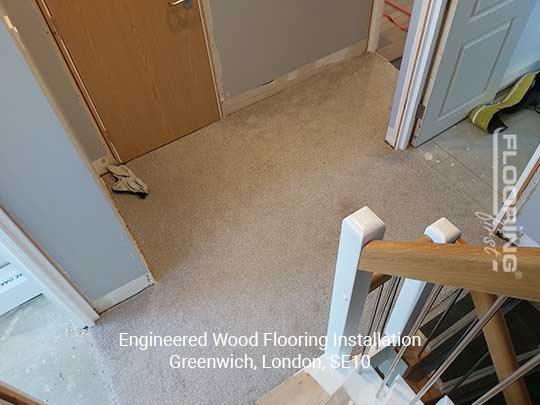
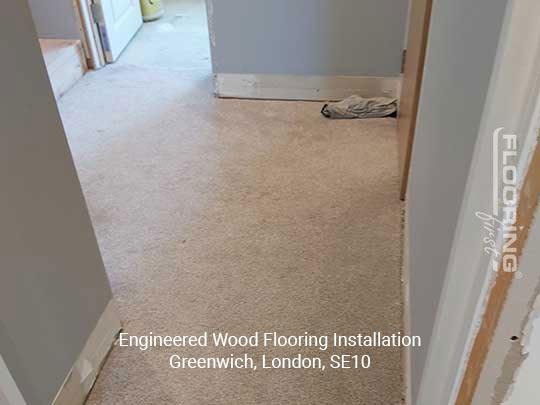
- Carpet removal: The existing carpet and underlay were lifted and removed, along with any gripper rods and tack strips.
- Moisture control: A two-part epoxy damp-proof membrane was applied directly to the concrete and allowed to cure fully. This creates a reliable moisture barrier that will protect the engineered boards for the life of the floor.
- Levelling: A self-levelling compound was poured across the concrete and spread to bring the floor within two millimetres of level over the two-metre span specified in the engineered floor manufacturer's fitting guidelines. The compound was allowed to cure for 24 hours before any further work proceeded.
- Acclimatisation: The engineered boards were laid flat in the room for 48 hours to adjust to the room's humidity and temperature before fitting.
- Underlay: A suitable underlay compatible with the underfloor heating was laid across the concrete. The thermal resistance rating was kept within the limits specified for the heating system.
- Board installation: The boards were installed using a floating click system in a staggered pattern. Expansion gaps were maintained around the perimeter and at any fixed objects such as pipe runs and island units.
- Finishing: Matching skirting was fitted to cover the expansion gaps, and colour-matched threshold strips were installed at the kitchen entrance and doorways.
The Result
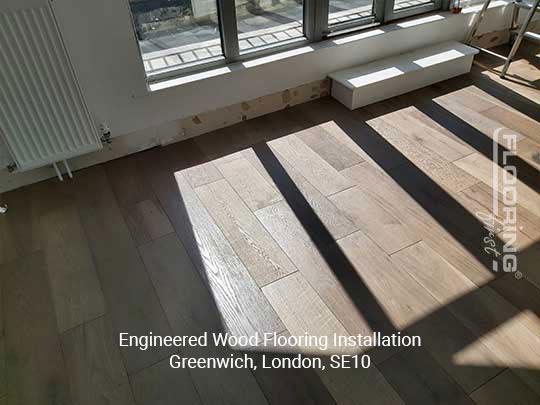
The finished floor completely transformed the flat. The open-plan space now had a consistent, warm floor surface running from the entrance hallway through the living area and into the kitchen. The boards were clean and level, the joints tight, and the colour, a natural brushed oak, worked well with the client's furniture. The floor also performed well with the underfloor heating, warming up evenly without any creaking or movement at the joints. This is a floor that, properly maintained, should give 25 to 30 years of good service.
Frequently Asked Questions
Why is levelling the subfloor so important before fitting engineered wood?
Engineered boards are rigid, and if they span an uneven subfloor, the joints take the strain. Over time, this can cause the click joints to crack or the boards to develop a slight rocking motion underfoot. Most manufacturers specify a maximum of two millimetres deviation over two metres for their floating floor products.
Is a damp-proof membrane always needed under engineered wood on concrete?
It depends on the moisture readings in the concrete. If readings are within acceptable limits, a standard underlay with an integrated moisture barrier is often sufficient. If moisture levels are elevated, a dedicated epoxy or sheet membrane is necessary. We always test moisture levels before recommending a course of action.
How do you handle expansion gaps around kitchen islands and fixed objects?
The standard approach is to maintain the required expansion gap around all fixed objects and cover it with a suitable trim or threshold strip. In some kitchen installations, the island units are sited on top of the finished floor rather than fixed to the subfloor, which removes the need for a gap around them entirely.