Project Overview
This engineered wood flooring installation in Abbey Wood replaced a solid wood floor that had been damaged beyond economical repair by repeated moisture fluctuations. The clients had chosen to move to engineered boards, which have a more dimensionally stable construction and are better suited to homes where humidity levels vary throughout the year. We fitted the new floor across the ground floor of the property, covering the living room, dining area and hallway.
The Challenge
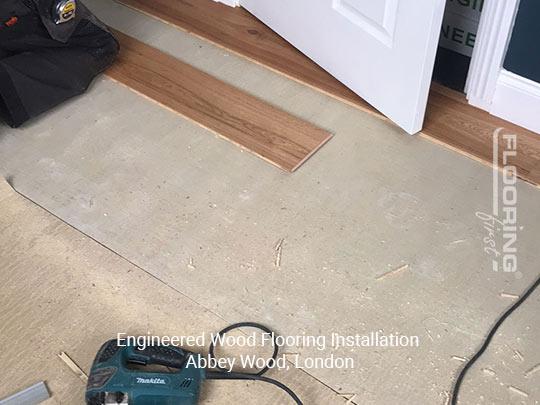
The existing subfloor had been affected by the same moisture issues that had damaged the old solid wood floor. Before the new engineered boards could go down, the subfloor needed to be dried out properly and in some areas replaced where it had deteriorated. We also needed to identify and address the source of the moisture ingress before fitting -- there was no point fitting a new floor on a subfloor that was still damp. The moisture issue turned out to be a failed damp-proof membrane in part of the ground floor, which was treated and sealed before we proceeded.
Our Approach
- Subfloor investigation: Moisture readings were taken across the full area before any work began. Problem areas were mapped and the source of moisture identified.
- Remediation: The failed damp-proof membrane section was treated. Affected subfloor sections were replaced and allowed to dry to an acceptable moisture level before fitting.
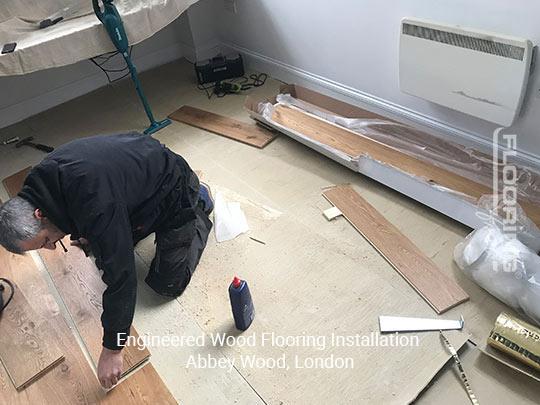
- Acclimatisation: Engineered boards were left in the property for several days to adjust to the ambient conditions before fitting began.
- Installation: Boards were glued down to the subfloor rather than floated, which provides a more stable result in an environment with known moisture history. Gluing down also eliminates the hollow sound underfoot that floating installations can sometimes produce.
- Finishing: Expansion gaps were fitted at all walls and covered with matching beading. A final protective oil coat was applied across the whole floor.
The Result
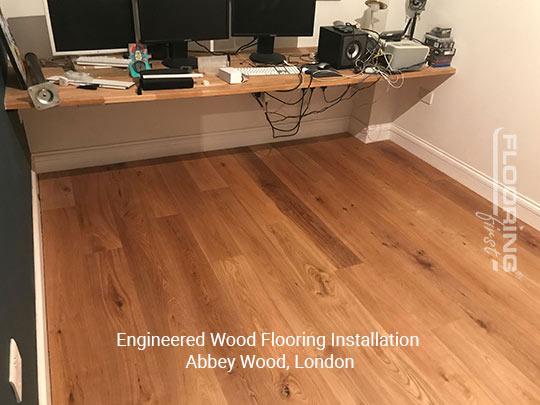
The new floor looked fantastic and the clients immediately noticed how much more stable and solid it felt compared with the old floor in its later years. By addressing the moisture issue properly before fitting, we gave the new floor the best possible start. Engineered wood flooring supply and installation typically runs between £35 and £60 per square metre. The additional work on the subfloor was costed separately and transparently, and the clients felt the overall investment was excellent value given the quality of the result.
Frequently Asked Questions
Why is engineered wood more stable than solid wood?
Engineered wood has a real wood top layer bonded to a core made of multiple layers of plywood or HDF. These layers are laid at opposing angles, which counteracts the natural tendency of wood to expand and contract with moisture changes. This makes it more suitable for ground floors and environments with variable humidity.
Should engineered wood be glued down or floated?
Both methods work well in different circumstances. Gluing down is preferable where the subfloor has a history of moisture issues or where a very solid feel underfoot is required. Floating is faster and makes the floor easier to remove in future if needed. We advise on the best method at the survey stage.
Do you cover Abbey Wood and southeast London?
Yes. We work across southeast London including Abbey Wood, Woolwich, Plumstead and the wider DA and SE postcode areas.