Project Overview
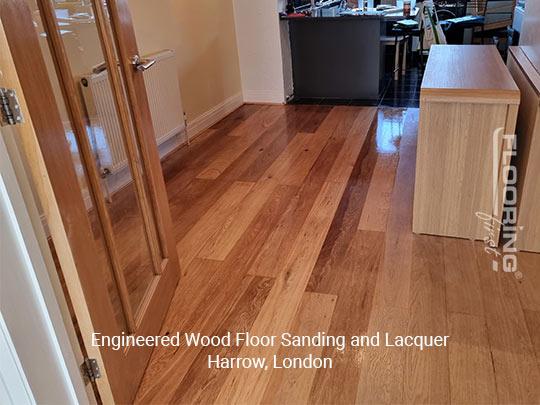
This engineered wood floor in Harrow was in need of a professional sanding and refinishing service after years of daily use had taken their toll on the finish. The floor itself was structurally sound; the issue was entirely cosmetic and protective, with the old lacquer worn through in places and the surface showing scratches and dull patches throughout. The owners had done their research and understood that engineered wood floors, unlike laminate, are made from real wood and can be sanded and refinished to restore them. We were asked to sand the floor and apply a high-quality lacquer appropriate for the level of traffic in the property.
The Challenge
The primary challenge on this job was the choice of finishing product. The property had a busy household with children and pets, meaning the floor needed a lacquer that could genuinely handle the demands placed on it. Standard lacquers vary considerably in hardness and durability, and not all of them are suitable for very high traffic conditions. Choosing the wrong product would mean the finish showing wear again within a year, which would be a waste of the sanding work. We also needed to ensure the sanding was thorough enough to remove all traces of the old finish, because any remaining old lacquer under the new coat creates a weak bond that causes the new finish to peel or flake prematurely.
Our Approach
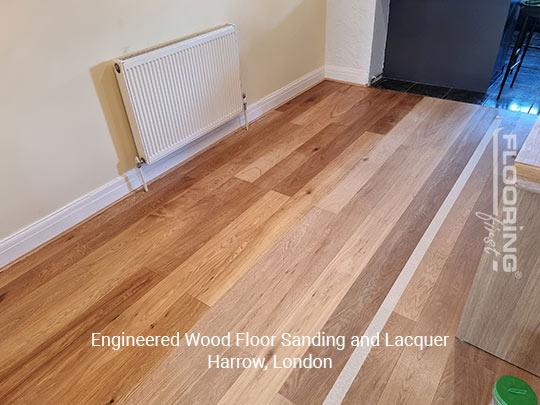
Surface preparation check. We tested whether the existing finish had fully failed or just worn in patches. Where old lacquer remained, the sand had to be deep enough to remove it completely before the new finish was applied.
Progressive sanding. Starting at medium grit to cut through the old finish and bring the entire surface back to bare wood, we progressed through finer grits to achieve a smooth, consistent finish ready for coating. Edge sanding and hand scraping completed the perimeter.
Product selection. For this project we used Bona Traffic HD matt, a commercial-grade lacquer designed specifically for floors subject to high traffic. It is harder than standard domestic lacquers and maintains its protective properties for considerably longer under heavy use.
Lacquer application. Two coats were applied in full accordance with the manufacturer's guidelines, with the recommended interval between coats to allow proper curing before the second coat was laid on top.
The Result
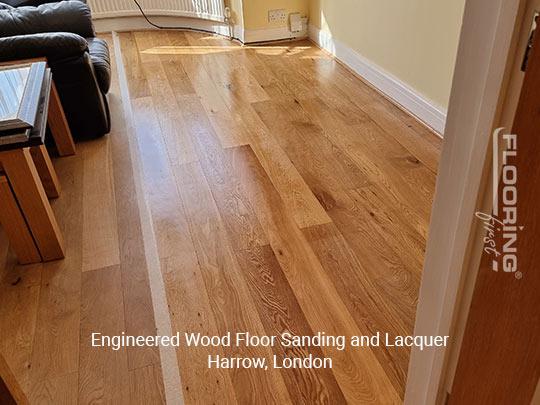
The floor looked outstanding once completed. The Bona Traffic HD matt gave a clean, low-sheen finish that showed the natural beauty of the wood without the high-gloss appearance some people find too formal. The surface was smooth and uniform throughout, and the hardness of the lacquer means this floor will stand up to the demands of a busy household for several years before needing any further treatment. The owners were very happy with both the appearance and the practical durability of the result.
Frequently Asked Questions
What makes Bona Traffic HD different from standard lacquer?
Bona Traffic HD is a two-component commercial lacquer that is significantly harder than most single-component domestic lacquers. It is designed for use in commercial and high-traffic residential settings where standard finishes would show wear too quickly. The main practical difference is that it maintains its protective properties for much longer under heavy daily use.
Can all engineered wood floors be sanded regardless of thickness?
No. The number of sanding cycles available depends on the thickness of the hardwood top layer. Floors with a 2mm or thinner wear layer cannot be sanded without risk of breaking through to the plywood core. A professional assessment of the remaining thickness is always the first step.
How long does Bona Traffic HD take to fully cure?
The floor can take light foot traffic within about 24 hours, but full hardness is not reached for five to seven days. During this curing period, furniture should not be placed back on the floor and the surface should not be cleaned with water or cleaning products.