Project Overview
This project in Cricklewood involved replacing old, worn hardwood flooring with a new engineered wood floor. The work included lifting and disposing of the existing floor, trimming door frames to accommodate the new height, fitting the engineered boards, adding beading along the walls, and installing thresholds at room transitions. The client wanted a clean, modern feel that would work with the rest of the property.
The Challenge
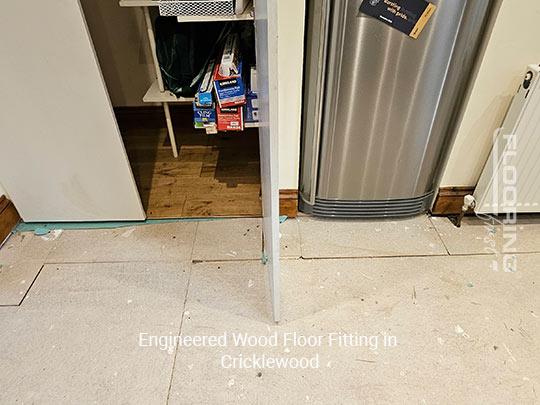
The initial state of this space featured worn and outdated hardwood flooring, contributing to a dull atmosphere. The old flooring had lost its character, showing signs of wear and tear throughout. The project began by carefully lifting and disposing of the old hardwood flooring, creating a clean starting point for the new installation. The doors' frames were then trimmed to ensure a clean integration with the new flooring height.
Lifting old hardwood can reveal surprises. In this case, the subfloor beneath had some areas of minor unevenness that needed attention before the new engineered boards could go down. Engineered flooring is more tolerant of minor subfloor variation than solid wood, but it still needs a reasonably flat surface to avoid any bounce or flex underfoot.
There was also a question of matching the new floor height to the existing floor level in adjacent rooms that were not being done at the same time. Selecting the right board thickness and underlay combination ensured the transition worked out at a manageable step height.
Our Approach
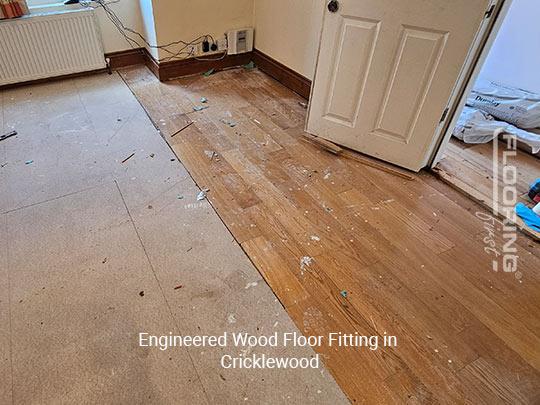
After stripping the old floor, the subfloor was checked with a straight-edge and uneven sections were addressed with levelling compound where needed. Once dry and solid, a foam underlay was laid across the area before boarding began.
Door frames were undercut with a multi-tool and flush-cut blade to the correct height, using a spare board and underlay as a gauge. This ensures a tidy result at doorways without any visible gap between the board end and the frame base.
Engineered boards were laid floating, starting from the straightest wall and working across the room. Each row was staggered by at least 300mm from the previous one to prevent any lined-up joints that weaken the floor's appearance and structure. Expansion gaps were left at all walls and fixed objects. As the job progressed, boards were cut to fit around any obstacles and trimmed at the final row to leave a consistent expansion gap all around.
Beading was pinned in place along the perimeter to cover the expansion gaps, and thresholds were fitted at doorways to bridge the connection between the new floor and adjacent areas neatly.
The Result
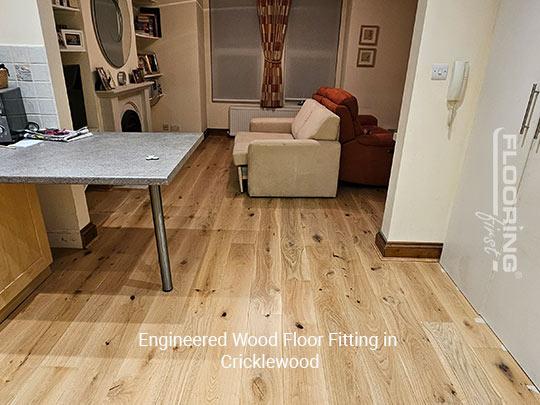
The installation of the engineered wood flooring brought an immediate improvement to the room. Each plank was laid with care, producing a uniform and clean surface throughout. The new flooring introduced warmth and a sense of quality that the old, tired hardwood could no longer provide.
Thresholds were fitted to give smooth connections at doorways, and the beading around the perimeter produced a neat edge on all sides. The result is a well-integrated floor that functions well and looks considerably better than what was there before.
Frequently Asked Questions
Is engineered wood a good replacement for old solid hardwood?
In most cases, yes. Engineered wood offers similar appearance to solid hardwood at the surface level, but is more stable in conditions where humidity varies, such as older London properties that are not well insulated. It is also typically less expensive to supply and fit than solid hardwood of equivalent quality.
What underlay is best for engineered wood floors?
For a floating installation, a foam underlay with a built-in vapour barrier is standard in most situations. Where there is a concern about sound transmission between floors, a denser underlay with better acoustic properties is worth considering. We advise on underlay type based on the specific property and subfloor conditions.
What does engineered floor fitting cost in Cricklewood?
In Cricklewood and North West London, fitting rates for engineered flooring typically run between £35 and £55 per square metre for labour. Old floor removal is usually charged separately, as is any significant subfloor levelling. Materials are quoted separately based on the product selected.