Project Overview
This Walthamstow property needed a new floor fitted across the ground floor, with the client choosing engineered wood as the preferred option. The installation included all floor accessories, beading and threshold strips to complete the finish throughout. The client had chosen their board specification in advance and wanted a clean, straightforward installation with minimal disruption.
The Challenge
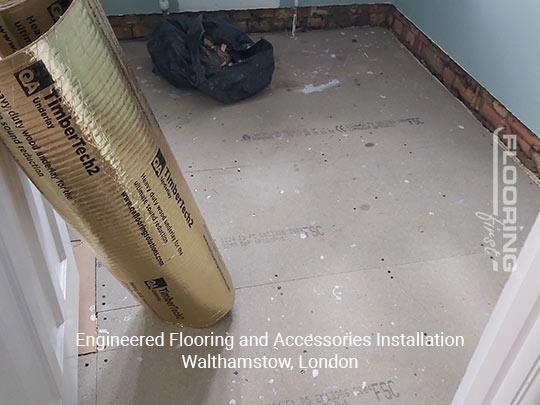
The subfloor in this property had a slight variation in level across the room, which is common in older London terraces. Before any boards go down, the subfloor must be within the manufacturer's tolerance for levelness, otherwise boards will flex, joints will open, and the floor will develop a hollow sound underfoot. There was also a question about the best installation method given the layout of the space and the direction of natural light, which affects how the grain of the boards reads in a finished room.
Our Approach
Subfloor Preparation
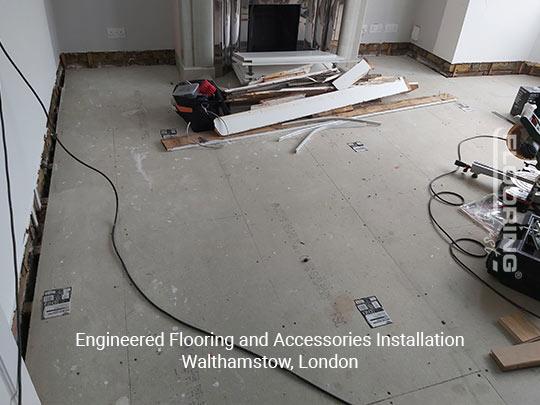
We started with a full inspection and measurement of the subfloor. Where the level was outside tolerance, we used a self-levelling compound to bring the surface into an acceptable range before any boarding work began. This step takes time but is what separates a floor that stays flat and tight over years from one that starts showing problems within months.
Acclimatisation
The engineered boards were left in the property for the recommended period before fitting. Engineered wood is more stable than solid hardwood, but it still responds to the temperature and humidity of the space it will be installed in. Skipping this step is a common cause of gaps appearing after fitting.
Board Installation
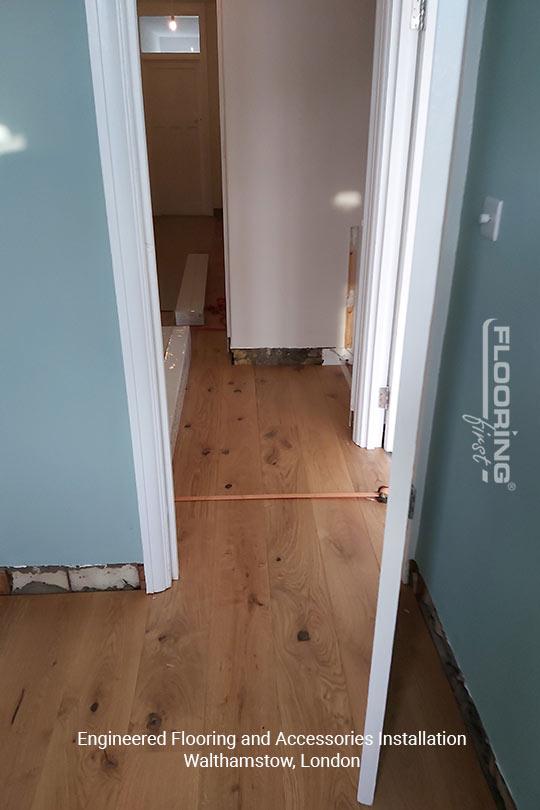
The boards were fitted using a floating method, which is well suited to this type of subfloor and allows the floor to move slightly with seasonal changes in the home environment. We worked from the most visible wall, keeping the layout symmetrical and the board direction aligned to the length of the room. Expansion gaps were maintained at all perimeters.
Finishing and Accessories
Once all boards were down, we fitted skirting beading to cover the expansion gaps and installed threshold strips at all doorways and transitions. These finishing details are what make the installation look complete and professional rather than rushed.
The Result
The finished floor runs cleanly through the ground floor of the property, with all accessories neatly fitted and consistent throughout. The client was happy with the layout decision and the way the boards read in the natural light of the space. Engineered floor fitting in London is typically priced between £35 and £60 per square metre for supply and fit, depending on the board specification and the condition of the existing subfloor.
Frequently Asked Questions
How long does engineered floor fitting take for a ground floor?
For a typical two to three room ground floor in a London terrace, fitting usually takes one to two days, depending on the complexity of the layout and the amount of subfloor preparation needed. Larger areas or more complicated layouts will take longer.
Can engineered flooring be sanded and refinished?
Yes, most engineered boards have a wear layer thick enough to be lightly sanded and refinished at least once during their lifetime. The number of times depends on the thickness of the veneer layer, which varies between products. We can advise on this when specifying the boards.
Is engineered wood suitable for properties with underfloor heating?
Engineered wood is one of the best options for use over underfloor heating. Its layered construction gives it much greater dimensional stability than solid wood when exposed to the heat cycles of a UFH system. We check the specific product compatibility and maximum temperature tolerances for each installation.