Project Overview
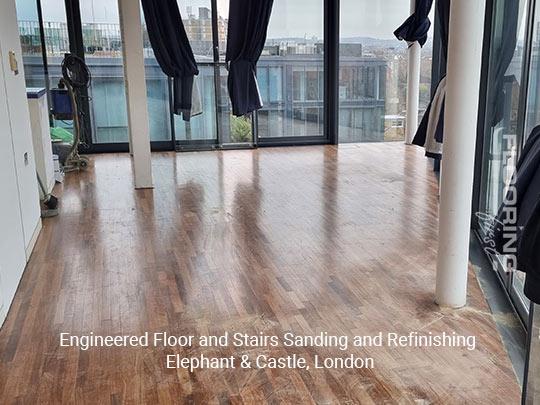
This project at a residential property in Elephant and Castle covered the sanding and refinishing of an engineered wood floor and a wooden staircase. Both had been in daily use for several years and were showing the expected signs of wear — the lacquer had dulled and worn through in high-traffic areas, the stairs were scuffed on the treads and nosings, and the overall colour had faded and greyed. The client wanted both surfaces looking consistent and fresh again without the disruption and expense of replacing either. Sanding and refinishing an engineered floor and stairs in London typically costs between £25 and £40 per square metre equivalent, making it a practical option at this stage of wear.
The Challenge
Engineered wood has a real hardwood wear layer on top, but that layer is thinner than on solid boards — typically 3 to 6 mm depending on the product. This limits how aggressively you can sand. Too coarse a grit or too many passes in any one area risks cutting through the wear layer into the plywood beneath, at which point the board needs replacing rather than refinishing. The stairs presented a different challenge: treads, risers and nosings all need different sanding approaches, and the detailing around spindles and stringer boards requires hand tools and care. Getting a consistent finish across both surfaces — flat floor and stair profile — demands good equipment and technique.
Our Approach
Inspection and assessment: Before starting, we checked the wear layer thickness on the engineered boards and confirmed there was enough material to sand. The stairs were checked for any loose treads or fixings, which were tightened before sanding began.
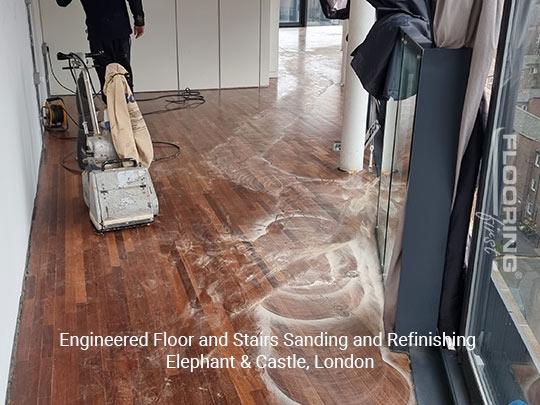
Engineered floor sanding: We used a random orbital sander rather than a heavy drum sander on the engineered floor to avoid removing too much material in a single pass. Working from medium to fine grit, the old finish and surface marks were removed evenly across the whole area. Edging tools worked the perimeter and corners.
Stair sanding: Treads were sanded along the grain with a detail sander, paying particular attention to the nosings where wear was heaviest. Risers and the areas around spindles were done by hand with appropriate grit papers for a clean result into every corner.
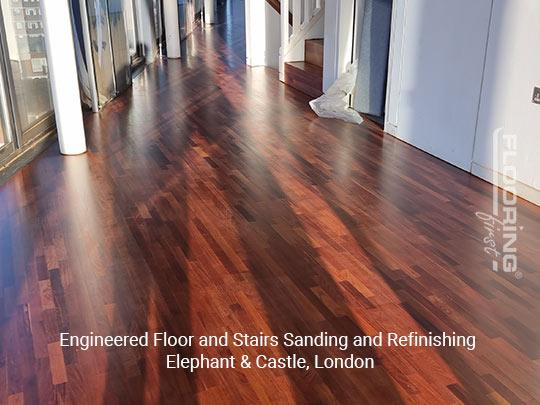
Lacquering both surfaces: Two coats of hard-wearing water-based lacquer were applied to the floor with light abrading between coats. The same lacquer was used on the stairs for a consistent colour and sheen level across both surfaces. The result is a fresh, durable finish with no visible join between floor and staircase.
The Result
Both the engineered floor and the wooden stairs came out looking clean, consistent and well-protected. The colour is even throughout and the satin lacquer gives a smart but not overly shiny appearance. Regular sanding and refinishing at intervals of around eight to ten years keeps engineered floors and stairs in good condition and extends their useful life considerably. This Elephant and Castle project shows what a professional treatment can achieve without any replacement work.
FAQ
How many times can an engineered wood floor be sanded?
This depends on the thickness of the wear layer. A 4 mm wear layer can typically be sanded twice, while a 6 mm layer may allow three or four sandings. We always check this before starting — if the wear layer is too thin, we will tell you rather than proceed and risk damaging the floor.
Can stairs be sanded and lacquered to the same standard as a flat floor?
Yes, with the right tools and enough time. Stairs take longer per square metre than flat floor because of the profiled edges and the detailing around spindles. The result is worth the effort — a well-finished staircase makes a significant difference to the look of a hallway.
Does lacquering stairs make them slippery?
A satin or matt lacquer finish provides reasonable grip underfoot. If slip resistance is a concern — particularly on stairs used by older family members or young children — we can add a small amount of anti-slip additive to the final coat, which is barely visible but reduces the risk of slipping.